





 USA
USA United Kingdom
 Germany
 Argentina
 Australia
 Canada
 New Zealand
Project cargo logistics in India involves far more than moving a large machine from one location to another. Heavy industrial equipment, oversized machinery, transformers, turbines, boilers, process skids and plant components need coordinated engineering, freight, Customs, route planning and final site handling.
For standard cargo, the transport route is usually known in advance. For project cargo, the route itself may need to be validated before the shipment is booked. A machine may fit on a vessel but still fail at a bridge, toll plaza, factory gate or sharp turn during inland movement.
This is why project cargo planning should begin with technical data, not freight rates.
A strong project movement generally follows this sequence:
Technical drawings – cargo dimensions – gross weight – centre of gravity – route survey – equipment selection – port and carrier feasibility – Customs preparation – inland movement – final delivery
For large industrial shipments, a mistake made in the first 2 or 3 planning stages can later create delays of several days and additional costs running into lakhs of rupees.
What Qualifies as Project Cargo in India?
Project cargo usually refers to cargo that is oversized, overweight, high-value, difficult to handle or operationally complex. It often includes equipment that cannot move through the standard container and trucking system without special planning.
Typical project cargo includes transformers, boilers, turbines, industrial presses, reactors, pressure vessels, construction equipment, power plant machinery, renewable energy components and complete production-line machinery.
The important point is that project cargo is not determined only by weight. A cargo unit weighing 20 MT may still qualify if it is extremely wide, long or high. At the same time, a compact 80 MT machine may be easier to transport if the route and handling infrastructure are suitable.
The logistics team therefore needs to evaluate the complete physical profile of the cargo.
A project movement may be considered complex because of:
- Length, width or height
- Gross weight
- Centre of gravity
- Special lifting points
The final transport decision should only be made after the actual transport dimensions are confirmed.
Project Cargo, ODC, OOG and Heavy-Lift Cargo
The terms project cargo, ODC, OOG and heavy-lift cargo are often used together, but they refer to different parts of the transport process.
ODC means Over Dimensional Cargo. It usually refers to road cargo that exceeds standard dimensions and requires special vehicle planning, permits and route checks.
OOG means Out of Gauge. This term is commonly used in container shipping where cargo exceeds the normal dimensions of a container, such as over-width or over-height machinery on a flat rack.
Heavy-lift cargo refers to units that require specialised cranes, trailers or lifting arrangements because of weight.
Project cargo is the broader category that can include all of these.
For example, a 90 MT transformer imported into India may move as breakbulk or OOG cargo by sea, require heavy-lift handling at the port and then travel inland as ODC on a hydraulic multi-axle trailer.
A procurement team should therefore avoid using these terms interchangeably when requesting quotations because the equipment and cost structure can be completely different.
Why Project Cargo Planning Starts With Engineering Data
The first stage of project cargo planning is technical data collection.
At a minimum, the forwarder and transporter should receive the final packed:
Length x Width x Height
along with the gross weight.
However, dimensions alone are not enough.
The logistics team should also have the General Arrangement drawing, packing drawing, centre of gravity, lifting points and support points.
This information becomes especially important when the cargo is moved by crane or hydraulic trailer.
Suppose an industrial machine has a manufactured height of 4.1 metres. After the wooden base, transport skid and protection are added, the packed height becomes 4.5 metres. If the selected trailer deck adds another 0.8 metre, total movement height becomes approximately 5.3 metres.
That difference can determine whether the cargo can pass under a bridge or overhead structure.
A 20 cm error in declared dimensions may look small on paper but can be enough to make an approved route unusable.
This is why project cargo freight should be quoted on final transport dimensions rather than manufacturing dimensions.
Route Survey for ODC Cargo Transportation in India
Route survey is one of the most important parts of ODC cargo transportation in India.
The purpose is not simply to measure road distance. The purpose is to confirm whether the cargo can physically travel along the planned route without creating a safety or clearance issue.
The survey normally checks height restrictions first. These can include flyovers, railway crossings, toll gates, electrical lines, telecom lines and industrial entry gates.
Width restrictions are equally important. Narrow bridges, road medians, market areas, construction zones and toll lanes can make a route unsuitable for extra-wide cargo.
Length creates another challenge. A 25 metre industrial vessel may require a much larger turning radius than a normal truck. A route that appears open on a map may still be impossible at one sharp junction.
Weight also affects feasibility.
The route team may need to evaluate bridge strength, culverts, pavement condition and axle-load distribution.
For highly complex cargo, the survey may include temporary obstruction removal, road widening, electrical shutdown coordination or local traffic support.
A proper route study may take 2 to 7 days, while more complex routes can require additional engineering review.
The important rule is simple:
Do the route survey before mobilising the trailer.
Weight Distribution, Axle Load and Trailer Selection
Heavy cargo transportation India is not simply a matter of choosing a trailer based on total weight.
The weight distribution across the cargo matters just as much as the gross tonnage.
A 100 MT machine with a balanced centre of gravity may require one trailer configuration, while another 100 MT machine with uneven load concentration may need a different axle arrangement.
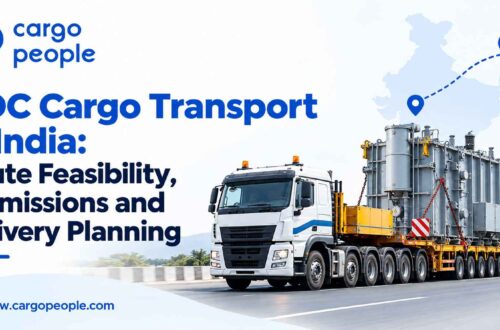
Hydraulic modular trailers are commonly used for heavy ODC cargo because the load can be distributed across multiple axle lines.
Low-bed trailers are often selected when reducing total movement height is important.
Extendable trailers may be required for long steel structures, vessels or industrial columns.
SPMTs can be used for extremely heavy modules or controlled movement inside large industrial sites.
The equipment selection should therefore follow this sequence:
Gross weight – centre of gravity – load distribution – route condition – trailer configuration
Selecting the trailer before reviewing this information can create permit or safety problems later.
For project cargo, the most expensive trailer is not necessarily the safest choice, and the cheapest trailer is not necessarily suitable.
Flat Rack vs Open Top vs Breakbulk vs RoRo
The correct international shipping method has a major impact on project cost.
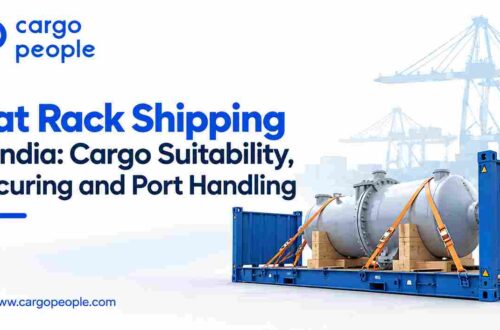
Flat rack cargo is commonly used when machinery exceeds normal container width or height but can still be secured safely on container equipment.
Flat racks can be practical because they remain within the container shipping network. However, OOG cargo can attract additional slot, handling and lashing costs.
Open-top containers work well where the cargo fits within normal width but exceeds height or needs to be loaded vertically using a crane.
Breakbulk becomes relevant when the cargo is too large or too heavy for container equipment.
Large transformers, industrial vessels, turbines and major plant components may be loaded directly onto the vessel as individual units.
RoRo is useful for wheeled cargo such as construction equipment, mobile cranes and heavy vehicles.
Heavy-lift vessels may be required where normal ship or terminal crane capacity is insufficient.
The final mode should be selected based on dimensions, weight, sailing frequency, handling requirement, port capability and inland delivery.
For example, a flat-rack option may look cheaper at ocean-freight level but become more expensive after OOG surcharges, special handling and inland costs are added.
Sea Freight Planning for Heavy and Industrial Cargo
Sea freight is the main mode used for project cargo logistics because it can accommodate larger and heavier cargo than air freight.
For shorter Asian routes, project cargo sea transit may be around 7 to 20 days, depending on the origin, port pair and vessel service.
For longer routes from Europe, North America or other distant markets, transit may be around 20 to 45 days or more.
However, vessel transit is only one part of the total project timeline.
A complete project may require 3 to 10 days for engineering and feasibility, another 3 to 7 days for booking and carrier approval, 1 to 5 days for origin movement and handling, and 2 to 5 days or more for Customs and destination operations.
Inland ODC movement may then take additional days depending on route length and permit requirements.
This means an 18-day vessel journey can easily become a 30-day or 40-day door-to-site project.
Procurement teams should therefore compare total project lead time, not only ocean transit.
Air Freight for Time-Critical Industrial Cargo
Air freight is not normally used for very large project cargo, but it can be extremely useful for urgent industrial components.
Critical spare parts, control panels, automation components, specialised tooling and commissioning equipment may be moved by air when a delayed item is holding up production or project installation.
For suitable cargo, international air transit may be around 3 to 7 days.
Oversized air cargo may require a freighter aircraft because passenger aircraft door dimensions and payload restrictions can be limiting.
Extremely urgent cargo may even require charter planning.
The commercial decision should be based on the cost of delay.
If production downtime is costing ₹5 lakh per day, paying an additional ₹8 lakh or ₹10 lakh for urgent air freight may still make commercial sense.
This is why air freight for project cargo should be evaluated as a business-continuity decision rather than only a transportation cost.
Step-by-Step Project Cargo Logistics Process in India
A project cargo movement should start with cargo engineering.
The logistics team first reviews the drawings, packed dimensions, gross weight, centre of gravity and lifting points.
Once the physical profile is understood, the route survey and equipment selection can begin.
At the same time, the freight forwarder evaluates the international shipping method and identifies suitable ports and carriers.
The Customs broker should then begin reviewing HS classification, technical documents and commercial paperwork before the vessel arrives.
After cargo arrival, port handling, Customs clearance, trailer mobilisation and ODC permits should work on one coordinated schedule.
Project Cargo Logistics Workflow
| Stage | Main Responsibility | Typical Planning Time | Main Risk |
|---|---|---|---|
| Cargo study | Importer / Forwarder | 1-3 days | Wrong dimensions |
| Route survey | Engineer / Transporter | 2-7+ days | Route not feasible |
| Trailer planning | Transporter | 1-3 days | Wrong axle configuration |
| Carrier booking | Forwarder / Carrier | 3-7+ days | Space or acceptance issue |
| Origin handling | Origin Agent | 1-5 days | Handling damage |
| Main carriage | Shipping Line | Route dependent | Schedule change |
| Customs clearance | Customs Broker | 2-5+ days | Query or examination |
| Inland ODC movement | Transporter | Route dependent | Road obstruction |
| Final site delivery | Project Team | 1-2+ days | Unloading issue |
These are planning ranges and not guaranteed timelines.
Documents Required for Project Cargo
Project cargo needs a wider document set than ordinary container freight.
The commercial invoice, packing list and Bill of Lading remain essential, but engineering and technical documents can be equally important.
The GA drawing helps the logistics team understand the exact equipment layout, dimensions and weight.
The packing drawing is important because it shows the shipment after transport supports and packing have been added.
Technical catalogues help the Customs broker understand what the imported equipment actually does.
Lifting and lashing plans help reduce handling and marine risk.
Project Cargo Documentation Matrix
| Document | Main Purpose | Main Risk if Missing |
|---|---|---|
| Commercial Invoice | Customs value | Assessment delay |
| Packing List | Quantity, dimensions and weight | Handling mismatch |
| Bill of Lading | Shipment record | Cargo release issue |
| Bill of Entry | Customs clearance | No import release |
| Technical Catalogue | HS classification support | Customs query |
| GA Drawing | Cargo engineering | Wrong planning |
| Packing Drawing | Final transport dimensions | Wrong equipment |
| Certificate of Origin | Origin evidence | Duty issue |
| Insurance Certificate | Cargo protection | Claims exposure |
| Lashing Plan | Cargo securing | Damage risk |
| Lifting Plan | Crane handling | Handling risk |
| ODC Permit | Inland movement | Route delay |
For project cargo, document consistency is especially important.
If the drawing says 68 MT and the packing list says 72 MT, the difference should be resolved before equipment is booked.
Customs Clearance for Project Cargo in India
Customs clearance for project cargo should begin before vessel arrival.
The National Time Release Study 2025 examined 62,981 Bills of Entry and reported an average seaport release time of approximately 79 hours and 4 minutes.
Air cargo complexes averaged approximately 39 hours and 20 minutes.
For project cargo, a properly prepared shipment may clear in around 2 to 4 days, but technical queries, classification disputes, examination or regulatory checks can increase the timeline.
Heavy industrial machinery often has high invoice values and complex descriptions.
The Customs broker should understand what the equipment is, what function it performs and how individual packages relate to the complete machine.
A vague description such as “industrial machinery parts” may create unnecessary clarification.
Customs examination is risk-based, so there is no fixed inspection percentage that applies to all project cargo.
The risk depends on classification, value, importer profile, documentation and applicable regulatory conditions.
For heavy equipment, physical examination can also be operationally expensive because crane or specialised handling may be required.
Why Advance Customs Preparation Matters
Advance Customs preparation can reduce both clearance time and equipment standby risk.
The Customs broker should ideally receive the commercial invoice, packing list, technical catalogue, GA drawing and classification details before the cargo reaches India.
If a shipment consists of 15 or 20 packages, each package should be mapped clearly to the relevant machine or equipment section.
This becomes particularly important for complete production lines and multi-package industrial systems.
If Customs raises a query after the hydraulic trailer and crane have already been mobilised, standby cost can increase quickly.
For example, if a trailer costs ₹35,000 per day and a crane costs ₹50,000 per day, a 3-day Customs delay can create ₹2.55 lakh in standby exposure even before storage is considered.
This is why Customs planning should be integrated into the overall project schedule.
Port Selection for Project Cargo in India
Port selection can have a larger financial impact than the ocean freight rate itself.
A project port should be evaluated on vessel connectivity, crane capacity, storage availability, Customs operations and inland route feasibility.
For western India, gateways such as JNPA and Mundra are frequently considered for industrial cargo.
JNPA handled around 834,697 TEUs in September 2026 and approximately 4.66 million TEUs from April to September FY 2026-27, showing the scale of cargo handled through the western region.
Mundra is also highly relevant for project cargo, RoRo and heavy industrial movement.
For projects in Gujarat, Rajasthan and northern India, Mundra may be commercially attractive depending on routing.
For projects in Maharashtra, JNPA may offer a shorter inland route.
For southern India, Chennai and other suitable gateways may be considered.
The final decision should compare total cost.
A port saving ₹2 lakh in sea freight may not be attractive if inland ODC transport costs ₹4 lakh more from that location.
Inland Heavy Cargo Transportation in India
Inland transportation is often the most technically difficult stage of a project cargo movement.
A vessel can carry a 100 MT machine without difficulty, but the final 150 km from the port to the plant may require weeks of planning.
ODC movement may involve hydraulic trailers, escorts, restricted movement hours and route management.
In some cases, electrical lines may need temporary lifting or shutdown coordination.
Road medians or signboards may need temporary removal.
A bridge may require engineering review before crossing.
The daily movement distance can therefore be significantly lower than standard trucking.
A normal commercial truck may travel 400 to 500 km in a day on suitable roads.
A complex ODC convoy may cover only 50 to 150 km depending on route restrictions and operating windows.
This is why inland transit must be planned independently from normal road freight assumptions.
ODC Permits and Route Approvals
ODC cargo may require route and vehicle permissions depending on dimensions, weight, trailer type and road network.
The exact approval requirement varies by movement.
For major projects, the cargo may pass through national highways, state highways, local roads and industrial zones.
Each section may involve different authorities or operating conditions.
The project team should therefore create a permit matrix before movement begins.
The matrix should identify the route section, authority, cargo dimension, vehicle configuration and expected approval timeline.
For some routes, approvals may take several days.
If the ODC cargo is already sitting at the port while approvals are being obtained, storage and detention exposure can increase quickly.
Permit planning should therefore begin before vessel arrival wherever possible.
Project Cargo Logistics Cost Breakdown
Project cargo cost is normally built from several different cost components rather than one freight rate.
International freight may include flat rack freight, OOG surcharge, breakbulk freight, heavy-lift charges, RoRo charges or charter costs.
Origin cost can include factory pickup, crane mobilisation, heavy trailer movement, port handling, export Customs and lashing.
Destination cost may include discharge, storage, Customs clearance, ODC permits, hydraulic trailer movement, escorts and crane operations.
Engineering itself may also create cost.
Route surveys, lifting studies, bridge checks and method statements may be required before transport.
Indicative planning ranges can vary significantly:
| Cost Component | Broad Planning Range |
|---|---|
| Route survey | ₹25,000-₹1,00,000+ |
| Crane mobilisation | ₹30,000-₹2,00,000+ |
| Heavy trailer movement | ₹50,000 to several lakh |
| Lashing and securing | ₹20,000-₹1,00,000+ |
| Storage exposure | ₹7,000-₹15,000+ per day |
| Heavy equipment standby | ₹25,000-₹75,000+ per day |
These figures are only broad planning references.
Actual pricing depends on dimensions, weight, crane capacity, route length, port, equipment availability and project complexity.
Demurrage, Crane Standby and Trailer Detention
Demurrage is only one part of project cargo delay cost.
A delayed movement can trigger port storage, trailer detention, crane standby, labour standby and escort charges at the same time.
For example, assume the project has:
Hydraulic trailer standby: ₹35,000 per day
Crane standby: ₹50,000 per day
Storage and related port exposure: ₹12,000 per day
The combined daily exposure is approximately ₹97,000.
A 4-day delay can therefore create approximately ₹3.88 lakh in additional cost.
If the project also delays commissioning or plant installation, the indirect commercial impact may be much higher.
For this reason, procurement teams should not judge a project solely on a ₹50,000 or ₹1 lakh freight difference.
Schedule reliability can be financially more important.
Common Causes of Project Cargo Delays
The most common project cargo delays are often caused by planning errors rather than actual transport problems.
Incorrect dimensions can cause route and equipment failure.
Incorrect weight can affect crane and trailer selection.
Late Customs preparation can hold cargo at the port.
Carrier approval can be delayed when final packing dimensions change after booking.
Route approval can also become a problem if the project team starts permit work too late.
Port congestion or vessel schedule changes can add another layer of uncertainty.
A verified project file should therefore be maintained with final drawings, dimensions, weight, Customs documents, transport plan and lifting details.
A 1-day technical review before booking can prevent delays of 3 to 7 days later in the project.
Crane Selection and Lifting Planning
Crane selection is one of the most misunderstood areas in project cargo handling.
A cargo weighing 50 MT does not automatically require a 50 MT crane.
Crane capacity reduces as lifting radius increases.
Ground condition, boom length, lifting height and rigging arrangement also affect the lift.
A 50 MT machine being lifted at a long radius may require a crane with substantially higher rated capacity.
The lifting plan should therefore include cargo weight, centre of gravity, crane position, radius, lifting points and sling arrangement.
Ground bearing pressure may also need to be checked where large cranes are positioned on weak surfaces.
For high-value machinery, lifting should be treated as an engineering activity rather than a routine handling task.
Lashing and Cargo Securing
Project cargo can experience substantial forces during sea transport.
Vessel rolling, pitching, acceleration and terminal handling can place stress on the cargo and its securing system.
Flat rack and breakbulk cargo therefore require proper lashing calculations and approved securing arrangements.
The logistics team should consider cargo weight, centre of gravity, contact points and movement forces.
Poor securing can damage both the equipment and the vessel.
For large machines, the lashing plan should ideally be prepared before cargo reaches the port so that the required chains, wires, shackles or supports are ready.
Cargo securing should be treated as part of the engineering plan rather than a last-minute loading activity.
Multimodal Project Cargo Planning
Project cargo does not always need to move only by road and sea.
Depending on the project location, rail, barge or inland waterways may be useful.
A typical multimodal flow can be:
Factory – road – port – vessel – destination port – hydraulic trailer – site
Another project may use:
Factory – barge – sea vessel – port – road – final site
For long-distance heavy cargo, rail can sometimes reduce dependence on road transport.
However, each mode change creates additional lifting and handling.
If an extra transloading operation costs ₹2 lakh, the saving from rail or barge must be large enough to justify the additional handling risk.
The correct decision should therefore be based on total movement cost and execution complexity.
How to Choose the Right Shipping Method
There is no single best shipping method for all project cargo.
Flat rack works well for manageable OOG cargo that can remain within container-line infrastructure.
Open top works for cargo that exceeds height but remains within container width.
Breakbulk is better for large indivisible units.
RoRo is suitable for wheeled machinery.
Heavy-lift vessels may be necessary for extremely heavy cargo.
Air freight is useful only for smaller urgent project components.
The decision should be based on six key factors:
Dimensions – weight – urgency – port capability – inland route – total landed cost
If these six factors are reviewed together, the logistics decision becomes much more accurate.
Role of a Project Cargo Freight Forwarder in India
A project cargo freight forwarder should coordinate the shipment from engineering stage to final delivery.
The forwarder should first review drawings, dimensions, weight and lifting data.
Then the route, trailer and port options are evaluated.
The freight forwarder also coordinates carrier selection and international booking.
At origin, the role may include factory pickup, crane arrangement, export documentation, port handling and lashing.
After arrival in India, the forwarder coordinates Customs clearance, port release, ODC permits, specialised transport and final site delivery.
For a large industrial shipment, the real value of the forwarder is coordination.
The shipping line may control the sea leg.
The transporter may control the road movement.
The crane contractor may control lifting.
The Customs broker may manage clearance.
The freight forwarder connects these different stages into one operational schedule.
Conclusion
Successful project cargo logistics India depends on detailed planning before the cargo starts moving.
The first focus should be accurate technical data, including dimensions, gross weight, centre of gravity and final packing profile.
The second focus should be route and equipment feasibility.
The third should be international freight and port selection.
Customs preparation should begin before vessel arrival, while ODC permissions and inland planning should be completed as early as possible.
With average seaport release time around 79 hours, a normal clearance delay may appear manageable. However, when a crane, hydraulic trailer and labour team are already on standby, even 3 additional days can create several lakh rupees in extra cost.
Project cargo therefore needs to be managed as one connected movement from the supplier’s factory to the final project site.
Cargo People Logistics & Shipping Pvt. Ltd. supports project cargo shipping, heavy cargo transportation, ODC movement, Customs clearance, air freight, sea freight and door-to-door industrial logistics across India.
📞 +91 97174 65454
📧 wecare@cargopeople.com
👉 Get a Shipping Quote from Cargo People Logistics
Frequently Asked Questions
1. What is project cargo logistics in India?
Project cargo logistics involves transportation of oversized, overweight, high-value or technically complex industrial cargo requiring specialised planning, equipment and handling.
2. What is ODC cargo transportation?
ODC cargo transportation refers to movement of cargo exceeding standard road dimensions and requiring specialised trailers, route surveys and permissions.
3. Which transport mode is best for project cargo?
It depends on size, weight and urgency. Flat rack, open top, breakbulk, RoRo and heavy-lift vessels are commonly used for different cargo profiles.
4. How long does project cargo Customs clearance take in India?
A well-prepared shipment may clear in around 2 to 4 days, but Customs queries, examination or technical documentation issues can increase the timeline.
5. Which Indian ports are commonly used for project cargo?
Mundra, JNPA, Chennai, Hazira, Kandla, Kolkata and Visakhapatnam may be considered depending on vessel connectivity, port capability and final project location.