








 USA
USA United Kingdom
 Germany
 Argentina
 Australia
 Canada
 New Zealand
An Import Export Consultant in India supports businesses with IEC-related guidance, product classification, regulatory checks, customs documentation, freight planning, customs clearance and shipment coordination.
A properly planned shipment may complete customs processing within 24 to 72 hours. However, actual release time depends on the port or airport, product category, document quality, customs risk assessment and whether approval from another government agency is required.
Recent customs performance data has shown average import release times of approximately 79 hours at seaports, 84 hours at Inland Container Depots and 39 hours at air cargo complexes. These figures demonstrate why importers should not promise customer delivery based only on vessel or flight arrival.
The consultant should also help the trader choose between air freight, FCL, LCL, courier and project cargo. The decision must consider urgency, shipment value, cargo weight, delivery commitment and the financial impact of delay.
A Common Import-Export Problem Faced by Indian Traders
Consider a Delhi-based importer purchasing industrial components from China. The supplier offers a competitive product price and agrees to ship under CIF terms. The importer assumes that the supplier will manage almost everything because freight is included in the price.
The container is dispatched before the importer confirms the correct HS classification and whether the product falls under any mandatory certification requirement. When the shipment reaches India, the customs broker requests technical literature, model details and regulatory clarification.
The importer then spends three working days collecting documents from the supplier. Meanwhile, shipping line formalities, container free time and terminal storage continue to move forward.
A freight saving of ₹12,000 can quickly disappear if the importer incurs ₹10,000 per day for two chargeable days, ₹5,000 for documentation amendments and another ₹8,000 for transport rescheduling.
The total avoidable cost can reach ₹33,000 even before considering delayed production, missed customer delivery or working capital blockage.
This is why import-export planning should begin before the purchase order is confirmed. The correct sequence is to verify the product, understand the applicable rules, calculate the expected landed cost and only then approve the shipment.
What Does an Import Export Consultant in India Actually Do?
An Import Export Consultant in India helps a business understand whether a proposed international transaction is commercially workable, legally permitted and operationally manageable.
The process normally begins with a review of the product description, technical specifications, country of origin, transaction value, quantity, intended use and delivery location. These details influence customs classification, applicable duty, import policy and product approvals.
The consultant may also examine the proposed Incoterm. Many businesses agree to FOB, CIF, CFR, EXW or DDP without fully understanding which party is responsible for freight, customs, insurance, terminal charges and inland delivery.
For example, CIF does not normally mean that the seller will pay every charge until delivery to the buyer’s warehouse. The importer may still be responsible for destination charges, customs duty, customs clearance, transport and container return.
A practical Import Export Consultant should coordinate with the freight forwarder, customs broker, shipping line, airline, transporter, warehouse and overseas partner. Without this coordination, the trader may receive conflicting information from different vendors.
The consultant’s role generally includes:
- Product and HS classification review
- Import-export policy and approval checks
- Documentation and customs planning
- Freight and delivery coordination
Why First-Time Traders Need Detailed Pre-Shipment Planning
First-time traders often begin with IEC registration because it is the most visible requirement. However, IEC is only one part of the process.
A business may have a valid IEC but still be unable to clear a shipment because the exact product requires BIS certification, FSSAI approval, WPC approval, Legal Metrology compliance, EPR registration, CDSCO permission or quarantine clearance.
Product compliance should be checked at the exact model and technical specification level. A supplier may say that it has exported the same category of product to India, but this does not confirm that every model or configuration is compliant.
Duty calculation is another important part of planning. Customs duty is not based only on the invoice amount. It may include Basic Customs Duty, Social Welfare Surcharge, IGST, compensation cess, anti-dumping duty or safeguard duty.
If an importer purchases goods worth ₹25 lakh and the final duty incidence is 6 percent higher than expected, the additional cash requirement may be ₹1.5 lakh.
The business should also calculate the financial impact of transit time. A 35-day sea shipment may be cheaper than air freight, but the saving may not be useful if the production line stops for five days.
Before confirming the first shipment, the trader should verify:
- Product classification and policy status
- Total duty and landed cost
- Required registrations and approvals
- Freight mode and expected delivery timeline
Import-Export Process in India – Complete Step-by-Step Workflow
The international trade process starts with product selection and regulatory assessment. The trader should first determine whether the product is freely importable or exportable and whether any licence, registration or certificate is required.
The second stage is commercial negotiation. The buyer and seller agree on the quantity, price, payment terms, Incoterm, shipment schedule and quality specifications.
The Incoterm determines which party arranges freight, insurance and delivery at different stages. However, it does not replace the commercial contract. The purchase order should clearly mention who will pay origin charges, destination charges, customs duty and inland transportation.
After commercial terms are finalised, the freight forwarder receives the shipment details. These include cargo weight, dimensions, number of packages, commodity, pickup location, destination and expected readiness date.
For air freight, the forwarder checks chargeable weight, airline space, flight schedules, security requirements and terminal cutoff. For sea freight, the forwarder checks FCL or LCL suitability, container availability, vessel schedules, routing and free-time conditions.
Documentation should be prepared before the cargo arrives in India. For imports, advance preparation gives the customs broker time to review classification, value, country of origin and licence requirements.
After filing, customs may accept the declaration, raise a query, select the shipment for examination or refer it to another government agency.
Once customs release is completed, the importer may still need to obtain the shipping line delivery order, pay terminal charges, arrange vehicle placement and plan empty container return.
Import-Export Logistics Process
| Stage | Responsible Party | Normal Planning Time | Key Documents | Main Risk |
|---|---|---|---|---|
| Product assessment | Trader and consultant | Before purchase order | Catalogue, specifications and HS code | Restricted product |
| Commercial agreement | Buyer and seller | Before shipment | Purchase order and Incoterm | Unclear cost responsibility |
| Freight booking | Forwarder and carrier | 3 to 14 days before departure | Booking request | Space shortage |
| Documentation review | Consultant and customs broker | Before arrival | Invoice, packing list and licence | Incomplete information |
| Customs filing | Customs broker | Before or after arrival | Bill of Entry or Shipping Bill | Wrong classification |
| Assessment and examination | Customs and other agencies | Several hours to multiple days | Supporting documents | Query or physical examination |
| Duty payment | Importer | After assessment | Duty challan | Fund or payment delay |
| Cargo release | Customs, carrier and terminal | After formalities | Delivery order and release documents | Storage or carrier hold |
| Inland delivery | Transporter and warehouse | Same day to several days | E-way bill | Vehicle or warehouse delay |
Documents Required for Import and Export Shipments
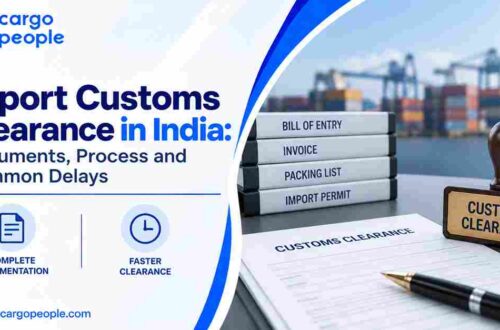
The commercial invoice is the main financial and customs document. It should clearly mention the seller, buyer, product description, quantity, unit price, total value, currency, Incoterm and country of origin.
A general description such as “industrial material” or “machine spare” can create classification and valuation questions. A detailed description such as “stainless steel pump impeller for industrial centrifugal pump” gives customs a clearer understanding of the product.
The packing list should match the invoice and transport document. It normally records package count, gross weight, net weight, dimensions and packing method.
The Bill of Lading is used for sea freight, while the Air Waybill is used for air freight. Incorrect consignee details, wrong port information or cargo-description mismatch can result in amendment fees and release delays.
The Certificate of Origin is particularly important where the importer plans to claim a preferential customs duty. The certificate must comply with the conditions of the relevant trade agreement.
Product-specific documents may also be required. These can include a BIS licence, FSSAI licence, test report, technical catalogue, WPC approval, EPR registration or Legal Metrology declaration.
Main Import-Export Documents
| Document | Prepared or Issued By | Main Purpose | Common Error |
| Commercial Invoice | Exporter | Declares product and value | Vague product description |
| Packing List | Exporter | Shows packages and weight | Quantity mismatch |
| Bill of Lading | Shipping line or NVOCC | Confirms ocean carriage | Wrong consignee |
| Air Waybill | Airline or forwarder | Confirms air carriage | Incorrect cargo details |
| Bill of Entry | Importer or customs broker | Import declaration | Wrong HS code |
| Shipping Bill | Exporter or customs broker | Export declaration | Wrong scheme claim |
| Certificate of Origin | Authorised body | Confirms origin | Incorrect origin criteria |
| Insurance Certificate | Insurer | Confirms cargo insurance | Low coverage |
| Product Approval | Relevant authority | Confirms compliance | Model not covered |
| Delivery Order | Carrier | Authorises release | Pending line charges |
How Customs Clearance Works Through ICEGATE
For imports, the customs broker files the Bill of Entry electronically. The declaration includes the product description, HS code, quantity, value, country of origin, duty details and notification claims.
Supporting documents are uploaded and linked to the customs declaration. Customs officers and the risk management system then review the information.
Some shipments receive facilitated processing, while others may require document review, scanning or physical examination. The process can also involve agencies responsible for food, medical products, wireless products, plants, animals or other controlled goods.
There is no universal physical examination percentage for all imports. The likelihood of examination depends on commodity risk, importer compliance history, valuation, classification, country of origin and intelligence inputs.
Once customs completes assessment, the importer pays the duty. Customs then grants Out of Charge after all requirements are fulfilled.
However, customs release is only one milestone. The importer must also complete shipping line formalities, obtain the delivery order, settle terminal charges, arrange a vehicle and ensure that the warehouse is ready to receive the cargo.
A shipment may therefore be customs-cleared but still remain inside the port for another 8 to 24 hours because of operational coordination.
Realistic Customs Clearance Timelines in India
A common market statement is that customs clearance takes 24 to 72 hours. This is possible for well-prepared shipments, but it should not be treated as a guarantee.
Average import release time has been recorded at approximately 79 hours at seaports and 84 hours at Inland Container Depots. Air cargo complexes have recorded an average of approximately 39 hours.
These numbers include shipments that clear quickly and shipments delayed by queries, duty payment, document amendments, examination or regulatory approvals.
| Customs Location | Average Import Release Time |
| Seaports | 79 hours 4 minutes |
| Inland Container Depots | 83 hours 41 minutes |
| Air Cargo Complexes | 39 hours 20 minutes |
| Integrated Check Posts | 13 hours 30 minutes |
Approximately 52 percent of seaport imports were released within the applicable 48-hour target. At air cargo complexes, approximately 55 percent of imports were released within the 24-hour target.
This means that nearly half of shipments may take longer than the official target. Traders should therefore include a customs buffer in production and customer-delivery planning.
For a time-sensitive shipment, a 24-hour delay can create a larger business loss than the freight cost itself. If a manufacturing line produces goods worth ₹8 lakh per day, even a one-day stoppage can make premium air freight commercially reasonable.
Import-Export Shipment Cost Breakdown
International freight is only one component of the total import-export cost. Businesses should compare landed cost rather than looking only at the freight quotation.
A sea freight shipment may include ocean freight, origin handling, terminal handling, documentation, destination charges, customs clearance, customs duty, inland transport and container-related charges.
An air freight shipment normally includes airline freight, fuel surcharge, security surcharge, terminal handling, documentation, customs clearance and delivery.
Air freight is charged on chargeable weight. For example, a shipment may physically weigh 500 kg but have a volumetric weight of 750 kg. The airline may charge freight on 750 kg.
LCL sea freight is generally calculated on weight or measurement, whichever produces the higher chargeable volume. The trader should also consider consolidation and deconsolidation charges.
A full landed-cost calculation should include:
| Cost Category | Typical Charges |
| International freight | Air, FCL, LCL or special equipment |
| Carrier surcharges | Fuel, security and peak-season charges |
| Origin charges | Pickup and export handling |
| Destination charges | Delivery order and handling |
| Customs duty | BCD, surcharge and IGST |
| Clearance fees | Filing and examination coordination |
| Inland transport | Port pickup and final delivery |
| Warehousing | Unloading, storage and distribution |
| Insurance | Cargo risk coverage |
| Delay costs | Demurrage, detention and storage |
A quotation that is ₹15,000 cheaper may still be a poor choice if it includes only four free days, a longer transshipment route or higher destination charges.
Demurrage, Detention and Port Storage Explained
Demurrage generally applies when the container remains inside the port or terminal beyond the available free period.
Detention generally applies when the container has been taken outside the terminal but is not returned to the shipping line within the allowed time.
Port storage or ground rent may be charged separately by the terminal. An importer can therefore face detention and port storage on the same shipment depending on the circumstances.
The charges normally increase by slabs. The rate for the first few chargeable days may be lower, while later days can become substantially more expensive.
A standard container may incur an illustrative delay cost of ₹7,000 to ₹15,000 per day. Reefer, hazardous or special-equipment containers can cost significantly more.
Suppose an importer has three chargeable days at ₹9,000 per day. The direct delay cost becomes ₹27,000. If truck rescheduling costs ₹6,000 and the warehouse charges ₹4,000 for emergency handling, the total impact reaches ₹37,000.
These costs are usually preventable through advance document preparation, duty-fund readiness, delivery-order planning and vehicle allocation.
Common Reasons for Customs and Logistics Delays
Incorrect HS classification is a major cause of customs queries. The HS code determines the duty, import policy, applicable licences and eligibility for exemptions.
A trader should not select a classification only because it has a lower duty rate. The classification must be supported by technical characteristics, composition, function and end use.
Document mismatch is another common problem. Customs may raise questions when the invoice shows 1,000 units, the packing list shows 980 units and the Bill of Lading uses a different product description.
Valuation queries may arise where the declared value appears lower than comparable imports or where royalty, design, commission or related-party payments are not clearly disclosed.
Product approval issues can also delay clearance. A company may hold a valid registration, but the exact model, manufacturer or brand may not be covered.
Operational delays include:
- Missed airline or vessel cutoff
- Port congestion or vessel rollover
- Container shortage
- Delivery-order delay
Incorrect HS Code Increased Duty by ₹90,000
An importer purchases electronic control equipment worth ₹18 lakh. The HS code is selected based on a similar product listed online.
During customs assessment, the officer requests technical documents and determines that another classification applies. The revised duty incidence is approximately 5 percent higher.
The additional customs duty becomes approximately ₹90,000. The importer also spends three days arranging funds and responding to the classification query.
Storage and handling charges add another ₹18,000. The total unplanned impact reaches approximately ₹1.08 lakh.
The problem could have been reduced through pre-shipment classification based on technical literature.
Late Documents Created ₹30,000 in Charges
A sea freight container arrives before the importer has collected the required product documents.
The customs broker cannot complete the assessment because customs requests test reports and technical literature.
The delay extends beyond the available free period. Two chargeable days at an illustrative ₹10,000 per day create ₹20,000 in charges.
Document amendments and transport rescheduling add another ₹10,000. The final avoidable cost becomes ₹30,000.
The important lesson is that documents should be ready before the vessel reaches the destination port.
The Cheapest Freight Quote Cost ₹35,000 More
A regular importer compares two FCL quotations. One quotation is ₹12,000 cheaper, and the importer accepts it without reviewing the route or free-time conditions.
The selected shipment moves through a transshipment port and misses the connecting vessel. The total transit is extended by six days.
After arrival, the limited free period creates pressure on customs clearance and container return. The importer pays approximately ₹22,000 in detention and ₹13,000 in transport and storage-related expenses.
The total additional cost becomes ₹35,000. The lower freight rate ultimately produces a higher landed cost.
Air Freight or Sea Freight – Which Is Better?
Air freight is suitable for urgent, high-value, lightweight or production-critical cargo. It is often used for electronic components, samples, medicines, replacement parts and time-sensitive commercial goods.
A typical international air shipment may take 3 to 7 days on a door-to-door basis. Actual timing depends on airline space, cargo cutoff, security checks, customs clearance and final delivery.
Sea freight is generally more suitable for heavy, high-volume and cost-sensitive cargo. International transit may range from 20 to 45 days depending on the port pair, route and transshipment.
FCL gives the shipper access to a complete container. LCL allows smaller shipments to share container space but may involve additional consolidation and handling.
| Factor | Air Freight | Sea Freight |
| Typical transit | 3 to 7 days | 20 to 45 days |
| Best for | Urgent and high-value cargo | Heavy and regular cargo |
| Charging basis | Chargeable weight | Container or volume |
| Main risk | Space and cutoff | Rollover and port delay |
| Main document | Air Waybill | Bill of Lading |
The decision should be based on inventory cost, delivery commitment and business impact. Freight price alone is not enough.
Support Required by Regular Importers and Exporters
Regular traders need process control rather than one-time assistance. Every repeat shipment should use verified product descriptions, HS codes, duty structures and document templates.
The business should also maintain a record of actual freight cost, customs clearance time, delivery performance and container free-time usage.
For example, an importer handling 20 containers per month can save ₹2,000 per container through better route planning and local-charge negotiation. The monthly saving becomes ₹40,000, while the annual saving reaches ₹4.8 lakh.
Regular importers should also monitor customs queries. If the same product receives repeated classification or valuation questions, the documentation should be improved instead of responding separately each time.
An Import Export Consultant can support regular traders with:
- Standard operating procedures
- Shipment and landed-cost reporting
- Carrier and route comparison
- Customs exception management
Role of a Freight Forwarder in Import Export Consulting Services
A freight forwarder converts a commercial order into an executable cargo plan.
The forwarder checks cargo weight, dimensions, pickup location, destination, route, transit time, airline or vessel availability and equipment requirements.
For sea freight, the forwarder may arrange FCL, LCL, reefer, flat-rack, open-top or special-equipment containers. For air freight, the forwarder coordinates airline space, terminal acceptance and security requirements.
The forwarder also connects the shipper, consignee, carrier, customs broker, transporter and overseas agent. This coordination is important because one incorrect document can affect several stages.
A complete solution may include air freight, sea freight, customs clearance, door-to-door delivery, cargo insurance, warehousing and distribution.
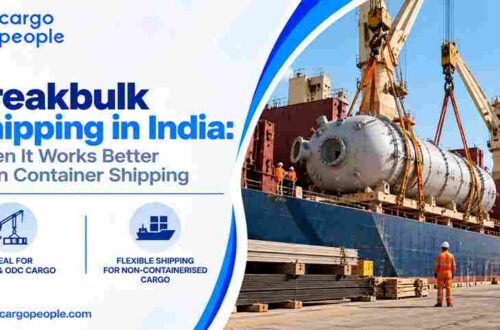
For project cargo, the scope may include route surveys, crane planning, specialised trailers, permits and site delivery. These shipments need detailed engineering and operational planning.
How to Select an Import Export Consultant in India
A business should select a consultant based on practical trade experience, not only registration support.
The consultant should understand product classification, customs duty, documentation, Incoterms, freight modes and local delivery requirements.
The business should ask whether the consultant can coordinate with the customs broker, forwarder, carrier, transporter and warehouse. A fragmented service model can create confusion during a delay.
The quotation should clearly explain which services are included and which charges are based on actual carrier, terminal or government costs.
A professional consultant should not guarantee that every shipment will clear within 24 hours. The consultant should explain the risks, prepare the documents and create a realistic timeline.
The consultant should also be able to support both first-time and repeat shipments. The needs of a trader importing one sample shipment are different from those of a manufacturer handling 50 containers per month.
Why Integrated Logistics Support Matters
India’s major ports handle more than 900 million tonnes of cargo annually, while JNPA handles more than 8 million TEUs in a year.
These numbers reflect the scale of cargo movement and the number of parties involved in international logistics.
A shipment may involve the overseas supplier, origin forwarder, shipping line, destination agent, customs broker, customs authority, terminal, transporter and warehouse.
When these parties work without central coordination, small communication gaps can create large delays.
An integrated logistics partner provides one operating structure for freight booking, customs clearance, door-to-door delivery, warehousing and shipment monitoring.
This does not eliminate every delay, but it improves response time, accountability and visibility.
Conclusion
An Import Export Consultant in India should help a business plan the complete international trade transaction, not only obtain an IEC or prepare one document.
First-time traders need support with product compliance, HS classification, duty calculation, Incoterms, documentation and freight planning.
Regular traders need stable costs, consistent customs declarations, better carrier terms, shipment reporting and delay-risk management.
A two-day documentation delay can easily add ₹20,000 to ₹30,000 to a container shipment. A 5 percent classification difference on an ₹18 lakh shipment can create ₹90,000 in additional duty.
These examples show that proper planning usually saves more money than last-minute negotiation.
The right Import Export Consultancy Services India provider should combine regulatory understanding with practical freight, customs and delivery experience. This approach helps businesses control costs, reduce uncertainty and build a more dependable international supply chain.
CTA
📞 +91 97174 65454
📧 wecare@cargopeople.com
👉 Get a Shipping Quote from Cargo People Logistics
Frequently Asked Questions
1. What does an import export consultant do?
An import export consultant supports IEC, product compliance, HS classification, documentation, customs clearance, freight planning and delivery coordination.
2. Is IEC enough to start importing into India?
No. Depending on the product, BIS, FSSAI, WPC, EPR, Legal Metrology, CDSCO or another approval may be required.
3. How long does customs clearance take in India?
A well-prepared shipment may clear within 24 to 72 hours. Average release time varies by location and can exceed three days at seaports and ICDs.
4. Which documents are required for imports?
Common documents include the invoice, packing list, Bill of Lading or Air Waybill, Bill of Entry, Certificate of Origin and applicable product approvals.
5. Is air freight better than sea freight?
Air freight is better for urgent and high-value cargo. Sea freight is generally more economical for heavy and regular shipments.