







 USA
USA United Kingdom
 Germany
 Argentina
 Australia
 Canada
 New Zealand
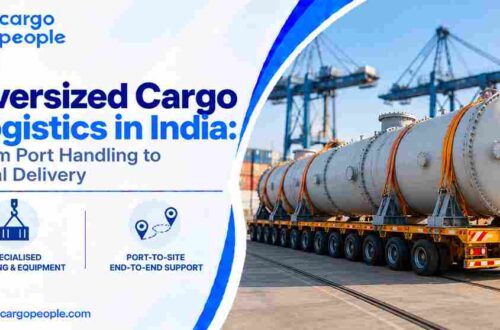
Oversized cargo logistics in India is not a normal trucking assignment with a bigger vehicle. Once cargo exceeds standard road, trailer or container dimensions, the movement becomes a coordinated engineering, regulatory and execution project.
For a 90-tonne transformer, 30-metre-long industrial module or 5.5-metre-high machinery package, the real risk is often not distance. It may be a weak bridge, a narrow turn, an overhead cable, a toll plaza, a railway crossing or a factory gate that is too tight for the final loaded combination.
This is why ODC cargo transportation should be planned from the final project site backward to the port or factory of origin.
A successful movement normally requires cargo engineering, route survey, ODC permission, trailer selection, bridge and utility checks, customs clearance, port handling, escort planning and final site delivery.
For importers, manufacturers and EPC companies, the right question is not simply, “What is the transport rate?”
The better question is:
Can this cargo complete the entire route safely, legally and on schedule without creating a ₹5 lakh, ₹10 lakh or ₹20 lakh delay problem?
Why Oversized Cargo Logistics in India Is an Engineering Job Before It Is a Transport Job
A conventional truck can often take a diversion if there is congestion or a road closure.
A 150-tonne machine on a modular hydraulic trailer may not have that flexibility.
Suppose an imported industrial machine measures 18 metres long, 4.5 metres wide, 4.2 metres high and weighs 85 tonnes.
If the trailer deck height is 1.2 metres, the actual travelling height becomes:
4.2 m + 1.2 m = 5.4 metres
That additional 1.2 metres may decide whether the cargo can pass under an overhead structure.
The same applies to width.
A 4.5-metre-wide cargo can require traffic control, shoulder use or temporary obstacle removal on narrow road sections.
For very heavy equipment, total weight alone is not enough.
The load must be distributed across enough axle rows to keep axle loading within permissible limits.
Current heavy-transport frameworks use 18 tonnes per axle row as an important reference for applicable modular hydraulic trailer configurations.
This means a 180-tonne cargo cannot simply be placed on any heavy trailer and moved.
The logistics team must calculate:
- total travelling weight
- axle load distribution
- loaded height
- turning geometry
For procurement heads, this is the first important decision point.
The trailer should not be selected separately from the route.
The trailer and route must be designed together.
What Is Considered Over Dimensional Cargo in India?
ODC generally refers to cargo that causes the loaded transport combination to exceed the dimensions permitted for normal road movement.
Oversized cargo and overweight cargo are related, but they are not the same.
A machine may be very wide and tall but relatively light.
Another unit may be compact but extremely heavy.
For logistics planning, both dimensional and weight parameters must be checked.
Typical ODC cargo includes power transformers, industrial presses, refinery vessels, reactors, boilers, turbines, wind-energy equipment and large production-line machinery.
The important number is not always the equipment’s factory dimension.
It is the final packed transport dimension.
For example, a machine measuring 4.8 metres high may become 5.1 metres high after packing.
If the selected trailer adds 1 metre of deck height, the travelling height becomes:
5.1 + 1.0 = 6.1 metres
A difference of just 300 mm in packing can therefore make an existing route unusable.
That is why packed dimensions should be final before route approval and trailer mobilisation.
Why ODC Permits Need to Be Planned Early
One of the most common mistakes in project cargo is treating permits as a last-stage documentation task.
The permit process should begin much earlier.
The transporter’s National Permit and the cargo-specific ODC permission are different.
A National Permit allows the commercial vehicle to operate across relevant jurisdictions.
ODC or OWC permission is linked to the actual cargo, trailer configuration and route.
For applicable National Highway movements using modular hydraulic trailers, the current framework uses a route approval process designed around 7 days, subject to complete technical data and engineering conditions.
In practice, project teams should maintain additional buffer.
The reason is simple.
A 600 km movement may pass through National Highways, state roads, municipal roads and industrial zones.
Different sections may require separate coordination.
If the route changes after the application is submitted, the permission process may also need revision.
For a time-sensitive import, a 4-day or 5-day delay in route approval can quickly become expensive once port storage, trailer standby and crane bookings start accumulating.
For a complex ODC movement, permit preparation should ideally begin 2 to 4 weeks before expected cargo availability, especially when several jurisdictions are involved.
How Heavy Trailer Configuration Is Calculated
Trailer configuration is one of the most technical parts of ODC transportation.
The selection depends on cargo weight, centre of gravity, loaded height, axle spacing and bridge constraints.
Current modular hydraulic trailer configurations can support very large gross weights depending on the number of axle rows.
| Trailer Configuration | Axle Rows | Indicative GVW Excluding Puller |
|---|---|---|
| HT-1 | 4 | 72 MT |
| HT-3 | 8 | 144 MT |
| HT-5 | 12 | 216 MT |
| HT-7 | 16 | 288 MT |
| HT-9 | 20 | 360 MT |
| HT-12 | 14 + 14 | 504 MT |
| HT-13 | 16 + 16 | 576 MT |
These figures do not mean that a 500-tonne cargo can automatically move on every road.
The route still needs to support the required loading.
Bridge condition can become the limiting factor.
Turning radius can become the limiting factor.
Loaded height can become the limiting factor.
Suppose a 150-tonne machine is placed on a configuration that technically handles the weight.
If the trailer deck increases loaded height by 700 mm, a previously acceptable flyover may become impossible to clear.
The logistics engineer may then choose a lower-deck configuration even if it is more expensive.
This is why ODC planning is a balance between weight distribution, loaded height and route feasibility.
Why the Route Survey Is the Most Critical Part of ODC Cargo Transportation
A route survey is not just a drive from origin to destination.
For heavy cargo, it is a detailed transport feasibility exercise.
The survey team should assess the cargo in its final loaded condition.
That means checking total travelling height, width, length, gross combination weight and axle distribution.
Then the route is evaluated against every major constraint.
A professional survey should review:
- bridge and culvert condition
- overhead clearance
- road width
- turning radius
For complex cargo, the survey also needs to check gradients, railway crossings, toll plazas, construction zones and temporary bypasses.
Consider a 120-tonne machine moving 450 km.
The shortest route is 410 km.
The alternative route is 465 km.
The shorter route contains one narrow bridge and 3 low overhead utility lines.
The longer route avoids all 4 problems.
Even though the alternate route adds 55 km, it may save several lakh rupees in utility work and civil modification.
This is why route selection should be based on execution risk, not map distance.
Bridge Crossings Can Decide Whether an ODC Route Is Viable
Bridges are often the single biggest constraint in heavy cargo logistics.
Current operating conditions for applicable ODC and OWC movements require highly controlled bridge crossing.
The heavy vehicle may need to move at 5 km/h or less while crossing the bridge.
The trailer combination may also need to remain close to the centreline to manage structural loading.
An eccentricity limit of around 300 mm is used in the relevant framework for applicable bridge conditions.
This means the cargo cannot simply move across the bridge like a conventional truck.
Traffic may need to be controlled.
The speed may need to be reduced.
The loaded combination may need to follow a very specific line.
Certain bridges can also be unsuitable for heavy movement.
This may include single-lane bridges, steel-truss structures, Bailey bridges, curved bridges or bridges with existing load restrictions.
A 300 km route can therefore fail because of one 30-metre bridge.
For a 200-tonne or 300-tonne project movement, bridge feasibility should be confirmed before the final freight quotation is locked.
Why Weather Conditions Matter in ODC Execution
Weather can affect heavy road transportation as much as sea freight.
Current ODC operating guidelines include wind-related restrictions, with 40 km/h acting as an important operational threshold in the applicable framework.
Tall cargo can be particularly sensitive.
Suppose a 40-metre-long process column has a large exposed surface area.
Strong crosswinds can affect trailer stability and steering control.
Rain creates another problem.
Temporary road shoulders, unpaved sections and weak bypasses can lose load-bearing capacity.
A section that supports a 200-tonne combination in dry conditions may become unsafe after heavy monsoon rain.
This is why project logistics teams should monitor weather daily during execution.
For particularly sensitive cargo, the movement schedule should include contingency days.
A 2-day weather buffer may look expensive on paper, but it can be cheaper than forcing a movement under unsafe conditions and damaging a ₹20 crore machine.
Real India ODC Example: 375-Tonne Vacuum Tower Movement
A strong example of heavy cargo execution in India involved a 375-tonne vacuum tower.
The cargo measured approximately:
55.73 metres long, 10 metres wide and 9.45 metres high.
These dimensions immediately show why standard trucking was not enough.
The movement reportedly required 16 electrical line shutdowns.
More than 100 steel plates were also used to strengthen or stabilise selected route sections.
The project used a combination of road and coastal movement because a full road route created major infrastructure and geographical challenges.
This is an important lesson for project cargo planning.
The shortest road route is not always the lowest-risk route.
A multimodal route can sometimes reduce exposure to bridges, utilities, urban roads and state-level coordination.
For very heavy cargo, a route with an additional sea leg may actually be safer, faster and commercially stronger than an all-road movement.
Real India ODC Example: 3 Units of 95 MT Each Over 672 km
Another recent project involved 3 oversized cargo units weighing approximately 95 MT each.
Each unit measured approximately:
33 metres long, 5.3 metres wide and 5.4 metres high.
The cargo moved around 672 km from Vadodara to Kandla Port.
For a normal truck, 672 km may be treated largely as a distance-based freight movement.
For ODC, that logic does not work.
A 33-metre-long cargo needs much more turning space.
A 5.4-metre-high cargo may face overhead clearance problems.
A 95-tonne unit may require specialised axle configuration and controlled bridge movement.
The route may also require night movement, escort vehicles and planned halts.
That is why two transporters quoting the same 672 km route can have very different cost structures.
One may include proper route engineering and permit planning.
Another may only quote the trailer movement.
The lower quote can become much more expensive if the route is not actually executable.
Full Step-by-Step ODC Logistics Process in India
The ODC process should begin before the cargo is packed.
The first stage is cargo engineering.
The manufacturer or supplier should provide final dimensions, gross weight, lifting points, centre of gravity and transport drawings.
The second stage is international shipping planning.
The cargo may move on a flat rack, open top, breakbulk vessel, RoRo vessel or heavy-lift ship depending on dimensions and handling requirements.
Once the Indian port or inland origin is identified, the route survey begins.
The survey team identifies bridges, overhead structures, sharp turns, railway crossings and utility obstacles.
Trailer selection should happen after the route constraints are known.
ODC permissions are then prepared using the final trailer and route details.
For imported cargo, customs documentation should be prepared before vessel arrival.
Once the cargo is released, specialised trailers are positioned.
Road execution then begins under escort and controlled conditions.
The final stage is site delivery, unloading and positioning.
ODC Logistics Process
| Stage | Main Activity | Typical Planning Time | Main Risk |
|---|---|---|---|
| Cargo engineering | Confirm dimensions and weight | 1-3 days | Incorrect data |
| Shipping selection | Flat rack, open top, breakbulk | 3-10 days | Wrong equipment |
| Route survey | Physical and technical survey | 2-7 days | Missed obstruction |
| ODC permit | Route and vehicle approval | Around 7 days or more | Permission delay |
| Customs clearance | Import clearance | 24-72 hours in clean cases | Query or examination |
| Port handling | Lift and transfer | 1-3 days | Equipment mismatch |
| Road movement | ODC transport | Route dependent | Infrastructure delay |
| Site delivery | Final unloading | 1-2 days or more | Site access problem |
For large industrial projects, the total planning cycle can easily be 3 to 8 weeks before physical movement begins.
Documentation for Oversized Cargo Needs Engineering Accuracy
ODC documentation is more demanding than normal freight documentation.
A standard shipment may move with an invoice, packing list and Bill of Lading.
A heavy machine needs technical and transport documents as well.
The cargo’s final dimensions should match the transport drawing.
The centre of gravity should be known.
The trailer details should match the permit application.
A mismatch in any of these areas can create delays.
Suppose the route survey is based on a 5.7-metre loaded height.
At the port, the actual loaded height is measured at 6 metres.
That 300 mm difference can make the approved route invalid.
This is why dimensional verification should happen before final dispatch.
Key Documents for ODC Cargo
| Document | Purpose | Main Risk |
|---|---|---|
| Commercial Invoice | Customs value | Wrong description |
| Packing List | Weight and dimensions | Incorrect measurements |
| Bill of Lading | Sea transport | Release delay |
| Bill of Entry | Customs clearance | Classification issue |
| Technical Datasheet | Equipment details | Missing specifications |
| Transport Drawing | Trailer planning | Wrong loaded dimensions |
| Centre of Gravity Drawing | Stability planning | Unsafe load |
| Trailer Documents | ODC application | Configuration mismatch |
| Route Survey Report | Route feasibility | Missed obstruction |
| ODC Permit | Legal movement | Vehicle stopped |
| Insurance Policy | Cargo protection | Coverage gap |
For cargo worth ₹10 crore or ₹25 crore, spending an extra day verifying drawings can save several days of execution delay later.
Customs Clearance for ODC and Project Cargo
Customs clearance for project cargo uses the same customs system as other imports, but the physical process can be more difficult.
For a clean machinery import with complete documentation and no major Customs query, 24 to 72 hours can be used as a practical planning range for core customs processing.
This is not a guaranteed timeline.
ODC cargo may take longer if Customs asks for technical literature, valuation support, licence clarification or physical examination.
A normal container can often be positioned for examination relatively easily.
A 30-metre-long cargo on a flat rack may require special positioning.
A breakbulk machine may require lifting equipment.
If a crane or trailer is required just for Customs examination, extra cost can start immediately.
This is why importers should keep technical documents ready before vessel arrival.
For high-value machinery, the customs file should ideally include:
- detailed product description
- technical catalogue
- machinery drawing
- HS classification support
A 24-hour documentation delay can create a much larger physical handling delay if specialised equipment is already mobilised.
Why Fixed Customs Inspection Percentages Should Be Avoided
There is no single reliable inspection percentage that applies to every ODC shipment.
Customs examination is risk-based.
The likelihood of physical inspection depends on cargo type, importer profile, declared value, classification, regulatory controls and documentation quality.
For project cargo, the issue is not simply whether examination happens.
The bigger question is how much it costs to facilitate that examination.
If a ₹15 crore machine requires a 100-tonne crane to reposition it for examination, the operational cost can be much higher than a routine container inspection.
Project teams should therefore prepare for examination even when they expect normal clearance.
Port Selection Can Save More Money Than the Lowest Ocean Freight Rate
The nearest port is not always the best port for ODC cargo.
For project cargo, port selection should consider handling capability and inland evacuation.
A port with a lower ocean freight rate may create a much more expensive road movement.
For example, Port A may be ₹3 lakh cheaper on sea freight.
But inland movement from Port A may require:
- 2 utility shutdowns
- 1 road widening
- 150 km extra road distance
- 2 additional permit jurisdictions
Port B may cost ₹3 lakh more in sea freight but save ₹7 lakh in inland execution.
The correct comparison is therefore total landed project logistics cost.
Mundra is relevant for heavy and project cargo because it handles oversized and overweight cargo and has around 400,000 square metres of open-yard area across categories including project cargo and steel.
JNPA is another major gateway.
In September 2026, JNPA handled about 834,697 TEUs.
Between April and September 2026, throughput reached approximately 4.66 million TEUs, representing around 17.61% year-on-year growth.
These numbers show the scale at which Indian ports operate.
For ODC cargo, this makes pre-booked handling windows, port equipment and evacuation planning even more important.
Flat Rack, Open Top or Breakbulk: Choosing the Right Shipping Mode
Not every oversized machine needs breakbulk shipping.
Some cargo can move on a flat rack.
Some can move in an open-top container.
Others require breakbulk or heavy-lift vessels.
The decision depends on final packed dimensions and weight.
Suppose a machine measures 3.8 metres wide and 4.2 metres high.
A flat rack may be possible depending on shipping-line acceptance.
If the same cargo measures 6 metres wide and weighs 120 tonnes, breakbulk or another specialised solution may become more appropriate.
Packaging design can also influence mode selection.
Reducing packed height by 200 mm or 300 mm may allow the shipper to use a more economical option.
That decision should be made before packing is final.
Once the machine reaches the overseas port, changing the shipping method can delay the project by several days or even weeks.
Sea Freight Planning for Oversized Cargo
Sea freight remains the primary international transport mode for large industrial equipment.
The cargo may move through flat racks, open tops, breakbulk, RoRo or heavy-lift services.
The sea freight quotation should never be evaluated alone.
Suppose sea freight through Port A is ₹15 lakh.
Port B costs ₹19 lakh.
At first glance, Port A saves ₹4 lakh.
However, inland movement from Port A costs ₹18 lakh because of longer distance and route modification.
From Port B, inland movement costs ₹10 lakh.
The total becomes:
Port A: ₹15 lakh + ₹18 lakh = ₹33 lakh
Port B: ₹19 lakh + ₹10 lakh = ₹29 lakh
The more expensive sea freight option saves ₹4 lakh overall.
This is why ODC planning should use total logistics cost rather than individual freight line items.
When Air Freight Can Make Sense for Industrial Cargo
Most true ODC cargo cannot move by air because of aircraft limitations.
However, urgent industrial components can still make air freight commercially sensible.
Consider a 3-tonne turbine component.
Sea freight takes 18 days.
Freighter air cargo takes 4 days.
The air freight premium is ₹6 lakh.
If the factory loses ₹12 lakh of production every day without the part, paying ₹6 lakh extra can be justified immediately.
This is why air freight decisions for industrial cargo should be based on production-loss economics, not just freight cost.
Aircraft door dimensions, floor loading and carrier acceptance also need to be checked before booking.
ODC Transportation Cost in India: Why There Is No Standard Per-Kilometre Rate
ODC transport does not have a dependable universal ₹ per kilometre rate.
Two 500 km cargo movements can differ by ₹10 lakh or more even if the distance is identical.
The difference comes from dimensions, weight, trailer type, road modifications, escorts, bridge restrictions and utility work.
Consider an 85-tonne machine moving 420 km.
An illustrative budget could look like this:
| Cost Component | Illustrative Amount |
|---|---|
| Trailer mobilisation and transport | ₹8.5 lakh |
| Route survey | ₹1.25 lakh |
| Permit coordination | ₹75,000 |
| Escort vehicles | ₹1.5 lakh |
| Utility coordination | ₹2 lakh |
| Temporary civil work | ₹3 lakh |
| Crane and unloading | ₹4 lakh |
| Contingency | ₹2 lakh |
| Indicative Total | ₹23 lakh |
This is only an illustration.
Another 85-tonne machine could cost ₹14 lakh or ₹35 lakh depending on route and dimensions.
A tall 85-tonne cargo can sometimes be more difficult than a compact 120-tonne cargo.
How a Route Change Can Add ₹3 Lakh to ₹5 Lakh
Imagine a transporter quotes a 420 km movement at ₹18 lakh.
During the final survey, one bridge is found unsuitable.
The route must be increased by 110 km.
The additional distance is only one part of the cost.
The new route may require another escort shift, additional permit coordination and an extra night halt.
If total project cost increases by 20%:
₹18 lakh x 20% = ₹3.6 lakh
The new cost becomes approximately:
₹21.6 lakh
This is why preliminary route survey should be completed before the commercial quote is treated as final.
Demurrage, Detention and Project Cargo Delay Can Escalate Quickly
For standard containers, businesses may internally model delay charges at around ₹7,000 to ₹15,000 per day after applicable free time.
ODC cargo can create much higher exposure.
Suppose a machinery shipment arrives on 4 flat racks.
Assume a planning exposure of ₹10,000 per flat rack per day.
A 5-day delay becomes:
4 x ₹10,000 x 5 = ₹2 lakh
Now assume the hydraulic trailer is waiting at ₹1 lakh per day.
That adds another:
₹5 lakh
A crane standby charge of ₹1.5 lakh can take the total delay cost to:
₹8.5 lakh
This is before calculating any factory commissioning delay.
For high-value project cargo, documentation and permit delays can therefore cost more than the ocean freight difference between two carriers.
Practical Scenario: ₹8 Lakh Lost Because Route Approval Was Late
A manufacturer imports a 120-tonne industrial press.
Customs clearance is complete.
The trailer is already positioned.
The route permission is still pending.
The trailer and crew wait for 5 days.
Assume standby is ₹1.2 lakh per day:
₹1.2 lakh x 5 = ₹6 lakh
The destination crane incurs another ₹2 lakh in standby cost.
The direct logistics impact becomes:
₹8 lakh
If commissioning is also delayed, the commercial impact may be much higher.
This is why route and permit work should begin before the cargo reaches India.
Practical Scenario: A 300 mm Dimension Error Changes the Entire Route
A supplier declares a packed height of 4.8 metres.
The survey is completed based on that number.
After final packing, the cargo height is measured at 5.1 metres.
The difference is only:
300 mm
But after loading onto the trailer, the total travelling height now exceeds the planned overhead clearance.
The project team may need to change the trailer, modify the route or arrange temporary utility lifting.
What looked like a 300 mm error can create a 3-day to 7-day delay.
For a hydraulic trailer costing ₹1 lakh per day, that can mean:
₹3 lakh to ₹7 lakh
before other costs are included.
Why Multimodal Planning Can Reduce Risk for Very Heavy Cargo
Road-only transport is not always the best strategy.
Suppose a 250-tonne machine needs to move 1,500 km.
A pure road route may cross dozens of important bridges, several states and multiple urban bottlenecks.
A multimodal plan may instead use:
120 km road + 1,100 km coastal shipping + 150 km road
The total distance may not reduce dramatically.
But infrastructure exposure can.
For very heavy cargo, reducing the number of bridges and utility conflicts can significantly improve schedule certainty.
The correct comparison is therefore:
road distance + permit complexity + infrastructure risk + handling cost + schedule certainty
not road kilometres alone.
Why Final Site Survey Is as Important as the Main Route Survey
ODC projects frequently face problems in the final 500 metres.
The highway route may be perfect.
The factory gate may not be.
A 30-metre-long cargo may not be able to make the final turn.
A 5-metre-wide trailer may not fit through the project entrance.
The internal road may also be too weak.
Crane positioning can create another issue.
A 100-tonne crane may require firm ground and a large operating radius.
If there is not enough space, another crane configuration may be needed.
That can increase cost by several lakhs.
The site survey should therefore confirm:
- gate width
- turning radius
- internal road strength
- crane positioning
For a ₹25 crore machine, the final 500 metres deserve the same attention as the first 500 km.
Why Centre of Gravity Matters in Heavy Cargo Transportation
Weight alone does not tell the transporter how stable the cargo will be.
The centre of gravity is equally important.
Suppose an 80-tonne machine has a large internal component positioned on one side.
The overall cargo may look balanced externally, but actual weight distribution may not be symmetrical.
The trailer arrangement must account for this.
The lifting team must also know the centre of gravity before crane operations begin.
Incorrect centre-of-gravity information can create uneven lifting, unstable loading or excessive axle load on one side.
For project cargo, the transport package should ideally include:
- gross weight
- final dimensions
- lifting points
- centre of gravity
These should be verified before mobilisation.
Cargo Insurance for Oversized and High-Value Machinery
Project cargo insurance should reflect the actual movement.
A ₹20 crore machine should not be treated like normal palletised cargo.
The risk may include sea transport, port lifting, temporary storage, hydraulic trailer movement and final unloading.
For very high-value equipment, insurers may require an independent engineering review or Marine Warranty Survey.
The insurer may specify lifting methods, lashing plans or transport conditions.
This is another reason to involve insurance and logistics teams early.
If the insurance company requests a revised method after the trailer has already been mobilised, the project can lose several days.
Role of a Freight Forwarder in ODC Logistics
The freight forwarder’s role should begin well before the machinery reaches the port.
The first step is to understand the cargo technically.
That means checking dimensions, weight, lifting points, packing and centre-of-gravity information.
The second step is to determine the best international shipping mode.
Flat rack, open top, breakbulk and heavy-lift shipping should be evaluated against both sea freight and inland transport requirements.
The third stage is port selection.
The forwarder should consider whether the cargo can be handled and evacuated efficiently from the proposed gateway.
Customs documentation should then be prepared before arrival.
At the same time, route survey, trailer selection, permits and utility planning should progress.
During physical execution, the forwarder coordinates the shipping line, Customs broker, port operator, transporter, escort team, crane provider and consignee.
For complex cargo, one central execution plan is far safer than managing each party separately.
How Cargo People Supports Oversized Cargo Logistics in India
Cargo People Logistics & Shipping Pvt. Ltd. supports importers, manufacturers and project companies with integrated ODC and project cargo logistics.
Planning can begin at the overseas supplier’s factory.
The cargo can be evaluated for flat rack, open top, breakbulk or other suitable sea freight options.
Customs clearance and port handling can then be coordinated alongside specialised inland transport.
For over-dimensional and heavy cargo, planning can include route survey, trailer selection, permit coordination, escort planning and final site delivery.
Where the project site is not ready, warehousing or temporary storage can also be integrated.
For industrial plants, machinery packages and infrastructure projects, Cargo People can coordinate the complete movement across:
international freight + customs clearance + port handling + ODC transport + final delivery
The objective is not simply to move the cargo.
The objective is to complete the movement with controlled cost, predictable execution and minimum risk to the project schedule.
Decision Guide: When Road-Only Transport Makes Sense and When Multimodal Is Better
Road-only transport is usually practical when distance is manageable and the route has sufficient bridge, utility and road capacity.
A 90-tonne machine moving 250 km may be straightforward with the right low-bed or hydraulic trailer.
A 300-tonne industrial unit travelling 1,400 km requires a different assessment.
As weight, dimensions and distance increase, multimodal transport becomes more attractive.
Coastal shipping can reduce exposure to long road routes.
Rail may also be evaluated in suitable cases.
The decision should compare:
- total project cost
- route risk
- permit complexity
- schedule certainty
A route that costs ₹5 lakh more but reduces 8 major infrastructure risks may be commercially safer than the cheaper alternative.
Conclusion
Oversized cargo logistics in India is fundamentally an engineering and execution challenge.
A suitable trailer alone does not guarantee a successful movement.
The project needs accurate cargo dimensions, correct axle configuration, route feasibility, ODC permits, bridge assessment, utility planning, customs readiness and safe final site access.
A 100-tonne machine may require a straightforward heavy-trailer movement.
A 375-tonne industrial unit measuring more than 55 metres in length can require utility shutdowns, temporary civil work and a multimodal transport strategy.
That is why procurement teams should not compare ODC cargo transportation in India only on the lowest freight quote.
A ₹2 lakh saving in transport cost can become irrelevant if poor planning causes ₹8 lakh in trailer standby, crane detention or port charges.
The strongest ODC logistics strategy is to plan the complete journey before the cargo starts moving.
Sea freight, customs clearance, port handling, route engineering, specialised transportation, warehousing and final delivery should work as one coordinated project.
For manufacturers and project companies importing high-value machinery, that level of planning can reduce both logistics cost and commissioning risk.
Get Expert Assistance for Oversized Cargo Logistics
Cargo People Logistics & Shipping Pvt. Ltd. supports manufacturers, importers and project companies with Air Freight, Sea Freight – FCL and LCL, Customs Clearance, Door-to-Door Delivery, Warehousing & Distribution and Project Cargo services across India and major international trade lanes.
📞 +91 97174 65454
📧 wecare@cargopeople.com
👉 Get a Shipping Quote from Cargo People Logistics
Frequently Asked Questions
1.What is oversized cargo logistics in India?
It involves transporting cargo that exceeds normal road or container dimensions and requires specialised equipment, route surveys, permits and controlled execution.
2.How long does an ODC permit take in India?
For applicable National Highway movements, route approval is designed around 7 days, subject to complete technical data and approval conditions.
3.How long can customs clearance take for ODC cargo?
For clean machinery imports, 24 to 72 hours can be used as a practical planning range. Complex valuation, examination or licensing cases may take longer.
4.How much does ODC transportation cost?
There is no standard rate. Cost depends on weight, dimensions, distance, trailer type, permits, utilities, escorts, civil work and crane requirements.
5.Can oversized machinery move in containers?
Yes. Some cargo can move on flat racks or open-top containers. Larger or heavier cargo may require breakbulk or heavy-lift shipping.