







 USA
USA United Kingdom
 Germany
 Argentina
 Australia
 Canada
 New Zealand
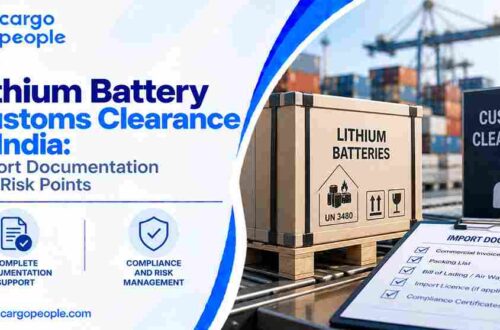
Lithium battery customs clearance in India needs more planning than ordinary cargo because one shipment can involve customs classification, dangerous-goods transport rules, product compliance checks and carrier-specific acceptance requirements at the same time.
For an importer, this means the shipment should not be treated as a normal freight booking with a few extra documents. A battery cargo movement can fail even when the commercial invoice and packing list are correct. The airline may reject the shipment because the DG documentation is incomplete. Customs may raise a query because the HS code does not match the product specification. BIS applicability may not have been checked before dispatch. EPR obligations may also need to be reviewed separately depending on how the batteries are placed in the Indian market.
For decision-makers, the most practical approach is to complete the battery technical review before cargo leaves the overseas supplier. A 2-day documentation delay at origin is usually easier to manage than a 4-day customs hold after the shipment reaches India.
Why Lithium Battery Customs Clearance in India Is More Complex Than General Cargo
Lithium battery cargo creates a different operational challenge because the shipment has to satisfy both customs and dangerous-goods requirements. These are related, but they are not the same process.
A normal industrial component may move once the importer confirms the HS code, prepares the invoice and packing list, files the Bill of Entry and completes customs clearance. A lithium battery shipment adds another layer. The freight forwarder may need to confirm the UN classification, battery chemistry, Watt-hour rating, packing configuration, UN 38.3 documentation and carrier acceptance before the cargo is handed over.
This is why the freight rate alone should never be treated as confirmation that the shipment can move. An importer may receive an attractive air freight quote of ₹210 per kg from China to Delhi, but that quote has little value if the airline later refuses the battery configuration.
The same applies to sea freight. A shipping line may quote an FCL rate, but the dangerous-goods booking still needs separate approval. If the cargo is LCL, the consolidator must also be willing to accept the battery shipment.
For lithium battery imports, the more reliable sequence is:
- Technical battery validation.
- DG classification and documentation.
- Carrier approval.
- Customs and regulatory planning.
- Freight movement and final clearance.
Lithium Battery HS Code India: Classification Should Be Finalized Before Shipment
The lithium battery HS code in India should be reviewed carefully before the supplier issues final shipping documents.
For rechargeable lithium-ion accumulators, HS 85076000 is commonly relevant. However, this should not be used automatically for every battery-related product.
The correct classification depends on the exact nature of the goods. A standalone rechargeable lithium-ion battery pack may be classified differently from a primary lithium battery. A battery imported as part of a larger machine or electronic product may also require classification under the heading applicable to the finished equipment.
This is why product descriptions such as “battery”, “lithium battery” or “battery pack” are often not enough for customs purposes. The importer should have technical information covering chemistry, voltage, capacity, intended application and whether the battery is shipped separately or integrated into equipment.
A classification issue can create a real cost impact. Assume a battery shipment worth ₹40 lakh reaches Nhava Sheva and Customs asks for technical clarification on the declared HS code. If the importer takes 3 working days to obtain the correct specification and amendment support from the supplier, and the shipment experiences an illustrative ₹10,000 per day in delay-related charges, the immediate cost impact can reach ₹30,000.
That does not include production loss, missed delivery commitments or the cost of carrying extra inventory.
For repeat importers, the practical solution is to maintain an approved HS master for each recurring battery model.
HS Code and UN Number Are Two Different Things
One of the most common mistakes in lithium battery logistics is treating the customs HS code and DG UN number as though they are interchangeable.
They serve different purposes.
The HS code is used for customs classification, tariff treatment and import policy. The UN number is used to identify the dangerous-goods transport category.
A single shipment can therefore have both classifications at the same time.
| Compliance Area | Example |
|---|---|
| Customs HS Code | 85076000 |
| DG UN Number | UN 3480 |
| Hazard Class | Class 9 |
| Product | Standalone lithium-ion battery |
| Transport Rules | IATA for air / IMDG for sea |
A shipment can be correctly classified under HS 85076000 and still be rejected by the airline if the DG paperwork does not support UN 3480 acceptance.
The reverse can also happen. The airline may accept the battery based on DG rules, but Indian Customs may still question the tariff classification, declared value or product compliance position.
This distinction should be understood by procurement, logistics and customs teams before the shipment is booked.
UN 3480, UN 3481, UN 3090 and UN 3091: The Core DG Classifications
Lithium batteries are generally handled as Class 9 dangerous goods for transport.
The most common classifications are UN 3480, UN 3481, UN 3090 and UN 3091.
UN 3480 generally applies to lithium-ion batteries shipped by themselves.
UN 3481 applies where lithium-ion batteries are packed with equipment or contained in equipment.
UN 3090 generally applies to standalone lithium-metal batteries.
UN 3091 applies when lithium-metal batteries are packed with or contained in equipment.
Main DG Classifications
| Battery Configuration | UN Number | Practical Meaning |
|---|---|---|
| Standalone lithium-ion battery | UN 3480 | Battery shipped separately |
| Lithium-ion battery packed with equipment | UN 3481 | Battery and equipment in same shipment |
| Lithium-ion battery contained in equipment | UN 3481 | Battery installed in equipment |
| Standalone lithium-metal battery | UN 3090 | Primary lithium battery |
| Lithium-metal battery with equipment | UN 3091 | Battery packed with or inside equipment |
The DG classification should be completed before the airline or shipping line is approached for final booking.
For a business importing 8 to 10 battery models, maintaining a model-wise DG master can reduce repeated checks and improve booking speed.
UN 38.3 Documentation Should Be Verified Before the Freight Booking
The UN 38.3 Test Summary is one of the most important documents in lithium battery transport.
Importers often lose time because they ask for the document only after the forwarder begins the DG approval process. By then, the airline may already be reviewing the shipment.
The better approach is to obtain the UN 38.3 documentation when the purchase order is finalized.
The technical file should ideally include the model number, battery chemistry, nominal voltage, capacity, Watt-hour rating and reference to the applicable test summary.
A mismatch between the commercial product name and the UN 38.3 model reference can trigger further questions.
For a first-time shipment, such clarification can add 1 to 3 working days before the carrier confirms acceptance.
Repeat importers should maintain a dedicated folder for each battery model containing:
- UN 38.3 Test Summary.
- Battery specification sheet.
- SDS or MSDS.
- Model reference and Watt-hour rating.
- Packing details.
This makes the shipment easier to validate the next time the same product is imported.
State of Charge Requirements Can Affect Air Freight Acceptance
For certain lithium-ion battery shipments moving by air, State of Charge is a key acceptance condition.
For applicable standalone lithium-ion batteries, a maximum 30% State of Charge is commonly relevant under current air transport provisions.
However, the 30% figure should not be applied blindly to every battery shipment. Applicability depends on the UN number, battery configuration, packing instruction and carrier conditions.
This is why the forwarder should review the technical details before confirming a flight.
For example, a Shenzhen supplier may prepare UN 3480 batteries for air freight to Delhi. If the carrier requires confirmation of the State of Charge and the supplier cannot provide it immediately, the shipment may miss the planned flight even though space is available.
A missed cut-off can easily add 1 to 2 days to the movement.
For routine lithium battery air freight, allowing 1 to 3 working days for technical review and carrier approval is a sensible planning assumption.
Lithium Battery Import Documentation India: Customs and DG Documents Must Match
Lithium battery import documentation should be reviewed as one coordinated file rather than as separate paperwork prepared by different teams.
The commercial invoice, packing list and transport document support customs clearance. The UN 38.3, SDS, battery specification and DG declaration support carrier acceptance.
Problems often occur when these documents describe the product differently.
For example, the invoice may describe the product as “Li-ion battery pack”, while the SDS uses a different model reference and the DG declaration uses another product description. The shipment may still be the same, but the inconsistency can trigger questions.
The importer should therefore compare all documents before dispatch.
Customs Documentation
| Document | Main Purpose | Main Risk |
|---|---|---|
| Commercial Invoice | Value and product description | Incorrect or vague description |
| Packing List | Quantity and packing details | Quantity mismatch |
| Bill of Lading / AWB | Transport evidence | Wrong consignee or shipment details |
| IEC | Importer identification | Registration mismatch |
| Bill of Entry | Customs declaration | Wrong HS code |
| Certificate of Origin, where applicable | Preferential duty claim | Incorrect claim |
DG and Technical Documentation
| Document | Main Purpose | Main Risk |
|---|---|---|
| UN 38.3 Test Summary | Transport testing evidence | Model mismatch |
| SDS / MSDS | Chemistry and safety details | Outdated information |
| DG Declaration | Dangerous-goods declaration | Wrong UN number |
| Battery Specification | Technical validation | Wrong Wh rating |
| Packing Details | Carrier acceptance | Non-compliant configuration |
For repeat imports, document verification should ideally be completed 2 to 3 working days before cargo handover.
BIS Compliance Should Be Checked at Product Level
BIS applicability should be reviewed before shipment rather than after the cargo reaches India.
Not every lithium battery follows the same compliance route.
The exact requirement depends on the product, end use, battery configuration and the applicable Indian Standard or notified product category.
For example, a standalone battery pack may have a different compliance position from a battery integrated into electronic equipment.
The importer should check the actual product model rather than relying on a generic supplier statement such as “BIS not required” or “BIS available”.
A practical pre-import review should cover:
- Exact product model.
- Battery chemistry.
- Intended use.
- Standalone or integrated configuration.
- Applicable BIS requirement, where relevant.
A 2-day compliance check before shipment is usually cheaper than a 5-day clarification after arrival.
Battery EPR Requirements Should Be Reviewed Separately
Battery EPR is another area where importers often mix environmental compliance with freight documentation.
Businesses placing batteries on the Indian market may have obligations under the Battery Waste Management framework.
That does not mean EPR should be treated as a standard airline or shipping-line document.
The importer should treat EPR as a separate regulatory question.
The three practical checks are:
Can Customs clear the product?
Can the carrier accept and transport the battery?
Does the importer have EPR or other post-import obligations in India?
Keeping these questions separate helps avoid confusion.
For businesses importing batteries regularly for resale, industrial use or incorporation into finished products, the EPR position should be reviewed as part of the broader compliance structure.
Step-by-Step Lithium Battery Customs Clearance Process in India
The customs clearance process should start before the supplier ships the cargo.
The first stage is product identification. The importer should confirm the battery chemistry, model, technical specification and HS classification.
The second stage is regulatory review. BIS, EPR, DGFT and any other product-specific requirements should be checked.
The third stage is DG review. The forwarder should confirm the UN number, UN 38.3 status, Watt-hour rating, packing configuration and carrier requirements.
Only after this review should the shipment be treated as ready for booking.
After arrival in India, the customs broker files the Bill of Entry through ICEGATE. Customs assesses the declaration and may raise questions on classification, valuation, technical specifications or compliance.
If the shipment is selected for examination, the cargo may need to be physically presented.
Once applicable customs requirements are completed and duty is paid, Out of Charge is issued and the shipment can move to final delivery.
Lithium Battery Customs Workflow
| Stage | Main Party | Planning Time | Main Risk |
|---|---|---|---|
| HS code validation | Importer / Advisor | Before shipment | Wrong classification |
| Product compliance review | Importer | Before shipment | Missing approval |
| DG classification | Forwarder / DG team | Before booking | Wrong UN number |
| Carrier approval | Airline / Shipping line | 1-3 days | Rejection |
| Freight movement | Carrier | Route dependent | Schedule change |
| Bill of Entry filing | Customs broker | Pre-arrival / arrival | Filing error |
| Customs assessment | Customs | 24-72 hours planning | Query |
| Examination, if selected | Customs | Additional time | Technical clarification |
| Out of Charge | Customs | After compliance | Pending condition |
| Final delivery | Logistics provider | Same day / next day | Vehicle delay |
The 24 to 72-hour customs range is a practical planning estimate, not a guaranteed clearance timeline.
Customs Examination Risk Should Be Planned, Not Predicted
There is no reliable universal inspection percentage that should be applied to all lithium battery imports.
Customs examination is risk-based and can depend on the importer profile, declared value, HS code, product type, compliance history and other parameters.
The correct approach is not to ask whether the shipment will definitely be examined.
The better question is whether the importer can immediately provide the technical file if Customs asks for clarification.
A well-prepared importer should be able to produce:
- Battery specification.
- Product catalogue.
- Chemistry details.
- UN 38.3 document.
- Relevant product compliance papers.
If these documents are already organized, a query can often be answered much faster.
Air Freight for Lithium Batteries: Speed Depends on DG Approval
Air freight is usually selected for urgent, production-critical or high-value battery cargo.
However, lithium battery air freight is not a simple airport-to-airport movement.
The airline must first accept the dangerous-goods configuration.
For a first-time battery model, the forwarder may need to submit the battery specification, UN number, Watt-hour rating, State of Charge details, packing information and supporting documents before the airline provides acceptance.
For planning purposes, China-to-India lithium battery air freight may take approximately 3 to 7 days door-to-door, but DG review can add 1 to 3 working days before departure.
This is important for procurement teams that assume air freight automatically means next-day movement.
If a plant is losing ₹4 lakh per day because a critical battery component is unavailable, spending an additional ₹1 lakh on approved air freight may still be commercially justified.
The decision should be based on production impact, not only freight cost.
Sea Freight and IMDG Coordination for Lithium Battery Imports
Sea freight is generally more practical for regular and high-volume battery imports.
A manufacturer importing 4 to 6 FCL containers every month may find ocean freight significantly more economical than air freight.
However, the shipping line still needs to approve the DG booking.
For FCL cargo, the carrier usually needs the UN number, proper shipping name, class, weight and packing details.
For LCL cargo, the consolidator must also approve the battery cargo.
A manufacturer should therefore avoid selecting the shipping line only on the lowest rate.
For example, saving ₹12,000 on an FCL rate has little value if the selected carrier takes 4 extra days to confirm the DG booking and the cargo misses the intended sailing.
Reliability of DG acceptance should be part of the freight decision.
Major Indian Gateways for Lithium Battery Imports
Lithium battery cargo can enter India through both sea and air gateways.
For sea freight, Nhava Sheva, Mundra and Chennai are commonly relevant depending on supplier origin and factory location.
For air freight, Delhi, Mumbai, Bengaluru and Chennai are important gateways for urgent battery cargo.
JNPA handled approximately 8.17 million TEUs in FY 2025-26, which shows the scale of container movement through one of India’s largest ports.
However, port volume alone should not determine the routing decision.
A manufacturer in Gujarat may find Mundra more efficient because of inland distance. A company in Maharashtra may prefer Nhava Sheva. A South India manufacturer may find Chennai more practical.
The correct comparison is total landed cost.
A ₹15,000 lower ocean freight rate may be cancelled out by ₹25,000 additional inland transportation.
Indicative Transit Times for Lithium Battery Imports
Transit times should be treated as planning ranges rather than guarantees.
| Route | Indicative Transit |
|---|---|
| China to India by air | 3-7 days door-to-door |
| Shanghai to Nhava Sheva | 18-28 days |
| Shenzhen to Chennai | 12-22 days |
| Jebel Ali to Mundra | 3-7 days |
| Europe to Nhava Sheva | 25-40 days |
The actual supplier-to-factory time can be longer.
For example, a 20-day sea transit can become a 26-day total lead time after origin handling, transshipment, customs and inland delivery.
Procurement teams should therefore plan inventory based on total lead time.
Lithium Battery Import Cost Breakdown
Lithium battery shipments often carry higher logistics costs than ordinary cargo because of DG surcharges, documentation and handling requirements.
For an illustrative sea shipment, the cost structure can look like this:
| Cost Component | Illustrative Range |
|---|---|
| Ocean freight | ₹80,000-₹1,50,000 |
| DG surcharge | ₹15,000-₹40,000 |
| Terminal and local charges | ₹20,000-₹35,000 |
| Customs brokerage | ₹7,000-₹15,000 |
| Documentation | ₹5,000-₹10,000 |
| Inland transportation | ₹20,000-₹50,000 |
These are budgeting estimates, not standard rates.
For air freight, the importer may have to budget for base freight, DG surcharge, terminal handling, security fees, customs brokerage and final delivery.
A manufacturer should compare total landed logistics cost rather than only the basic freight rate.
A ₹20,000 cheaper freight quote is not a saving if the shipment then incurs ₹50,000 in delay-related costs.
Demurrage, Detention and Delay Costs Can Rise Quickly
Lithium battery shipments can become expensive when documentation problems are discovered after arrival.
For financial stress testing, an illustrative delay range of ₹7,000 to ₹15,000 per container per day can be used.
A 5-day delay can therefore create:
- ₹35,000 at ₹7,000 per day.
- ₹50,000 at ₹10,000 per day.
- ₹75,000 at ₹15,000 per day.
These are only planning scenarios.
Actual demurrage, detention and terminal charges depend on the shipping line, free time, port, equipment and number of delayed days.
For a manufacturer importing 10 containers per month, repeated delays on even 2 containers can create a major annual cost.
Pre-arrival verification is usually much cheaper than post-arrival correction.
Practical Scenario 1: HS Code Clarification Adds 3 Days
Assume a battery importer brings a ₹40 lakh consignment through Nhava Sheva.
The Bill of Entry is filed under HS 85076000, but Customs asks for technical clarification because the product description is too generic.
The importer contacts the supplier and waits for the specification sheet.
The clarification takes 3 working days.
At an illustrative delay cost of ₹10,000 per day, the shipment creates ₹30,000 of additional logistics exposure.
If the batteries are needed for production, the commercial impact may be much higher.
The lesson is simple: product classification should be supported before the shipment departs.
Practical Scenario 2: Airline Rejects 800 kg Battery Cargo
Consider 800 kg of lithium-ion batteries planned from Shenzhen to Delhi.
The freight rate is approved and the importer expects the cargo to fly within 48 hours.
During DG review, the airline finds that the packing configuration does not match the supporting technical documents.
The shipment cannot move.
The importer may then need to arrange revised documentation, repacking, origin storage and a new flight booking.
A 2-day delay can easily cost more than the difference between a cheap freight quote and a properly reviewed DG shipment.
The correct approach is to obtain airline acceptance before cargo handover.
Practical Scenario 3: Product Compliance Is Checked Too Late
A company imports battery-powered industrial equipment.
The commercial documents are correct and the DG shipment is accepted.
After arrival, Customs asks whether the product falls under an applicable product certification requirement.
The importer has to obtain regulatory clarification.
The cargo remains pending for 2 to 5 working days.
During that time, the company may face storage charges, missed customer commitments and production delays.
The problem was not the freight rate or the DG declaration.
The problem was that the compliance review happened after shipment.
Air Freight vs Sea Freight for Lithium Battery Imports
Air freight is generally more suitable for urgent, small-volume and high-value battery shipments.
Sea freight is generally more suitable for regular, high-volume and containerized cargo.
However, the final choice should not be based on price alone.
For lithium batteries, the sequence should be:
DG validation -> carrier acceptance -> freight comparison -> customs planning.
An air rate of ₹240 per kg means little if the airline refuses the battery.
A cheap FCL rate means little if the shipping line rejects the dangerous-goods booking.
For production-critical cargo, the decision should also consider the daily cost of a factory delay.
Role of a Freight Forwarder in Lithium Battery Customs Clearance
The freight forwarder acts as the coordination point between the supplier, DG team, airline or shipping line, customs broker and importer.
Before booking, the forwarder should understand the battery chemistry, UN number, Watt-hour rating, net DG weight, packing configuration and technical documents.
For air freight, the forwarder coordinates airline acceptance, booking, terminal handling and arrival planning.
For sea freight, the forwarder coordinates DG approval, FCL or LCL booking, container movement and destination handling.
The customs broker then handles the Bill of Entry, customs queries, examination where applicable, duty payment and Out of Charge.
For importers handling 10 to 20 battery shipments every month, getting all parties to work from the same technical data can significantly reduce repeated errors.
Cargo People Logistics & Shipping Pvt. Ltd. supports lithium battery importers with air freight, sea freight, customs clearance coordination, door-to-door delivery, warehousing and distribution, and project cargo handling.
Conclusion
Lithium battery customs clearance in India is not simply a customs filing exercise.
The shipment needs coordination across HS classification, DG transport, product compliance, carrier acceptance and customs clearance.
The most important operational numbers are clear. HS 85076000 is commonly relevant to lithium-ion accumulators. UN 3480 and UN 3481 are key lithium-ion DG classifications. Routine DG review may take 1 to 3 working days. Customs processing may require around 24 to 72 hours for properly documented shipments. A 5-day container delay can create ₹35,000 to ₹75,000 in additional cost under a reasonable stress-test model.
The better strategy is to solve these issues before the shipment leaves the supplier.
When the HS code, UN number, UN 38.3, BIS applicability, EPR position, packing details and carrier acceptance are already aligned, customs clearance becomes much more predictable.
For lithium battery logistics, the cheapest shipment is not always the one with the lowest freight rate. It is usually the shipment that moves correctly the first time.
Get Expert Assistance for Lithium Battery Logistics
Cargo People Logistics & Shipping Pvt. Ltd. assists importers and manufacturers with lithium battery air freight, sea freight, DG coordination, customs clearance, door-to-door delivery and international logistics planning.
For businesses importing standalone batteries, battery packs, industrial batteries or battery-powered equipment, Cargo People can help coordinate the shipment from overseas supplier to final delivery in India.
📞 +91 97174 65454
📧 wecare@cargopeople.com
👉 Get a Shipping Quote from Cargo People Logistics
Frequently Asked Questions
1.What is the HS code for lithium-ion batteries in India?
HS 85076000 is commonly relevant to lithium-ion accumulators, but the exact classification should be verified based on product chemistry and configuration.
2.What is UN 3480?
UN 3480 generally applies to standalone lithium-ion batteries shipped by themselves.
3.What is UN 3481?
UN 3481 applies to lithium-ion batteries packed with equipment or contained in equipment.
4.Is UN 38.3 required for lithium battery transport?
UN 38.3 documentation is an important part of lithium battery transport compliance and should be checked before carrier booking.
5.How long does lithium battery customs clearance take in India?
For planning, 24 to 72 hours may be considered after complete documentation is available. Actual timelines depend on assessment, examination and compliance requirements.