








 USA
USA United Kingdom
 Germany
 Argentina
 Australia
 Canada
 New Zealand
Customs clearance for packaged commodities in India involves much more than filing a Bill of Entry and paying import duty. Before a shipment reaches India, the importer should determine whether the goods fall under the Legal Metrology Packaged Commodities Rules, confirm LMPC registration requirements, review the retail packaging, and ensure that mandatory declarations are correctly printed or affixed.
For applicable imported products, declarations may include importer details, country of origin, common product name, net quantity, MRP inclusive of taxes, consumer-care information and other product-specific information.
The actual customs clearance timeline depends on documentation quality, product classification, assessment, customs risk parameters, regulatory requirements and examination. India’s 2025 National Time Release Study recorded average import release times of approximately 79 hours at seaports and 39 hours at Air Cargo Complexes. That means importers should treat a 24 to 48 hour clearance as a good operational target, not as a guaranteed timeline.
The safest approach is to complete the label, LMPC and documentation review before cargo leaves the overseas supplier.
Why Packaged Commodity Imports Get Delayed Even When Documents Look Correct
Many importers assume that if the commercial invoice, packing list and Bill of Lading are correct, customs clearance should be straightforward. In practice, packaged consumer goods introduce another layer of compliance that can become visible only when the retail package is reviewed.
Consider an importer bringing 8,000 units of consumer electronics from China in one 40-foot container. The invoice mentions the correct value, the packing list matches the physical quantity, and the HS classification has already been reviewed. The shipment reaches Nhava Sheva, but the importer then discovers that the Indian importer address printed on the retail package belongs to an old office.
This does not automatically mean the cargo will be permanently blocked, but it creates a compliance problem that must now be solved while the container is already inside the Indian logistics system. The importer may need clarification, additional documents, package correction, customs coordination or relabelling under an applicable route.
The commercial impact can become larger than the original documentation issue. A delay of 4 to 6 additional days can generate container detention, terminal storage, CFS charges, truck rescheduling and inventory shortages. In one current 40-foot container tariff example, detention can reach around ₹11,800 per day after the initial free period. Four chargeable days at that level would already mean approximately ₹47,200 in equipment-related cost alone.
This is why experienced importers start customs clearance planning at the purchase-order and packaging stage rather than at vessel arrival.
What Is Customs Clearance for Packaged Commodities?
Customs clearance for packaged commodities is the combined process of clearing imported goods through Indian Customs while ensuring that the packages comply with applicable Legal Metrology and product-specific regulatory requirements.
The customs side covers HS classification, valuation, Bill of Entry filing, supporting documents, risk assessment, customs queries, examination where required, duty payment and final Out of Charge. The packaged commodity side focuses on whether the retail package carries the declarations required for the Indian market.
These two processes are closely connected. A shipment may be perfectly acceptable from a transportation point of view but still face an import-clearance problem because the package declarations were not prepared correctly.
For example, a factory in China may print 20,000 retail boxes using artwork designed for another market. The product itself may be acceptable for import, but the packaging may not contain the Indian importer details, MRP, consumer-care information or another applicable declaration. By the time the issue is noticed in India, correcting 20,000 finished packages becomes far more complicated than changing the artwork before production.
This is why packaged commodity import clearance should be managed as one continuous process:
Supplier approval, label review, freight booking, customs filing, regulatory verification, customs release and final delivery should all be connected.
Which Imported Goods Need LMPC Compliance?
Not every shipment entering India automatically falls under the same LMPC requirements. Applicability depends on the nature of the product, the packaging format, the quantity, the intended use and whether the goods are supplied in a pre-packaged form to customers in India.
A pre-packaged commodity is broadly a product placed inside a package without the purchaser being present and having a predetermined quantity. This commonly includes retail products such as electrical accessories, appliances, household products, consumer electronics, tools, personal-care items and packaged consumer merchandise.
Importers should be particularly careful when the overseas supplier is shipping ready-for-sale retail units. If the foreign supplier has already completed the final retail packaging, the Indian importer has much less flexibility after the shipment is dispatched.
Industrial goods require a more detailed review. A machine imported for use inside a manufacturing plant may have a different compliance position from 2,000 individually packed electronic accessories imported for resale.
Similarly, packaged products such as food, cosmetics, medical devices, wireless products, batteries or regulated electrical goods can involve additional compliance requirements beyond Legal Metrology. A product may therefore require customs clearance, LMPC review and another regulatory approval at the same time.
The correct compliance assessment should look at at least 4 factors:
- Product classification and HS code
- Packaging format
- Intended buyer or end use
- Product-specific Indian regulations
LMPC Label Requirements for Imported Packaged Commodities
The retail package is one of the most important areas to check before shipment. Importers frequently spend significant time negotiating freight rates while giving very little attention to the label that will eventually be examined or sold in the Indian market.
For applicable packaged commodities, the package may need to show the name and address of the manufacturer, packer or importer, country of origin, common or generic name of the product, net quantity, relevant date information, MRP inclusive of taxes and consumer-care details.
The exact requirement depends on the product and the applicable regulations, so importers should avoid using one generic label template for every shipment.
A practical mistake occurs when the importer checks only the master carton. A master carton may contain 24, 48 or 100 individual retail units, but the declarations relevant to retail sale may need to appear on the retail package itself.
For example, suppose an importer receives 10 pallets containing 12,000 individual retail units. If the master carton has the correct Indian importer details but the individual product boxes do not, the importer may still face a problem depending on the applicable packaging requirement.
Artwork control is therefore critical. The final label approved by the importer should be the same version used by the overseas factory during mass production.
For regular imports, companies should use a simple internal version-control system. The artwork can be marked as:
Version 1 – Draft
Version 2 – Compliance reviewed
Version 3 – Final approved for production
This reduces the risk of a factory accidentally printing an older design.
Important Label and Declaration Checklist
Before production starts, the importer should verify the final artwork against the product documents. The objective is not simply to check whether text exists on the box, but whether the information is correct and consistent with customs records.
Key declarations may include:
- Importer, manufacturer or packer details
- Country of origin
- Common or generic product name
- Net quantity
- MRP and consumer-care information
The importer should also check spelling, address format, quantity units and consistency between the package, commercial invoice and product registration documents.
A small difference may look harmless commercially but can create unnecessary questions during import clearance.
LMPC Registration Under Rule 27 for Importers
Importers should also review whether registration under Rule 27 of the Legal Metrology Packaged Commodities Rules applies to their business.
This registration should be handled as part of the importer setup process rather than after the first shipment has already reached India. For companies planning regular shipments, compliance readiness should ideally be completed before commercial quantities are dispatched.
This becomes even more important when a company imports from several countries.
Consider an importer sourcing the same category of product from 4 factories in China, 2 in Vietnam and 1 in Malaysia. If each factory independently prepares packaging artwork, small inconsistencies can appear across suppliers. One supplier may print an old importer address, another may omit country-of-origin wording, and another may use an outdated consumer-care contact.
The Indian importer should therefore maintain one controlled compliance master file containing approved importer details, label format, registrations and product requirements.
For procurement teams, the best practice is simple. The purchasing team should not approve production until the compliance team approves the package artwork.
That small operational rule can prevent much larger problems during customs clearance.
2026 Update for AEO Tier-2 and Tier-3 Bonded Warehouses
A significant change introduced in 2026 gives qualifying importers more flexibility in how mandatory declarations can be completed.
Under the Legal Metrology Packaged Commodities Third Amendment Rules, 2026, mandatory declarations may be made at bonded warehouses operated by AEO Tier-2 or AEO Tier-3 certified operators, subject to the applicable conditions.
The important practical condition is that the required declarations must be present on the retail packages before the goods leave the qualifying bonded warehouse.
This means that it is no longer accurate to say that every imported package must always be completely labelled overseas before the shipment enters India. There is now a specific route that may allow qualifying operations to complete declarations inside an approved bonded environment.
However, this should not be interpreted as permission to ship goods without planning.
If an importer wants to use this route for 15,000 retail units, the warehouse needs a defined process for receiving, segregating, labelling, checking and releasing those units. The labels must also be prepared in advance.
Imagine a warehouse processing 2,500 units per day. Relabelling 15,000 units could require approximately 6 working days before considering inspection, handling or operational delays. Therefore, even when legally permitted, relabelling after arrival can still increase lead time and cost.
The most efficient solution remains correct pre-shipment preparation whenever commercially practical.
Step-by-Step Customs Clearance Process for Packaged Commodities
The customs clearance process should begin before the overseas supplier closes the cartons.
The first step is product assessment. The importer or customs team reviews the HS classification, import policy, LMPC applicability and other regulatory requirements. This may include BIS, WPC, FSSAI, CDSCO, EPR or another authority depending on the product.
The second step is package verification. The final retail artwork is reviewed against the importer details, country of origin, quantity, MRP and other applicable declarations. If a supplier is printing 50,000 packages, this review should happen before bulk printing rather than after production.
The third step is freight planning. The importer decides whether air freight, FCL sea freight or LCL sea freight is appropriate. The decision depends on shipment size, urgency, value, inventory requirements and transportation cost.
The fourth step is preparation of customs documents. The final commercial invoice, packing list, Bill of Lading or Air Waybill, compliance documents and supporting certificates should be ready before arrival.
The fifth step is Bill of Entry filing. Where possible, a prior Bill of Entry should be filed so that customs processing begins before the cargo arrives.
The shipment then moves into customs assessment. Depending on the risk-management system, importer profile and cargo characteristics, the shipment may be facilitated or selected for additional assessment or examination.
After successful assessment and duty payment, Customs issues the Out of Charge order. The cargo can then proceed through terminal or CFS release, inland transportation and final warehouse delivery.
Customs Clearance Workflow
| Stage | Main Activity | Typical Timing | Main Risk |
|---|---|---|---|
| Product review | HS code and regulation check | Before order | Wrong regulatory assumption |
| Label approval | LMPC and artwork check | Before production | Missing declaration |
| Freight booking | Air, FCL or LCL booking | Before departure | Cargo shipped too early |
| Document preparation | Invoice and packing documents | Before arrival | Data mismatch |
| Bill of Entry | Customs filing | Preferably before arrival | Late filing |
| Assessment | Customs review | After filing | Query or amendment |
| Examination | Physical check if selected | Variable | Additional delay |
| Duty payment | Payment of assessed duty | After assessment | Payment delay |
| Out of Charge | Customs release | After compliance | Pending approval |
| Delivery | Port to warehouse | After release | Transport delay |
Documents Required for Packaged Commodity Import Clearance
The core customs document set looks simple on paper, but the real issue is consistency between documents.
A commercial invoice may state “Bluetooth Speaker Model X20”, the packing list may state “Electronic Speaker”, the label may use another product name and the regulatory certificate may refer to a different model number. Each document may be understandable individually, but the combined file can create questions.
The customs documentation team should therefore compare documents line by line before filing the Bill of Entry.
The commercial invoice should clearly show the supplier, buyer, product description, quantity, unit price, total value, currency and commercial terms.
The packing list should explain how the goods are physically packed. If the shipment contains 500 cartons with 20 units per carton, the total quantity should logically reconcile to 10,000 units.
The Bill of Lading or Air Waybill should contain the correct shipper, consignee and cargo information. Incorrect consignee details can create unnecessary amendments.
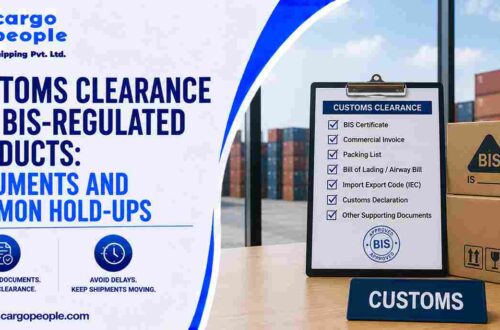
Additional compliance documents should also be ready before arrival. Depending on the product, this can include LMPC evidence, certificate of origin, BIS approval, WPC documents, FSSAI documentation, EPR registration or another regulatory certificate.
Documentation Table
| Document | Purpose | Common Problem |
|---|---|---|
| Commercial Invoice | Value and product description | Incorrect or vague description |
| Packing List | Quantity and packing structure | Quantity mismatch |
| Bill of Lading or AWB | Transport record | Consignee error |
| Bill of Entry | Customs declaration | Wrong HS code or value |
| LMPC documents | Packaged commodity compliance | Registration issue |
| Retail artwork | Label verification | Missing declarations |
| Certificate of Origin | Origin evidence | Origin mismatch |
| Product approval | Regulatory compliance | Missing approval |
| Insurance document | Cargo protection | Incorrect insured value |
Why Advance Bill of Entry Filing Matters
Advance filing is one of the simplest ways to reduce avoidable import dwell time.
India’s National Time Release Study 2025 found that approximately 91% of seaport Bills of Entry were filed in advance. Advance-filed seaport Bills of Entry recorded an average release time of approximately 71 hours 23 minutes.
Late-filed seaport Bills of Entry took approximately 158 hours 59 minutes on average.
That difference is almost 88 hours, or more than 3.5 days.
For an importer bringing a 40-foot container, an additional 3 to 4 days can affect free time, trucking plans, warehouse appointments and customer commitments.
The difference is also visible in air cargo. Advance-filed air cargo Bills of Entry recorded an average release time of approximately 29 hours 21 minutes, compared with an overall air cargo average of about 39 hours.
This matters because companies often select air freight specifically to save time. If an importer pays significantly more for air freight but starts preparing customs paperwork only after landing, part of that speed advantage is lost.
For urgent cargo, the customs file should be almost ready before the aircraft reaches India.
Customs Queries Can Turn a 3-Day Clearance Into More Than a Week
One customs query can materially change the delivery schedule.
India’s 2025 customs data showed that single queries occurred in less than 5% of cases, while multiple queries were seen in less than 1.5% of Bills of Entry in the study sample.
The percentages appear small, but the time impact is large.
At seaports, shipments without a customs query recorded release times of roughly 75 hours. One customs query increased average release time to around 170 hours.
That is approximately 7 days.
Multiple queries pushed average release time beyond 256 hours, equivalent to more than 10 days.
Air cargo showed a similar pattern. Cargo without a query recorded around 38 hours, while a single query increased average release time to approximately 151 hours. Multiple queries pushed it beyond 267 hours.
This is one reason documentation quality should be considered a financial issue, not only an administrative issue.
If a sales team has promised delivery within 7 days and Customs raises a query that adds another 4 or 5 days, the importer may lose more money through missed commitments than through customs charges themselves.
Bill of Entry Amendments and Their Cost in Time
Amendments are another common cause of avoidable delay.
Customs data from 2025 showed that approximately 51% of seaport Bills of Entry in the study involved amendments. Amended seaport Bills of Entry recorded an average release time of approximately 91 hours 21 minutes.
The amendment process itself averaged around 17 hours at seaports.
At Air Cargo Complexes, amended Bills of Entry recorded an average release time of roughly 49 hours 53 minutes.
An amendment may be required because of an incorrect description, quantity, invoice reference, classification, document number or another filing error.
The safest approach is to freeze the commercial documents before customs filing.
For regular importers, a 10-minute document reconciliation before filing can save several hours or even days later.
Customs Examination and Risk-Based Clearance
Indian Customs does not physically examine every import shipment. The system uses risk-based assessment to determine whether a shipment can move through documentary checks or requires further examination.
In the 2025 National Time Release Study, overall facilitation was approximately 86%, while facilitation at Air Cargo Complexes was around 91%.
This means a large proportion of import cargo moves through a relatively streamlined risk-management process.
However, importers should not interpret this as a guarantee that their shipment will not be examined.
The decision can depend on several factors including importer profile, HS code, product type, declared value, origin, compliance history and risk parameters.
Physical examination can have a significant time impact. In seaport data, normally facilitated shipments recorded substantially lower release times than first-check cases. First-check shipments could extend beyond 200 hours.
Therefore, importers handling regulated or sensitive products should build examination time into the shipment plan rather than assuming every container will receive immediate release.
Cost Breakdown for Packaged Commodity Imports
The landed cost of an import consists of many components. Freight is only one of them.
A typical sea-freight import may include overseas transportation, origin charges, destination terminal handling, documentation, customs-broker charges, customs duty, IGST, applicable surcharge or cess, carrier charges, CFS charges, inland transportation and warehouse receiving.
A shipment that looks cheap based on ocean freight alone can become expensive after destination charges are added.
For example, assume an importer buys goods worth ₹25 lakh and spends another ₹2 lakh on freight and handling before customs duty. If poor documentation then creates another ₹75,000 in detention, storage and transport rescheduling, that extra cost directly increases the landed cost of the inventory.
The importer may still make the sale, but the margin is lower.
This is why procurement teams should compare suppliers using landed cost rather than only FOB product price.
For regular shipments, companies should maintain a landed-cost sheet that includes:
Product cost, freight, insurance, customs duties, destination charges, inland transport and a reasonable contingency for operational delays.
Demurrage, Detention and Storage Charges
Demurrage, detention and storage are among the most misunderstood logistics costs.
The exact meaning and charging method varies between carriers, ports, terminals and CFS operators. Importers should therefore never assume that there is one standard India-wide daily rate.
A current commercial example for a 40-foot dry container shows how quickly charges can increase.
The first 4 days may be free depending on the applicable tariff and contract. During days 5 to 10, the rate can be around ₹11,800 per day. During days 11 to 14, it can increase to approximately ₹16,800 per day.
At later stages, daily charges can rise above ₹20,000.
Suppose a compliance issue holds a container for 7 chargeable days. Even at an average equipment cost of ₹12,000 per day, the importer could face approximately ₹84,000 before adding terminal storage or CFS charges.
This is why the first priority should always be preventing avoidable delay.
Consumer Electronics Through Nhava Sheva
Assume an importer brings 12,000 packaged electronic accessories into Nhava Sheva in one 40-foot container.
The commercial invoice and packing list are correct, but the importer discovers after arrival that part of the retail artwork contains an outdated office address.
The customs and compliance teams now need to review whether corrective action is required and how it can legally be completed.
The issue appears minor because the company itself has not changed. Only the address printed on the package is old.
Operationally, however, the container is already at one of India’s largest container gateways.
JNPA handled approximately 831,956 TEUs in August 2026 alone. At a port operating at that scale, importers should not rely on resolving preventable label problems after arrival.
If correcting the issue adds only 4 working days, the cost may still run into tens of thousands of rupees depending on the carrier and storage structure.
The better solution would have been a final artwork review before the factory printed all 12,000 packages.
Urgent Air Freight Through Delhi
Consider a company importing 1,500 units of urgently required packaged electronics through Delhi Air Cargo.
The company chooses air freight because the goods are required for a product launch in 5 days.
The cargo flies quickly, but the commercial invoice uses a generic description while the supporting regulatory documents use a detailed model-specific description.
Customs raises a clarification query.
Air cargo without a query recorded an average release time of around 38 hours in the 2025 customs study. With one query, the average increased to approximately 151 hours.
That is more than 6 days.
The importer may therefore spend substantially more on air freight to save transit time but lose the entire advantage because the customs file was not prepared correctly.
For time-sensitive imports, document preparation should happen before departure.
Late Bill of Entry for an FCL Shipment
Assume a manufacturer imports one FCL shipment of production-related components every month.
The overseas supplier sends the final invoice only after the vessel has sailed. The Indian team waits for the final document instead of preparing the customs file in advance.
The Bill of Entry is filed late.
India’s 2025 customs data recorded average release time of approximately 159 hours for late-filed seaport Bills of Entry, compared with approximately 71 hours for advance-filed entries.
The difference is nearly 88 hours.
If the factory relies on those components for production, the commercial impact may be larger than the freight cost.
The solution is not to pressure the customs broker after arrival. The company should improve the supplier documentation process so the final invoice and supporting documents are locked earlier.
FCL vs LCL for Packaged Commodity Imports
FCL and LCL are both commonly used for packaged goods, but the right choice depends on shipment volume, frequency and commercial urgency.
FCL is generally more suitable when the importer has enough cargo to economically utilize a dedicated container. It provides greater control over the shipment and avoids consolidation with other importers’ cargo.
LCL is useful when shipment volumes are smaller. Instead of paying for an entire container, the importer pays for the space used.
For example, an importer shipping 6 CBM of packaged goods may find LCL commercially more practical than booking a full 20-foot container.
An importer regularly shipping 22 to 28 CBM may find FCL more attractive once freight, destination handling and operational convenience are considered.
Interestingly, India’s 2025 customs study recorded average release times of approximately 83 hours 54 minutes for FCL cargo and 67 hours 55 minutes for LCL cargo within the study sample.
These figures should not be interpreted as proof that LCL is always faster. Release times vary by port, CFS, shipment profile, customs assessment and handling process.
The freight decision should therefore be made using total logistics cost rather than clearance time alone.
Air Freight vs Sea Freight for Packaged Commodities
Air freight is most useful when delivery speed has a direct commercial value.
Typical examples include urgent spare parts, high-value electronics, product samples, launch inventory and production-critical components.
Sea freight is usually more economical for larger commercial quantities.
Suppose an importer has 3,000 kg of packaged merchandise. Air freight may deliver the shipment much faster, but the freight bill can be several times higher than sea freight.
If the same goods are not urgently required, LCL or FCL sea freight may provide better landed economics.
Customs release time also matters. India’s 2025 study recorded average release times of around 39 hours at Air Cargo Complexes and around 79 hours at seaports.
However, these are customs-release figures, not international transit times.
The importer should calculate total lead time as:
Supplier preparation + international transit + customs clearance + cargo release + inland delivery.
That figure is more useful than comparing flight time with vessel time.
Direct Port Delivery and Faster Container Movement
Direct Port Delivery can help eligible importers reduce unnecessary cargo movement through the traditional CFS route.
India’s 2025 customs data recorded average release time of approximately 65 hours 33 minutes for DPD containers, compared with about 84 hours 03 minutes through the CFS route.
That represents a difference of approximately 18.5 hours.
The advantage can be greater at certain ports and for well-prepared importers.
However, DPD works properly only when the downstream process is also ready.
If Customs gives Out of Charge at 10 AM but the importer cannot arrange a truck until the next evening, part of the time benefit disappears.
The importer’s transport team, customs broker, shipping line and warehouse should therefore operate on one coordinated delivery plan.
Why AEO Importers Can Clear Faster
For businesses importing frequently, the Authorized Economic Operator framework can offer meaningful operational advantages.
India’s 2025 data showed that advance-filed seaport Bills of Entry for AEO importers recorded average release time of approximately 51 hours 03 minutes.
Comparable non-AEO shipments recorded around 81 hours 45 minutes.
That is a difference of more than 30 hours.
At Air Cargo Complexes, AEO advance-filed Bills of Entry recorded around 23 hours 25 minutes, compared with approximately 33 hours 42 minutes for non-AEO shipments.
AEO status does not eliminate customs law, LMPC compliance or product regulation. The goods still need to be correctly classified, valued and documented.
The advantage comes from being part of a trusted-trader framework with stronger compliance controls.
For a company importing 50 to 100 shipments per month, saving even several hours per shipment can produce a meaningful annual operational benefit.
Warehousing and Distribution After Customs Clearance
Customs Out of Charge is not the final step in the import supply chain.
The cargo still needs to leave the port, airport, CFS or bonded warehouse and reach the importer’s facility or customer.
For packaged goods, the warehouse should receive advance information about SKU count, cartons, pallets, batch information and expected arrival time.
Suppose a shipment contains 24 pallets and 18,000 retail units. If the warehouse expects 18 pallets because the final packing list was not circulated internally, unloading and inventory reconciliation can be delayed even after customs clearance is complete.
For the 2026 AEO bonded-warehouse labelling route, warehouse control becomes even more important because packages may need to be labelled and checked before release into the domestic market.
This is why door-to-door logistics should integrate customs clearance, carrier release, trucking, warehousing and distribution.
A shipment is not truly complete when Customs releases it. It is complete when the cargo reaches the intended business location in saleable or usable condition.
Project Cargo and Industrial Equipment Imports
Project cargo should not automatically be treated in the same way as retail packaged commodities.
Large machines, industrial equipment, electrical systems and oversized cargo often have a different regulatory and customs profile.
For example, a manufacturing plant may import a machine weighing 18 tonnes along with 600 individually packed accessories and replacement components.
The main machine may be treated as industrial equipment, while some packaged components may need separate regulatory review.
Project cargo can also involve detailed HS classification, technical literature, valuation, lifting plans, port handling, route surveys and special transport arrangements.
For this reason, customs clearance for project cargo should be planned line item by line item.
The logistics team should understand what is being imported, how each component is packed, which regulations apply and how the cargo will physically move after customs release.
Role of a Freight Forwarder in Packaged Commodity Imports
A freight forwarder should do more than obtain a freight rate.
The operational role starts with understanding what is being shipped, where it is coming from, how it is packed and when the importer needs it in India.
For sea freight, the forwarder coordinates FCL or LCL booking, shipping-line schedules, documentation, arrival information and destination handling.
For air freight, the focus includes airline space, flight routing, cargo acceptance, Air Waybill documentation and terminal coordination.
The customs team then works with the importer’s commercial and regulatory documents so the Bill of Entry can be filed correctly and, where possible, before arrival.
If Customs raises a query or examination requirement, the forwarder and customs broker coordinate the operational response while keeping the importer informed about the impact on release and delivery.
After clearance, the same logistics chain should manage carrier release, transport placement, warehousing and door delivery.
For importers moving regular cargo, the value of a freight forwarder lies less in one cheap shipment and more in reducing repeat delays across hundreds of shipments.
Pre-Shipment Checklist for Importers
A pre-shipment review does not need to be complicated. It simply needs to happen consistently.
Before giving the foreign supplier permission to dispatch the cargo, the importer should confirm:
- HS classification and product-specific import requirements
- LMPC applicability and final package artwork
- Commercial invoice, packing list and origin details
- Customs and regulatory documents needed before arrival
For a company importing every month, this checklist should become part of the purchase-order SOP.
One controlled review before shipment can prevent 3 to 7 days of unnecessary clearance delay later.
Conclusion
Customs clearance for packaged commodities is most effective when logistics and compliance are planned together.
An importer may negotiate a good freight rate and still lose the saving through a label problem, late Bill of Entry, customs query, document amendment or container detention.
The 2025 customs data illustrates the difference. Average import release time was approximately 79 hours at seaports and 39 hours at Air Cargo Complexes. A single customs query could push release time to around 170 hours at seaports and approximately 151 hours for air cargo.
Multiple queries could extend the process beyond 250 hours.
For importers, the main lesson is therefore not simply “clear the shipment faster.”
The better strategy is to remove problems before the shipment arrives.
Review the product classification, confirm LMPC applicability, approve the final retail label, complete registrations, prepare the customs documents early and file the Bill of Entry in advance wherever practical.
Companies handling regular air freight, FCL, LCL, customs clearance, door-to-door delivery, warehousing or project cargo can significantly improve supply-chain predictability when these activities are managed as one connected import process.
📞 +91 97174 65454
📧 wecare@cargopeople.com
👉 Get a Shipping Quote from Cargo People Logistics
Frequently Asked Questions
1. What is customs clearance for packaged commodities?
It is the process of clearing imported packaged goods through Indian Customs while meeting applicable documentation, LMPC labelling and product-specific regulatory requirements.
2. What declarations may be required on imported packaged goods?
Depending on applicability, the package may need importer details, country of origin, common product name, net quantity, MRP, consumer-care information and other required declarations.
3. How long does customs clearance take in India?
There is no guaranteed timeline. India’s 2025 customs study recorded average import release times of approximately 79 hours at seaports and 39 hours at Air Cargo Complexes.
4. Can the Bill of Entry be filed before cargo reaches India?
Yes. Importers can use prior Bill of Entry filing subject to applicable customs rules. Advance filing can significantly reduce post-arrival processing time.
5. Can labels be corrected after the goods reach India?
A 2026 amendment provides a specific route for mandatory declarations to be completed at qualifying AEO Tier-2 and Tier-3 bonded warehouses, subject to applicable conditions and completion before the goods leave the warehouse.