

 USA
USA
 United Kingdom
 Germany
 Argentina
 Australia
 Canada
 New Zealand
A mid-sized Bangalore-based auto components importer recently shifted shipments from Mumbai to Chennai to reduce inland transport cost. On paper, the decision looked efficient, with expected savings of nearly ₹20,000 per container.
However, the first shipment faced an unexpected delay of 4 days at Chennai Port. The issue was not congestion or vessel delay—it was a mismatch in the packing list and invoice quantity. This triggered a customs query and inspection.
During those 4 days:
- Demurrage charges crossed ₹28,000
- Detention charges added another ₹12,000
- Production planning at the factory was disrupted
The importer eventually realized that operational execution matters more than route selection. This is where experienced CHA coordination and freight forwarding play a critical role.
Understanding the Full Sea Freight Route to Bangalore via Chennai Port
Sea freight into South India is not just about port arrival. It is a multi-stage process where each step contributes to the final delivery timeline and cost.
When cargo arrives at Chennai Port, it enters one of India’s busiest container gateways, handling over 1.5 million TEUs annually. Due to this volume, even minor inefficiencies can create cascading delays.
The movement from Chennai to Bangalore, although only 350 km, becomes sensitive if port clearance is delayed.
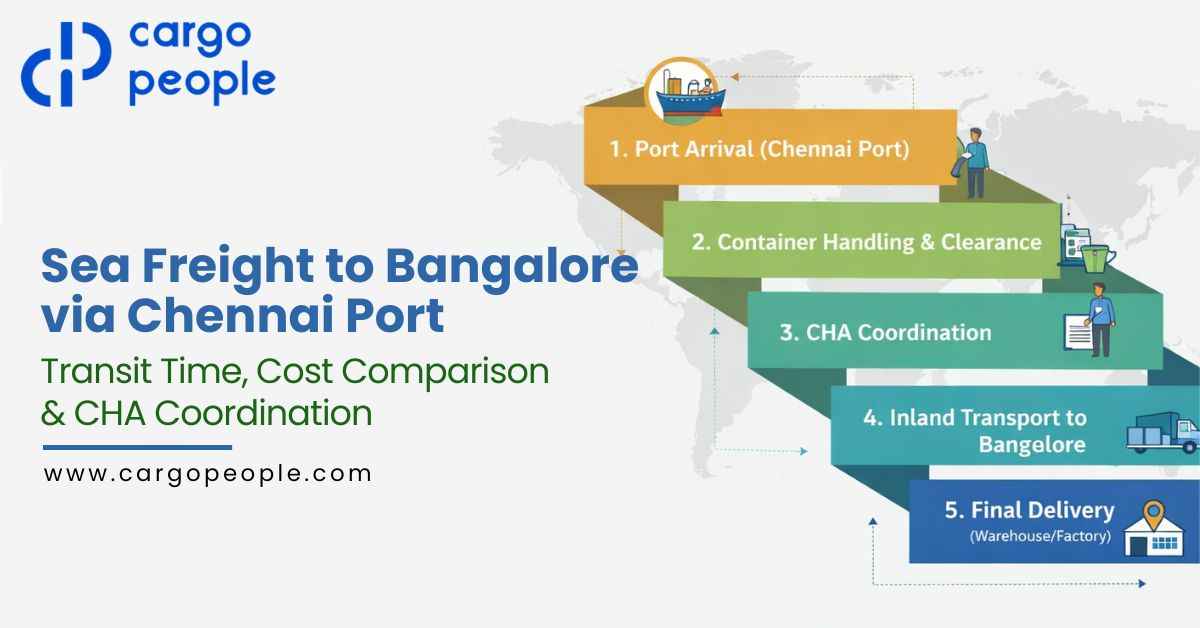
Operational Flow Explained
- Cargo is loaded at origin port and shipped via ocean carrier
- Vessel transit takes 15–30 days depending on geography
- Vessel berths at Chennai Port and cargo is discharged
- Import General Manifest is filed within 24 hours
- CHA files Bill of Entry on ICEGATE system
- Customs assesses duty and may trigger inspection (10–20% cases)
- After clearance, container is released from port
- Container is transported via trailer to Bangalore
- Cargo is delivered to factory or warehouse
Each of these stages has a defined timeline, but delays at any one point can increase total transit time significantly.
Transit Time Breakdown with Realistic Industry Numbers
The transit time for sea freight shipments is influenced by origin, vessel schedules, and port operations. For Bangalore-bound cargo via Chennai:
- China to Chennai: 18–25 days
- Southeast Asia: 10–18 days
- Europe to Chennai: 25–35 days
- Customs clearance: 2–4 days
- Port dwell time: 3–5 days
- Inland transport: 1–2 days
In practical scenarios, the total timeline falls between 22 to 35 days, but poorly managed shipments can easily extend beyond 40 days.
Cost Structure: Where Importers Actually Spend
Many importers underestimate the true landed cost because they focus only on ocean freight. In reality, sea freight is just one component of the total logistics expense.
The cost structure for a typical FCL shipment includes multiple layers of charges across international and domestic segments.
Key Cost Components
- Ocean freight (varies by route and season)
- Terminal Handling Charges at Chennai
- CHA clearance charges
- Customs duty and GST
- Documentation and delivery order charges
- Container detention and demurrage
- Inland transport to Bangalore
Typical Cost Range (FCL Container)
- Ocean Freight: ₹80,000 – ₹1,50,000
- Terminal Charges: ₹15,000 – ₹25,000
- CHA Charges: ₹8,000 – ₹18,000
- Inland Transport: ₹30,000 – ₹45,000
- Miscellaneous: ₹5,000 – ₹10,000
This brings the total logistics cost to approximately ₹1.5 lakh to ₹2.5 lakh per container, depending on cargo type and efficiency.
Logistics Process Overview and Delay Impact
| Process Stage | Authority | Timeline | Key Risk |
|---|---|---|---|
| Vessel Arrival | Shipping Line | Day 0 | Berthing delay |
| Manifest Filing | Shipping Line | 24 hrs | Clearance hold |
| Bill of Entry | CHA | 1–2 days | Late filing penalty |
| Customs Clearance | CBIC | 2–4 days | Inspection delay |
| Container Release | Port | 1 day | Demurrage |
| Inland Transport | Transporter | 1–2 days | Delivery delay |
Even a delay of 48 hours at port level can increase costs by ₹15,000–₹40,000 per container, depending on shipping line policies.
Documentation: The Most Critical Control Point
In most cases, delays are not caused by customs complexity but by documentation inaccuracies. More than 70% of shipment delays in Indian ports are linked to document errors or mismatches.
A single incorrect HS code or missing packing detail can result in inspection or reassessment.
Essential Documents
- Bill of Lading
- Commercial Invoice
- Packing List
- IEC (Importer Exporter Code)
- Bill of Entry
- E-way Bill for inland movement
Common Documentation Issues
- HS code misclassification
- Invoice and packing list mismatch
- Incorrect product description
- Missing importer details
CHA Coordination at Chennai Port: Operational Advantage
Chennai Port operates under high cargo pressure, and customs processing efficiency depends largely on how quickly documentation is filed and verified.
A local CHA provides practical advantages:
- Faster filing within 24 hours of vessel arrival
- Correct classification reducing inspection probability
- Real-time coordination with customs officers
- Faster cargo release and reduced dwell time
In efficient cases, CHA coordination can reduce clearance time from 4 days to under 48 hours.
Key Risks That Increase Transit Time and Cost
Sea freight operations are predictable, but execution risks can disrupt timelines.
The most common risks include:
- Customs inspection (10–20% shipments)
- Port congestion adding 2–4 days
- Late duty payment delays
- Container detention charges ₹5,000–₹10,000 per day
- Demurrage charges ₹7,000–₹15,000 per day
These risks are not random—they are usually linked to planning gaps or execution errors.
Practical Case: Cost vs Efficiency Trade-Off
A Bangalore-based electronics importer initially chose Chennai Port over Mumbai to save inland freight cost. While the base cost reduced by ₹25,000, poor coordination led to:
- 3-day clearance delay
- ₹21,000 demurrage
- ₹10,000 detention
After optimizing CHA and documentation processes, the same importer reduced clearance time to 48 hours and achieved net savings of ₹30,000 per shipment.
When Chennai Port is the Right Choice for Bangalore Imports
Chennai Port is operationally suitable for Bangalore-bound cargo due to proximity and cost advantage. However, it is not always the best choice for every shipment.
Best Use Cases
- Bulk cargo shipments (FCL/LCL)
- Heavy machinery or industrial goods
- Imports from Southeast Asia and China
- Cost-sensitive supply chains
When to Avoid
- Urgent shipments requiring faster delivery
- High-value cargo with tight timelines
- Time-critical manufacturing inputs
Role of Freight Forwarder in This Route
A freight forwarder acts as the central coordinator across shipping lines, port authorities, customs, and transporters.
Their role includes:
- Vessel planning and booking
- Documentation accuracy and compliance
- CHA coordination at port
- Duty planning and clearance strategy
- Inland transport management
With proper freight forwarding support, businesses can reduce delays by 30–50% and improve cost predictability.
Conclusion
Sea freight to Bangalore via Chennai Port offers strong cost advantages, but it requires precise operational execution. The biggest risks arise from documentation errors, delayed filings, and weak coordination between stakeholders.
When managed correctly:
- Transit time can be maintained within 22–30 days
- Clearance can be completed in 48–72 hours
- Logistics costs remain predictable and optimized
For importers, the key takeaway is clear—efficiency in execution matters more than route selection.
CTA — Cargo People Logistics
📞 +91 97174 65454
📧 wecare@cargopeople.com
Get a Shipping Quote from Cargo People Logistics