

 USA
USA
 United Kingdom
 Germany
 Argentina
 Australia
 Canada
 New Zealand
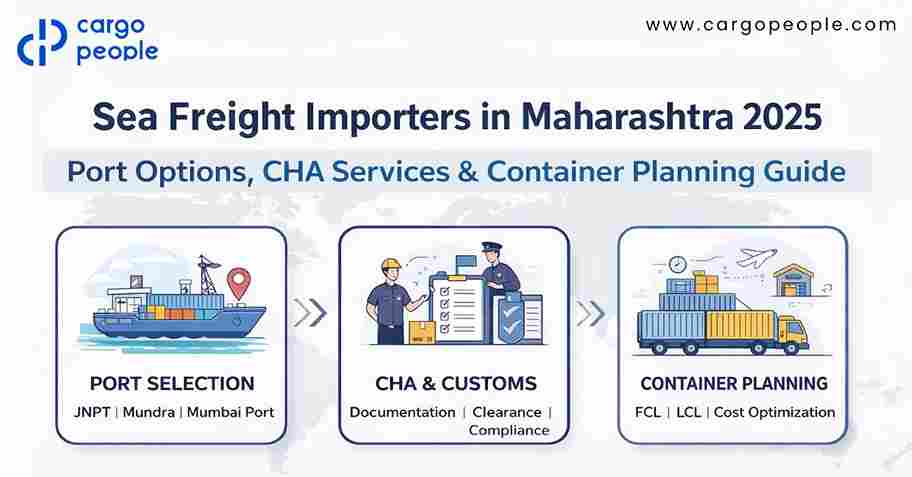
Sea freight imports into Maharashtra typically involve 7 to 28 days transit time, depending on origin, followed by customs clearance of 48 to 120 hours at major ports such as JNPT.
A standard import cycle includes:
-
Import General Manifest filing
-
Bill of Entry submission on ICEGATE
-
Duty assessment and payment
-
Customs inspection (triggered in roughly 10–20% of shipments)
-
Container release and gate-out
-
Inland transport to final destination
For most importers, total port-to-warehouse delivery takes 3 to 7 days after vessel arrival, assuming no documentation issues.
Real Business Scenario: Why Small Errors Cost Big Money
In Q1 2026, a mid-sized Pune-based importer brought in industrial components through JNPT. Due to an incorrect HS code and delayed documentation filing, the shipment faced:
-
5 days clearance delay
-
₹42,000 demurrage
-
₹18,000 container detention
-
Production halt for 72 hours
This is a common pattern. In practice, more than 30% of delays at Indian ports are documentation-related, not operational.
Sea freight is not just about booking a container. It is about managing timelines, compliance, and cost exposure at every step.
Major Sea Freight Port Options in Maharashtra
1. Jawaharlal Nehru Port (JNPT / Nhava Sheva)
JNPT is India’s largest container port, handling over 6 million TEUs annually, accounting for nearly 55% of the country’s container traffic.
Key operational facts:
-
Average dwell time: 48 to 72 hours (can extend to 5 days during congestion)
-
Daily container handling capacity: over 15,000 TEUs
-
Primary use: FCL shipments, industrial imports, large-volume cargo
This port is the default choice for most importers in Maharashtra.
2. Mumbai Port
Mumbai Port handles a mix of cargo types, especially:
-
Breakbulk shipments
-
Project cargo
-
Heavy machinery
Compared to JNPT, container volumes are lower, but it is more suitable for specialized cargo where containerization is not ideal.
3. Dighi Port (Emerging Alternative)
Dighi Port is increasingly being used by importers looking to avoid congestion.
Operational advantages include:
-
Clearance timelines as low as 24 to 48 hours in some cases
-
Lower vessel waiting time
-
Better suited for time-sensitive imports when JNPT is congested
Step-by-Step Sea Freight Import Process
Standard Import Workflow
-
Vessel arrival and berthing at port
-
Import General Manifest filed by shipping line
-
Bill of Entry filed through ICEGATE system
-
Customs duty assessed based on HS classification
-
Cargo selected for inspection (typically 10–20%)
-
Out-of-charge issued by customs
-
Container released by shipping line
-
Gate-out and inland transportation
Typical Timelines
-
Documentation filing: within 24 hours of arrival
-
Customs clearance: 2 to 5 days
-
Delivery to Pune/Nashik: 1 to 3 days
Total turnaround: 3 to 7 days under normal conditions
Container Planning: FCL vs LCL Decision
Full Container Load (FCL)
-
Recommended when cargo exceeds 15 to 18 CBM
-
Lower handling risk
-
Faster clearance
-
Lower cost per unit
Less than Container Load (LCL)
-
Suitable for small shipments under 10–12 CBM
-
Higher handling charges
-
Additional delays due to consolidation and deconsolidation
In real scenarios, importers using LCL for mid-volume shipments often pay 20% to 30% higher logistics cost per CBM compared to FCL.
Logistics Cost Breakdown for Sea Freight Imports
A typical import cost structure includes:
-
Ocean freight charges (varies by route and season)
-
Terminal Handling Charges: ₹6,000 to ₹12,000 per container
-
CHA / customs clearance charges: ₹3,000 to ₹10,000
-
Customs duty (5% to 28% depending on HS code)
-
Documentation charges: ₹1,000 to ₹3,000
-
Inland transportation: ₹15,000 to ₹40,000 (JNPT to Pune range)
-
Demurrage: ₹7,000 to ₹15,000 per day
-
Detention: ₹5,000 to ₹12,000 per day
Even a 2-day delay can increase total landed cost by ₹15,000 to ₹40,000 per container.
TABLE 1 — Sea Freight Process Overview
| Process Stage | Authority | Timeline | Documents Required | Risk if Delayed |
|---|---|---|---|---|
| Vessel Arrival | Port Authority | Day 0 | IGM | Congestion delays |
| BOE Filing | Customs | Day 1–2 | Invoice, BL | Clearance delay |
| Duty Assessment | Customs | 1 day | HS Code | Incorrect duty |
| Inspection | Customs | 1–2 days | Full docs | Cargo hold |
| Container Release | Shipping Line | Same day | Delivery Order | Detention charges |
| Gate-Out | Terminal | Same day | OOC | Demurrage |
Operational Insight:
Each additional day at port can increase costs by ₹8,000 to ₹20,000 per container.
TABLE 2 — Documentation Checklist
| Document | Issued By | Purpose | Stage | Risk if Missing |
|---|---|---|---|---|
| Bill of Lading | Shipping Line | Ownership proof | Arrival | Cargo hold |
| Commercial Invoice | Supplier | Value declaration | BOE filing | Duty issues |
| Packing List | Exporter | Cargo details | Inspection | Delay |
| IEC Certificate | Importer | Legal compliance | BOE | Rejection |
| Bill of Entry | Importer/CHA | Clearance | ICEGATE | Shipment stuck |
| Insurance | Insurer | Risk coverage | Optional | Financial loss |
In practice, nearly 25% of clearance delays are caused by incomplete or mismatched documentation.
CHA Services in Maharashtra: Operational Importance
A licensed CHA ensures:
-
Accurate Bill of Entry filing
-
Correct HS code classification
-
Duty optimization
-
Coordination with customs officers
-
Faster inspection clearance
Incorrect classification alone can increase duty liability by 5% to 28%, depending on the product category.
Key Logistics Risks for Importers
1. Customs Inspection Delays
Around 10% to 20% of shipments are physically inspected, adding 1 to 3 days.
2. Port Congestion
During peak seasons, JNPT delays can extend up to 5 to 7 days.
3. Demurrage and Detention
Combined charges can exceed ₹20,000 per day per container after free days.
4. Documentation Errors
Incorrect invoice or packing list can completely stop clearance.
5. Poor Container Planning
Wrong container choice increases cost by 15% to 25%.
Practical Business Scenario
A Mumbai-based chemical importer opted for LCL shipment for a 14 CBM cargo.
Outcome:
-
3-day delay due to consolidation
-
₹27,000 additional handling and storage cost
-
Missed production schedule
If shipped via FCL, total cost would have reduced by approximately 18% with faster delivery.
Decision Guide for Maharashtra Importers
Use JNPT When
-
You have regular container shipments
-
Volume exceeds 15 CBM
-
You require global connectivity
Use Mumbai Port When
-
Handling project cargo
-
Importing heavy machinery
-
Dealing with breakbulk shipments
Use Dighi Port When
-
Avoiding congestion
-
Prioritizing faster clearance
-
Optimizing logistics cost
Role of Freight Forwarders in Sea Freight Imports
A professional freight forwarder manages:
-
Shipping line booking and rate negotiation
-
Documentation accuracy and compliance
-
Customs coordination
-
Cargo tracking and milestone updates
-
Inland logistics planning
In real operations, experienced forwarders help reduce:
-
Clearance delays by up to 30%
-
Overall logistics cost by 10% to 18%
Conclusion
Sea freight imports in Maharashtra are driven by operational efficiency, not just freight rates.
Key success factors include:
-
Choosing the right port
-
Filing documentation on time
-
Correct container planning
-
Managing customs compliance
-
Minimizing port stay duration
Even small inefficiencies can lead to:
-
₹20,000 to ₹60,000 additional cost per shipment
-
2 to 7 days delay
-
Supply chain disruption
Businesses that approach sea freight strategically gain better cost control, faster turnaround, and predictable operations.
CTA — Cargo People Logistics
📞 +91 97174 65454
📧 wecare@cargopeople.com
Get a Shipping Quote from Cargo People Logistics