

 USA
USA
 United Kingdom
 Germany
 Argentina
 Australia
 Canada
 New Zealand
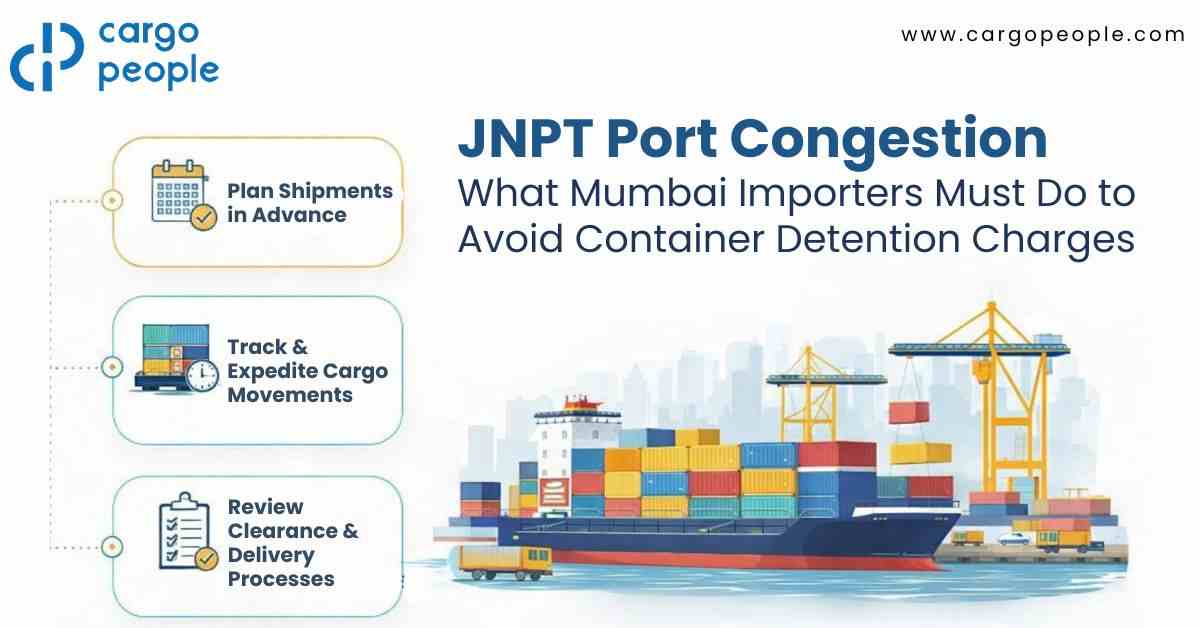
Introduction — Why JNPT Port Congestion 2026 Is a Direct Cost Risk for Importers
JNPT (Jawaharlal Nehru Port Trust) handles approximately 7.5–8 million TEUs annually and accounts for nearly 45–50% of India’s total containerized trade. In 2026, with import volumes increasing by an estimated 6–8% year-on-year, peak utilization at certain terminals has been crossing 90–95%.
When utilization exceeds 90%, operational buffers shrink. Yard density rises. Truck turnaround time increases. Even a delay of 48–72 hours can push containers beyond free time limits.
For Mumbai-based importers, JNPT port congestion 2026 is not simply a logistics inconvenience. It directly affects:
-
Container dwell time
-
Demurrage exposure
-
Detention penalties
-
Production planning cycles
-
Working capital rotation
A single 40’ HC container delayed by 5 days can incur ₹35,000–₹60,000 in additional costs. For businesses importing 15–20 containers per month, this can translate into ₹8–12 lakh of avoidable annual leakage.
JNPT Port Congestion 2026 — Structural and Operational Drivers
Congestion is not caused by a single factor. It is the result of simultaneous operational pressures across sea, terminal, customs, and inland transport ecosystems.
1. Vessel Bunching and Global Route Diversions
-
Rerouting due to geopolitical disruptions has increased call volumes at Indian west coast ports.
-
Vessel arrival windows often overlap, leading to berth waiting time of 24–72 hours.
-
Even a 1-day vessel delay disrupts downstream clearance planning.
2. High Yard Utilization
-
Terminal yard capacity crosses 90% during peak months.
-
Container stacking increases re-handling time.
-
Gate-out scheduling becomes slower due to slot congestion.
3. Inland Trucking Bottlenecks
-
Gate appointment slots may be delayed by 1–2 days during peak congestion.
-
Truck turnaround time at some terminals increases from 4–5 hours to 8–12 hours.
-
Driver shortages and fuel cost fluctuations further strain transport availability.
4. Increased Customs Examination Rates
-
Certain HS codes face 10–20% physical examination rates.
-
Even a routine examination can add 2–4 days to clearance during congestion.
Direct Business Impact
-
Extended container dwell time from 3–4 days to 7–9 days
-
Free time exhaustion before delivery
-
Increased warehouse buffer stock requirements
-
Cash flow blockage due to delayed inventory rotation
JNPT Throughput and Utilization — What the Numbers Indicate
Table 1 — JNPT Container Volume and Utilization Trend
| Financial Year | Throughput (TEUs) | Growth % | Estimated Peak Utilization |
|---|---|---|---|
| FY 2022-23 | 6.05 Million | — | 80–85% |
| FY 2023-24 | 7.30 Million | 13–14% | 90%+ |
| FY 2024-25 | 7.70 Million (Est.) | 5–6% | 92–95% |
| FY 2025-26 (Projected) | 8.10–8.30 Million | 6–8% | 95% Peak Period |
Interpretation:
When utilization consistently touches 92–95%, operational resilience drops sharply. Even minor clearance delays increase detention probability.
How JNPT Port Congestion 2026 Triggers Detention and Demurrage
Many importers assume charges start only after cargo pickup delays. In reality, the cost chain begins much earlier.
Cost Escalation Cycle
-
Vessel arrival delay due to berth congestion
-
Container discharge delayed
-
Terminal dwell time increases
-
Free time expires
-
Demurrage begins at terminal
-
Late pickup or delayed empty return triggers detention
Typical Free Time and Charges (Indicative 2026)
-
Free time: 3–7 calendar days
-
Demurrage: ₹3,000–₹8,000 per day per container
-
Detention: ₹2,500–₹7,000 per day
-
Reefer detention: ₹8,000–₹15,000 per day
A 7-day combined delay across 10 containers can result in ₹4–6 lakh additional expense.
Clearance Timeline Comparison — Normal vs Congested Scenario
Table 2 — Clearance and Gate-Out Timeline Impact
| Process Stage | Normal Days | Congested Days |
|---|---|---|
| Bill of Entry Filing | 0–1 | 1–2 |
| Customs Assessment | 1 | 2–3 |
| Examination (if selected) | 1 | 2–4 |
| Duty Payment & OOC | Same Day | 1–2 |
| Gate Appointment | Same Day | 1–2 |
| Total Dwell Time | 3–4 Days | 6–9 Days |
Interpretation:
During congestion, clearance timelines may double. Without extended free time, detention becomes almost inevitable.
Major Case Study — ₹4.8 Lakh Detention Exposure Due to Congestion Mismanagement
Company Overview
-
Sector: Consumer Electronics Importer
-
Monthly Volume: 18–22 containers
-
Shipment Value: ₹3.5 Crore (12 containers in this consignment)
-
Origin: Shenzhen, China
-
Terminal: BMCT, JNPT
Operational Timeline Breakdown
Day 1–2: Vessel Arrival and Discharge Delay
Vessel berthed 36 hours late due to queue congestion.
Day 3: Bill of Entry Filed Post-Arrival
Documentation was filed after discharge instead of pre-arrival filing. This consumed 2 critical free days.
Day 4–6: Customs Examination Triggered
HS code mismatch triggered examination. Physical inspection took 3 additional days due to yard congestion.
Day 7–8: Gate Slot Unavailability
No immediate trucking slots available. Gate appointments delayed by 48 hours.
Day 9–10: Empty Return Misalignment
Empty return depot was changed. Containers returned 2 days beyond allowable free detention period.
Financial Impact Analysis
| Cost Component | Days Charged | Rate | Total |
|---|---|---|---|
| Demurrage | 4 Days x 12 Containers | ₹5,500 | ₹2,64,000 |
| Detention | 3 Days x 12 Containers | ₹4,500 | ₹1,62,000 |
| Transport Premium | — | — | ₹54,000 |
| Additional Warehouse Holding | — | — | ₹48,000 |
| Total Loss | — | — | ₹4,80,000+ |
Secondary Business Consequences
-
Production halted for 6 days
-
Distributor penalty clauses triggered
-
12% delay in monthly sales target
-
Working capital cycle extended by 9 days
-
Strain on supplier credit terms
What Would Have Prevented This Loss
-
Pre-arrival Bill of Entry filing (saves 1–2 days)
-
HS classification validation before dispatch
-
Negotiated 7–10 free days
-
Pre-booked trucking and return depot alignment
-
Real-time congestion monitoring
This case demonstrates that during JNPT port congestion 2026, minor operational inefficiencies multiply financial risk.
Strategic Action Plan for Mumbai Importers in 2026
Strengthen Customs Compliance
-
Pre-arrival documentation filing
-
Accurate HS code validation
-
Advance duty calculation
-
RMS facilitation planning
Negotiate Commercial Protection
-
Secure minimum 7-day free time
-
Include detention cap clauses
-
Lock peak-season buffers
-
Renegotiate reefer penalty slabs
Improve Inland Coordination
-
Pre-book trucks 48–72 hours before arrival
-
Confirm empty return depot in advance
-
Avoid weekend cargo movement gaps
-
Consider rail evacuation to ICDs when yard density is high
Work with an Experienced Freight Forwarder in India
A professional freight forwarder provides:
-
Real-time vessel tracking
-
Congestion index analysis
-
Faster customs coordination
-
Carrier negotiation leverage
-
Alternative routing advisory (Mundra, Pipavav where viable)
This reduces detention exposure by 30–50% in peak scenarios.
Conclusion — Congestion Is Predictable, Penalties Are Preventable
JNPT port congestion 2026 is a measurable operational reality. Throughput growth, yard density, and trade volatility will continue putting pressure on west coast ports.
However, detention and demurrage charges are not unavoidable.
Importers who:
-
Plan documentation proactively
-
Monitor congestion signals
-
Strengthen inland transport coordination
-
Negotiate smarter freight contracts
-
Partner with experienced logistics professionals
can significantly reduce financial leakage and maintain supply chain continuity.
Reactive planning leads to penalties. Structured planning protects margins.
Secure Your Shipments with Cargo People Logistics
Cargo People Logistics supports Mumbai importers with:
-
Sea freight services
-
Customs clearance at JNPT
-
Door-to-door delivery
-
Container detention risk management
-
Strategic freight contract advisory
📞 +91 9717465454
📧 wecare@cargopeople.com
Book a Consultation with Cargo People Logistics