

 USA
USA
 United Kingdom
 Germany
 Argentina
 Australia
 Canada
 New Zealand
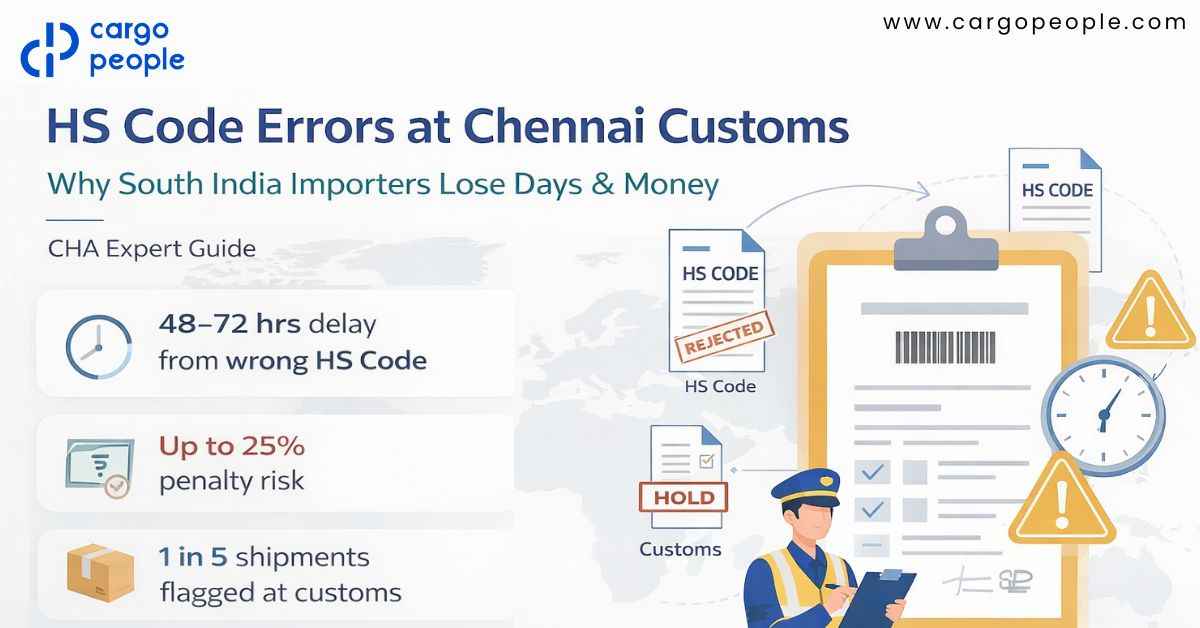
HS Code errors at Chennai Customs can delay cargo clearance by 2 to 5 additional days and increase total logistics costs by ₹25,000 to ₹1,20,000 per shipment, depending on inspection, duty reassessment, and demurrage exposure.
In a typical import cycle, classification errors directly impact:
-
Bill of Entry filing on ICEGATE
-
Customs duty calculation
-
Inspection selection probability
-
Cargo release timelines
HOW A SMALL ERROR CAUSED A BIG LOSS
In early 2025, a mid-sized importer in Coimbatore imported industrial pumps through Chennai Port. The supplier used a generic HS code applicable to basic machinery instead of the specific classification required.
At first, the shipment moved normally. However, during customs assessment:
-
Duty changed from 7.5% to 18%
-
Shipment flagged for inspection
-
Customs requested technical documentation
The cargo remained at port for 5 extra days, leading to:
-
₹68,000 demurrage
-
₹22,000 additional CHA and amendment costs
-
Production delay of nearly 72 hours
This situation is not rare. Across South India, HS code errors affect nearly 1 in 5 shipments involving mixed or technical goods.
WHY HS CODE ERRORS HAPPEN IN CHENNAI CUSTOMS
HS code classification is not always straightforward. It requires technical understanding, regulatory knowledge, and experience with customs interpretation.
In Chennai, which handles both industrial and consumer imports, classification complexity increases significantly.
Many importers rely on supplier-provided HS codes, but these are often based on export country standards, not Indian customs interpretation.
Key reasons behind HS code errors:
-
Incomplete or vague product descriptions
-
Supplier using global HS code instead of India-specific classification
-
Use of outdated HS codes after revisions
-
Multi-component products classified under a single code
-
Lack of technical documentation at filing stage
Operational consequences observed:
-
Inspection probability increases from 15% to nearly 40%
-
Clearance timelines extend from 2–3 days to 5–8 days
-
Duty disputes arise in 20–30% of misclassified shipments
HS CODE ERRORS CHENNAI CUSTOMS — DETAILED CLEARANCE PROCESS
The customs clearance process in Chennai follows a structured digital and physical workflow. However, HS code errors disrupt this flow and create repeated loops in assessment.
Step-by-Step Operational Workflow
1 Cargo arrival at Chennai Port or Air Cargo Terminal
2 Import General Manifest (IGM) filing by carrier
3 Bill of Entry filing on ICEGATE
4 HS code validation and duty assessment
5 Customs query generation if mismatch detected
6 Physical inspection in selected cases
7 Duty reassessment and amendment
8 Out of Charge (OOC) issued
9 Cargo moved for delivery
Where delays occur in reality:
-
At Step 4 when HS code mismatch is detected
-
At Step 5 when customs raises query
-
At Step 6 if inspection is triggered
Practical observation:
Nearly 70% of HS code-related delays occur between assessment and inspection stages, adding 48 to 96 hours to clearance.
LOGISTICS PROCESS OVERVIEW — TIME AND RISK ANALYSIS
| Process Stage | Authority | Typical Timeline | Documents Required | Risk if Delayed |
|---|---|---|---|---|
| Cargo Arrival | Shipping Line / Airline | Day 0 | BL / AWB | Storage charges begin |
| BOE Filing | Importer / CHA | 4–8 hours | Invoice, Packing List | Filing rejection |
| HS Code Assessment | Customs | 6–24 hours | Technical details | Reclassification |
| Inspection | Customs | 24–48 hours | Physical cargo | Damage risk |
| Duty Payment | Importer | Same day | Duty challan | Cargo hold |
| Release | Customs | 24 hours | OOC | Demurrage |
Cost implication of delays:
Each additional day at Chennai Port can result in:
-
₹7,000 to ₹15,000 demurrage per container
-
₹2,500 to ₹6,000 cargo storage (LCL or air cargo)
-
₹3,000 to ₹8,000 handling and coordination costs
DOCUMENTATION REQUIREMENTS — WHERE MOST IMPORTERS FAIL
Accurate documentation is the backbone of correct HS classification. In Chennai Customs, documentation gaps are one of the biggest reasons for classification disputes.
Many importers underestimate the importance of technical documents and rely only on commercial paperwork.
Essential documents for HS code accuracy:
-
Commercial Invoice with detailed product description
-
Packing List with item-level breakdown
-
Bill of Lading or Airway Bill
-
Product technical specification sheet
-
Catalog or product manual
-
Importer IEC details
Common documentation mistakes:
-
Using generic descriptions like “machine parts”
-
Missing material composition details
-
No mention of usage or function
-
Incomplete model or specification details
Impact:
-
Customs queries increase by 35–50%
-
Inspection likelihood rises significantly
-
Clearance delays extend by 2–4 days
LOGISTICS COST BREAKDOWN — HOW HS CODE ERRORS INCREASE IMPORT COST
Import costs are highly sensitive to HS code classification because duty rates vary widely across categories.
Even a small classification error can result in a major financial impact.
Typical import cost structure at Chennai:
-
Ocean freight: ₹80,000 to ₹2,50,000 per container
-
Terminal Handling Charges: ₹6,000 to ₹14,000
-
Customs duty: 5% to 28% depending on HS code
-
CHA charges: ₹4,000 to ₹12,000
-
Transportation: ₹10,000 to ₹30,000
Additional costs caused by HS code errors:
-
Duty difference: increase of 10% to 20%
-
Amendment charges: ₹5,000 to ₹15,000
-
Demurrage: ₹7,000 to ₹15,000 per day
-
Inspection handling: ₹3,000 to ₹10,000
Real impact:
A 3-day delay can increase total landed cost by 12% to 18% for medium-value shipments.
KEY LOGISTICS RISKS CAUSED BY HS CODE ERRORS
HS code mistakes trigger a chain reaction across the logistics process.
1 Duty Reassessment Risk
-
Incorrect duty applied initially
-
Recalculation delays cargo release
-
Financial planning disrupted
2 Increased Inspection Probability
-
Normal inspection rate: 10–20%
-
With HS error: increases to 30–40%
-
Adds 1–3 days to clearance
3 ICEGATE Amendment Delays
-
Filing corrections required
-
Approval can take 12–48 hours
-
Documentation re-submission needed
4 Port Congestion Impact
-
Chennai average dwell time: 2–3 days
-
During peak: 5–6 days
-
Errors amplify congestion delays
5 Demurrage and Storage Exposure
-
₹7,000–₹15,000 per day (FCL)
-
₹3,000–₹8,000 per day (LCL/air cargo)
PRACTICAL BUSINESS SCENARIOS FROM SOUTH INDIA
Scenario 1 — Textile Importer (Tiruppur)
A textile importer misclassified blended fabric under cotton category.
-
Duty revised from 5% to 12%
-
Clearance delay: 3 days
-
Total loss: ₹38,000
Scenario 2 — Electronics Importer (Bangalore)
Incorrect HS code triggered BIS compliance requirement.
-
Inspection required
-
Delay: 6 days
-
Demurrage cost: ₹70,000+
Scenario 3 — Machinery Importer (Chennai)
Supplier declared generic machinery HS code.
-
Customs demanded technical drawings
-
Delay: 4 days
-
Production line impact
DECISION FRAMEWORK — HOW BUSINESSES CAN AVOID HS CODE ERRORS
For importers handling regular shipments, HS code validation should be treated as a pre-shipment control process.
Recommended approach:
-
Validate HS code before shipment dispatch
-
Cross-check supplier classification with Indian tariff
-
Maintain updated HS code database
-
Keep technical documentation ready
-
Consult CHA for complex products
High-risk categories:
-
Machinery and industrial equipment
-
Electronics and telecom products
-
Chemicals and hazardous goods
-
Textile blends and composite materials
ROLE OF FREIGHT FORWARDER AND CHA IN ERROR PREVENTION
A professional CHA plays a critical role in minimizing classification risks.
They not only file documents but also act as compliance advisors.
Key operational responsibilities:
-
Pre-shipment HS code verification
-
Accurate Bill of Entry filing on ICEGATE
-
Handling customs queries and clarifications
-
Coordinating inspection and release
-
Advising on duty structure
Measurable benefits:
-
Reduces clearance time by 30% to 50%
-
Lowers inspection probability
-
Minimizes demurrage exposure
-
Ensures compliance with customs regulations
CONCLUSION
HS Code errors at Chennai Customs are one of the most common yet costly mistakes in import logistics.
They directly affect:
-
Clearance timelines, often adding 2 to 5 days
-
Logistics costs, increasing shipment expenses by ₹25,000 to ₹1,20,000
-
Supply chain reliability and delivery commitments
For businesses importing into South India, accurate classification is not just a compliance requirement. It is a key factor in controlling cost, speed, and operational efficiency.
Working with an experienced CHA and validating HS codes before shipment can significantly reduce these risks and ensure smooth cargo movement.
CTA — CARGO PEOPLE
📞 +91 97174 65454
📧 wecare@cargopeople.com
👉 Get a Shipping Quote from Cargo People Logistics