

 USA
USA
 United Kingdom
 Germany
 Argentina
 Australia
 Canada
 New Zealand
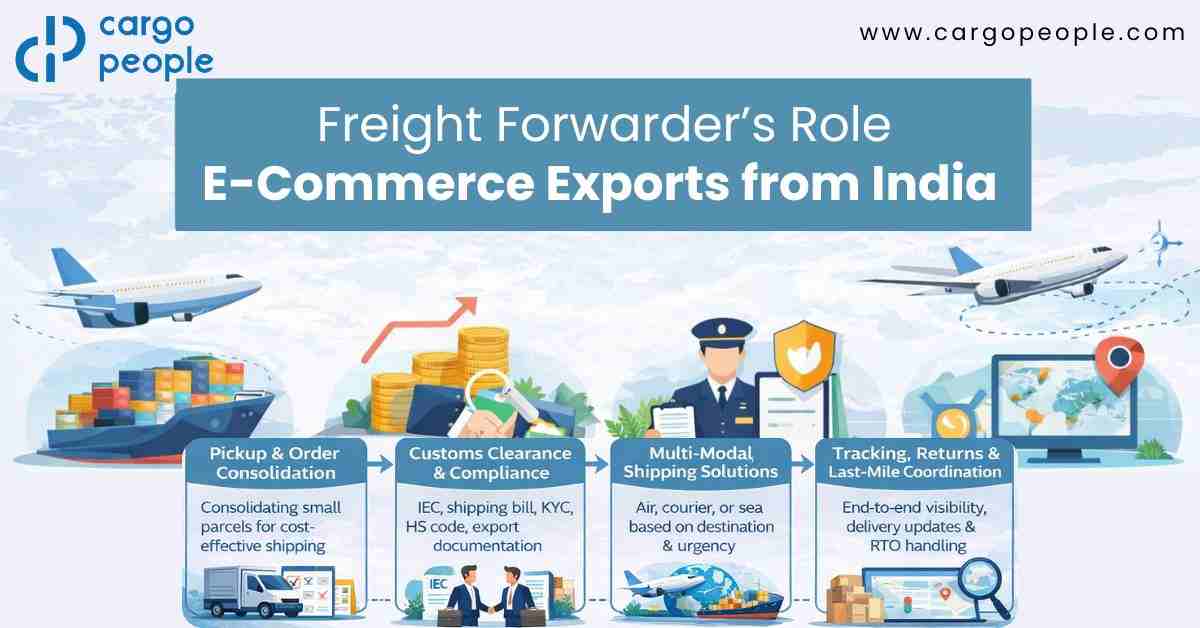
When Rohit, a handicraft exporter from Moradabad, began selling through an international e-commerce platform, global demand looked promising. Orders from the US and Europe started coming in steadily. But his excitement faded quickly when his first consolidated shipment was held at Nhava Sheva due to a documentation mismatch. Storage charges mounted daily, delivery timelines slipped, and an overseas buyer nearly cancelled future orders.
Rohit’s experience is not unique. For many Indian online sellers, exporting is no longer the challenge — managing logistics, compliance, and timelines is. This is where a freight forwarder plays a decisive role in e-commerce exports from India.
Understanding E-Commerce Export Logistics in India
E-commerce export logistics operates on a very different model compared to traditional bulk exports. Online sellers deal with frequent shipments, smaller order sizes, tight delivery commitments, and high customer expectations for visibility and reliability.
In the Indian context, exporters must also navigate:
-
DGFT and CBIC export regulations
-
Port congestion at gateways like Mundra and Nhava Sheva
-
Fluctuating air and sea freight rates
-
Customs scrutiny on courier and parcel exports
A freight forwarder acts as the operational backbone, coordinating transport, compliance, and documentation so exporters can focus on sales growth rather than firefighting logistics issues.
Why Freight Forwarders Are Critical for E-Commerce Shipping from India
E-commerce shipping is not just about moving goods internationally. It is about aligning cost, speed, and compliance without compromising customer experience.
A freight forwarder supports online exporters by:
-
Evaluating shipment urgency and recommending the right mode of transport
-
Consolidating multiple orders to reduce per-unit freight costs
-
Managing export documentation with precision
-
Coordinating customs clearance and inspections
-
Monitoring shipments and resolving transit disruptions
Without this expertise, exporters often face shipment delays, penalties, or reputational damage with overseas buyers.
Export Fulfillment Support for Online Sellers
Export fulfillment goes far beyond booking freight. It involves structuring a repeatable, scalable logistics process that aligns with e-commerce demand cycles.
A freight forwarder helps streamline export fulfillment by:
-
Planning pickups in sync with production and order schedules
-
Preparing compliant invoices, packing lists, and shipping bills
-
Advising on Incoterms to avoid cost disputes with buyers
-
Ensuring correct HS code classification and labeling
-
Coordinating overseas delivery partners for last-mile fulfillment
This structured approach minimizes errors, improves delivery reliability, and enhances buyer confidence.
Choosing the Right Shipping Mode for E-Commerce Exports
Selecting the wrong shipping mode can wipe out margins or delay customer deliveries. Freight forwarders help exporters make informed decisions based on shipment value, urgency, and destination.
Freight Mode Comparison for Indian E-Commerce Exporters
| Mode | Average Transit Time | Cost Impact | Best Suited For |
|---|---|---|---|
| Air Freight | 3–7 days | High | Fashion, electronics, urgent orders |
| Sea Freight (LCL/FCL) | 20–40 days | Low | Bulk exports, B2B e-commerce |
| Rail–Sea Hybrid | 12–25 days | Medium | Cost-sensitive Europe shipments |
What this means for exporters:
Air freight ensures speed but demands careful rate negotiation. Sea freight reduces cost but requires better inventory planning. Freight forwarders balance these trade-offs to protect profitability.
Customs Clearance: The Biggest Bottleneck in E-Commerce Exports
Customs clearance remains one of the most common pain points for Indian e-commerce exporters. Even minor documentation errors can lead to shipment detention, demurrage, or penalties.
Freight forwarders mitigate these risks by:
-
Conducting pre-shipment document checks
-
Ensuring accurate HS code classification
-
Filing shipping bills correctly and on time
-
Coordinating customs examinations
-
Resolving valuation or duty-related queries
Average Customs Clearance Timelines at Major Indian Ports
| Port | Average Clearance Time |
|---|---|
| Mundra | 2–4 days |
| Nhava Sheva | 3–5 days |
| Chennai | 2–3 days |
Interpretation:
Exporters who plan documentation in advance with a freight forwarder often reduce clearance time significantly, lowering demurrage and avoiding shipment delays.
Compliance Risks That Can Disrupt E-Commerce Exports
A Tirupur-based apparel exporter once claimed an incorrect duty exemption while shipping garments to Europe. Customs flagged the discrepancy, detained the shipment for inspection, and imposed a penalty. The exporter lost nearly ₹75,000 in demurrage and missed a seasonal sales window.
Such incidents usually occur due to:
-
Incorrect scheme selection
-
Inaccurate declarations
-
Lack of pre-shipment compliance review
Proactive logistics planning with a freight forwarder helps exporters avoid these costly mistakes.
Real Business Stories: How Logistics Decisions Changed Outcomes
-
A Jaipur-based jewelry exporter reduced annual air freight costs by ₹2.5 lakh by switching to consolidated weekly shipments.
-
A Delhi electronics seller avoided buyer cancellations by using alternate routing suggested by their freight forwarder.
-
A Surat textile exporter expanded to Europe after receiving Incoterms and compliance guidance before shipping.
These examples show how informed logistics decisions directly impact business growth.
Scaling E-Commerce Exports with the Right Freight Partner
As order volumes increase, logistics complexity grows exponentially. Freight forwarders help businesses scale by:
-
Designing standardized export workflows
-
Negotiating long-term freight contracts
-
Offering warehousing and distribution support
-
Managing multi-country compliance requirements
-
Providing predictability in delivery timelines
With the right logistics partner, exporters move from reactive shipping to strategic expansion.
Conclusion: Why Freight Forwarders Matter More Than Ever
E-commerce exports from India are growing rapidly, but success depends on more than just online sales channels. Freight forwarders play a vital role in reducing costs, avoiding delays, and ensuring regulatory compliance.
Ignoring logistics planning can lead to penalties, lost buyers, and operational stress. Partnering with an experienced freight forwarder enables exporters to ship confidently, scale sustainably, and compete globally.
📞 +91 9717465454 | 📧 wecare@cargopeople.com
Book a Consultation with Cargo People Logistics
FAQs: Freight Forwarding for E-Commerce Exports
What documents are required for e-commerce exports from India?
Commercial invoice, packing list, shipping bill, IEC, and compliance certificates depending on product type.
How do freight forwarders help with customs clearance?
They prepare documents, file shipping bills, coordinate inspections, and resolve customs queries.
Which shipping mode is best for e-commerce exports from India?
Air freight for urgent shipments, sea freight for bulk orders, and hybrid options for cost-sensitive routes.
How can exporters reduce shipping delays at Indian ports?
Advance documentation, correct classification, and working with an experienced freight forwarder.
What is the difference between FCL and LCL for e-commerce shipments?
FCL uses a full container, while LCL consolidates smaller shipments to reduce costs.
Can freight forwarders handle end-to-end export fulfillment?
Yes, including pickup, customs clearance, freight booking, and overseas delivery coordination.