

 USA
USA
 United Kingdom
 Germany
 Argentina
 Australia
 Canada
 New Zealand
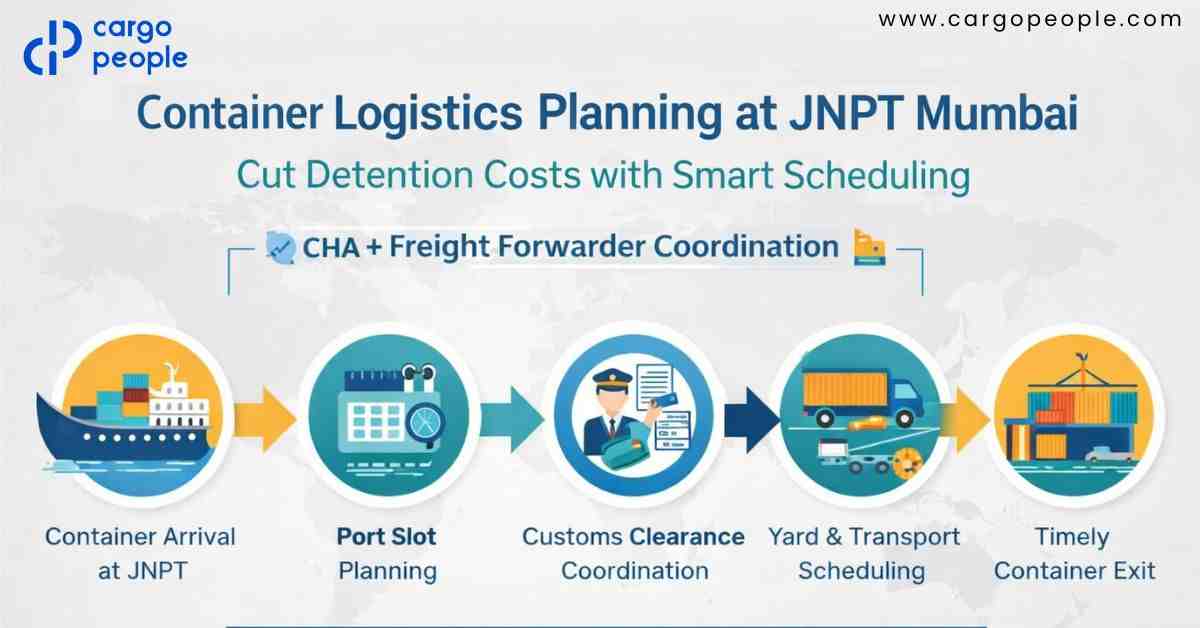
Container logistics planning at JNPT Mumbai plays a direct role in controlling detention and demurrage costs, which typically range between ₹7,000 to ₹15,000 per container per day depending on shipping line policies and free time conditions.
A well-planned import cycle reduces container dwell time from an average of 5–7 days to around 2–3 days. This is achieved through early documentation filing, synchronized transport planning, and close coordination with customs and terminal operators.
A standard container movement at JNPT involves:
-
Vessel arrival and container discharge
-
Yard stacking and availability for clearance
-
Bill of Entry filing through ICEGATE
-
Customs duty assessment and inspection (10–20% cases)
-
Out-of-charge clearance
-
Container pickup and evacuation
Even a delay of 48 hours can increase logistics costs by 15–25 percent per shipment.
Real Business Scenario: How Poor Planning Leads to Cost Escalation
In early 2025, a mid-sized electronics importer handling shipments at JNPT faced a delay of 5 days in container pickup due to lack of coordination between the CHA, transporter, and warehouse team.
The financial impact was significant:
-
Demurrage charges: ₹32,000
-
Detention charges: ₹18,000
-
Total avoidable loss: ₹50,000 on a single container
The key issues identified were:
-
Bill of Entry filed 2 days after vessel arrival
-
Transport arranged only after customs clearance
-
No tracking of free time expiry (typically 3–5 days)
This situation is common at JNPT, which handles over 6 million TEUs annually. High cargo volumes, combined with operational bottlenecks, make planning essential rather than optional.
Why Container Logistics Planning at JNPT Mumbai Is Critical
Container logistics planning at JNPT Mumbai is not just about movement of cargo. It directly impacts cost, timelines, and supply chain reliability.
Operational realities importers must consider:
-
Average dwell time: 3–5 days (can extend beyond 7 days in peak periods)
-
Customs inspection rate: 10–20 percent of shipments
-
Free detention period: 3–7 days depending on shipping line
-
Yard congestion during peak season can increase delays by 30–40 percent
Without structured planning, importers lose control over:
-
Clearance timelines
-
Cost predictability
-
Inventory flow
-
Delivery commitments
Container Logistics Planning at JNPT Mumbai: Step-by-Step Process
A clear understanding of the operational workflow helps reduce delays and avoid penalties.
1. Vessel Arrival and Container Discharge
Containers are discharged at terminals such as APMT, NSICT, or GTI.
Typical timeline is 12–24 hours after vessel berthing.
2. IGM Filing by Shipping Line
Import General Manifest must be filed before clearance can begin.
Any delay here pushes the entire process.
3. Bill of Entry Filing on ICEGATE
This is a critical step and should ideally be completed before vessel arrival.
Filing delay of even 24 hours can extend clearance timelines by 1–2 days.
4. Customs Duty Assessment
Duty calculation and approval typically take 4–12 hours if documentation is accurate.
5. Customs Inspection (Selective)
Around 10–20 percent of shipments are selected for inspection.
This can add 24–48 hours to the process.
6. Out-of-Charge Clearance
Once cleared, the container becomes eligible for pickup.
This stage is time-sensitive for avoiding demurrage.
7. Container Pickup and Gate-Out
Transport availability becomes critical here.
Delay in truck placement can result in immediate detention exposure.
Table 1 — Logistics Process Overview
| Process Stage | Authority | Typical Timeline | Documents Required | Risk if Delayed |
|---|---|---|---|---|
| Vessel Arrival | Port Terminal | 12–24 hrs | IGM | Yard congestion |
| Bill of Entry Filing | Customs | 24 hrs | Invoice, Packing List | Clearance delay |
| Duty Assessment | Customs | 4–12 hrs | HS Code | Incorrect duty |
| Inspection | Customs | 24–48 hrs | Cargo details | Demurrage |
| OOC Clearance | Customs | Same day | Approved BOE | Container hold |
| Gate-Out | Terminal | 1–2 days | Delivery Order | Detention |
Each stage is interconnected. A delay of even one day can trigger a chain reaction, increasing overall logistics cost by 10–20 percent.
Cost Breakdown: Container Import at JNPT
Understanding cost structure helps businesses identify where delays hurt the most.
Primary Cost Components
-
Ocean freight charges (variable by route and container size)
-
Terminal Handling Charges: ₹8,000–₹12,000 per container
-
Customs duty based on HS code and valuation
-
CHA service fees: ₹3,000–₹7,000
-
Transportation: ₹10,000–₹25,000 depending on distance
-
Demurrage: ₹7,000–₹15,000 per day
-
Detention: ₹5,000–₹12,000 per day
Key Observation
A delay of just 2 days can add ₹15,000 to ₹30,000 in additional costs, directly affecting shipment profitability.
Table 2 — Documentation Checklist
| Document | Issued By | Required For | Submission Stage | Risk if Missing |
|---|---|---|---|---|
| Bill of Lading | Shipping Line | Ownership proof | Pre-clearance | Shipment hold |
| Commercial Invoice | Exporter | Valuation | BOE filing | Duty error |
| Packing List | Exporter | Cargo verification | Inspection | Delay |
| IEC Code | Importer | Legal import | BOE filing | Rejection |
| Delivery Order | Shipping Line | Container release | Gate-out | Delay |
It is estimated that nearly 70–80 percent of clearance delays in India are linked to documentation errors or inconsistencies.
Logistics Risks and Delay Factors at JNPT
Several operational risks can disrupt container movement if not managed proactively.
Key Risk Factors
-
Port congestion during peak months increasing dwell time to 6–8 days
-
Incorrect HS code leading to reassessment and penalties
-
Late filing of Bill of Entry delaying clearance by 24–72 hours
-
Container yard congestion affecting retrieval speed
-
Truck unavailability causing missed pickup windows
-
Customs examination adding 1–3 days delay
Demurrage and detention combined can exceed ₹20,000 per container per day in worst-case scenarios.
Practical Business Scenario
A Delhi-based auto parts importer experienced a 3-day delay in container pickup due to late transport arrangement.
Financial impact:
-
Detention: ₹36,000
-
Demurrage: ₹12,000
Total additional cost: ₹48,000
After implementing structured planning:
-
Transport booked before vessel arrival
-
Documentation filed in advance
The next shipment was cleared within 48 hours with zero additional charges.
How Smart Port Scheduling Reduces Costs
Efficient scheduling is the most effective way to control logistics expenses.
Key Strategies
-
File Bill of Entry before vessel arrival
-
Pre-book transport at least 24–48 hours in advance
-
Track vessel ETA and terminal updates in real time
-
Align warehouse readiness with container arrival
-
Maintain daily coordination with CHA and shipping line
Operational Impact
-
Reduce dwell time by up to 40–50 percent
-
Eliminate detention charges in most cases
-
Improve delivery timelines and inventory flow
When Businesses Must Focus on Container Planning
Container logistics planning becomes critical for:
-
Importers handling more than 5 containers per month
-
High-value cargo such as electronics and machinery
-
Automotive supply chains with strict timelines
-
Retail and FMCG distribution networks
-
Project cargo requiring coordinated movement
Role of Freight Forwarder in Container Logistics Planning at JNPT Mumbai
A professional freight forwarder brings structure and predictability to the process.
Key responsibilities include:
-
Cargo booking and vessel planning
-
Coordination with shipping lines and terminals
-
ICEGATE documentation and compliance
-
Customs clearance management
-
Real-time cargo tracking
-
Transport and last-mile delivery coordination
With proper freight forwarding support:
-
Clearance time reduces by 30–40 percent
-
Risk of delays and penalties is significantly minimized
-
Operational visibility improves across the supply chain
Conclusion
Container logistics planning at JNPT Mumbai is a critical function that directly impacts cost efficiency and supply chain performance.
Key takeaways:
-
Detention and demurrage can exceed ₹10,000 per day per container
-
Most delays are preventable with proactive planning
-
Documentation accuracy drives clearance speed
-
Smart scheduling can reduce dwell time by up to 50 percent
For businesses managing regular imports, structured planning is essential to maintain cost control and operational reliability.
CTA — Cargo People Logistics
📞 +91 97174 65454
📧 wecare@cargopeople.com
Get a Shipping Quote from Cargo People Logistics