

 USA
USA
 United Kingdom
 Germany
 Argentina
 Australia
 Canada
 New Zealand
a Delhi-based electronics importer brought in a shipment worth ₹18 lakh through IGI Airport. Due to a mismatch between the invoice and packing list quantities, customs flagged the shipment for inspection.
What looked like a minor documentation error resulted in:
- Delay: 72 hours
- Demurrage: ₹24,000
- Terminal storage: ₹11,500
- Delayed delivery penalties: ₹35,000
Delhi IGI Airport handles over 1 million tonnes of air cargo annually, with peak volumes rising by 15–18% during festive and year-end seasons. In such high-volume environments, even small documentation gaps can lead to cascading delays.
Most importers assume delays are due to congestion. In reality, over 50% of clearance delays are caused by documentation errors and late filings, not operational inefficiencies.
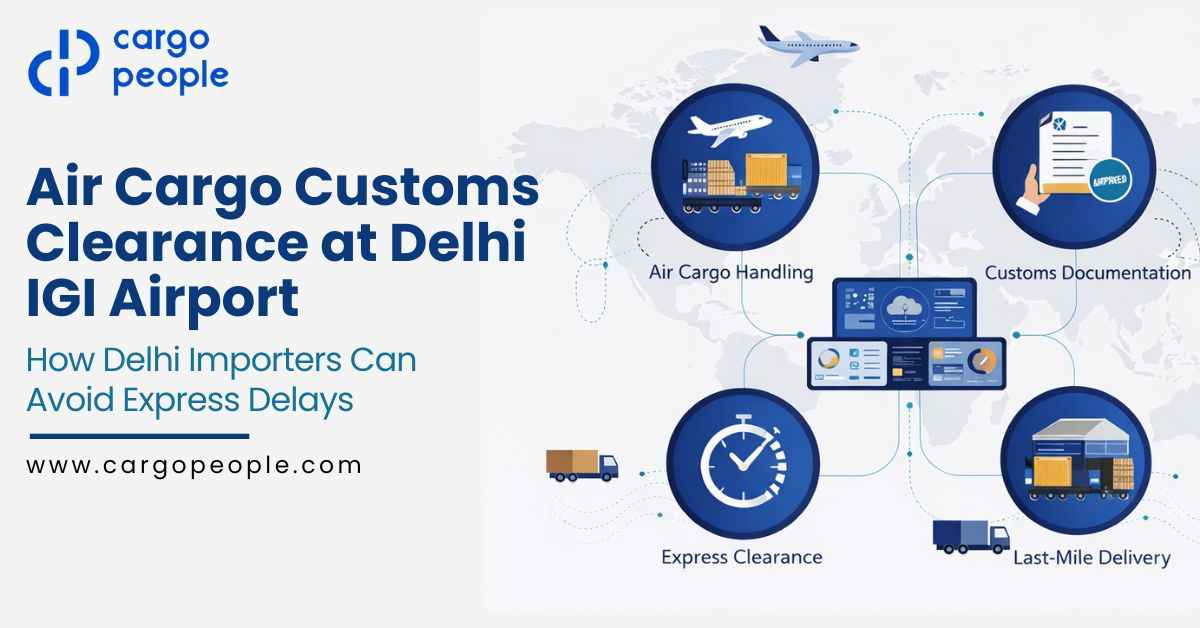
Air Cargo Customs Clearance at Delhi IGI Airport – Step-by-Step Process
Understanding the exact operational workflow helps importers reduce uncertainty and plan better.
1. Cargo Arrival at IGI Cargo Terminal
Once the aircraft lands, cargo is transferred to terminals like AISATS or Celebi. The airline submits the Import General Manifest (IGM) to customs.
- Timeline: 2 to 6 hours
- Key checkpoint: Cargo must be correctly manifested
If the IGM is incorrect or delayed, clearance cannot begin.
2. Airway Bill Verification
The Airway Bill (AWB) is verified against shipment details such as consignee name, IEC number, and cargo description.
- Common issue: Name mismatch or incomplete consignee details
- Impact: Immediate processing halt
Even a small spelling error can delay clearance by 12–24 hours.
3. Bill of Entry Filing on ICEGATE
The importer or CHA files the Bill of Entry electronically.
- Includes HS code classification
- Determines applicable duty
- Links shipment with importer IEC
- Timeline: 4 to 8 hours
- Critical factor: Correct HS code selection
Incorrect classification can lead to reassessment and 1–2 days delay.
4. Duty Assessment and Payment
Customs evaluates:
- Basic Customs Duty (BCD)
- IGST
- Additional duties (if applicable)
- Processing time: Same day if documents are accurate
Delays in duty payment can hold cargo even after clearance approval.
5. Customs Inspection (Selective)
Approximately 10% to 20% of shipments are flagged based on risk profiling.
Inspection may include:
- Physical cargo check
- Document verification
- Valuation assessment
- Inspection delay: 12 to 48 hours
High-risk categories like electronics, chemicals, and pharmaceuticals face higher inspection probability.
6. Out of Charge (OOC) – Final Clearance
Once cleared, customs issues the OOC status.
- Cargo becomes eligible for delivery
- Terminal generates delivery order
7. Cargo Delivery and Last-Mile Movement
After clearance:
- Cargo is moved out of terminal
- Transport arranged to warehouse or factory
- Delivery timeline: 6 to 24 hours depending on distance
Table 1 — Air Cargo Clearance Process Overview
| Process Stage | Authority | Typical Timeline | Documents Required | Risk if Delayed |
|---|---|---|---|---|
| Cargo Arrival | Airline / Terminal | 2–6 hrs | AWB, Manifest | Terminal backlog |
| BOE Filing | ICEGATE | 4–8 hrs | Invoice, Packing List | Filing errors |
| Duty Assessment | Customs | Same day | HS Code, Value | Reassessment |
| Inspection | Customs | 12–48 hrs | Cargo + Docs | Clearance hold |
| Cargo Release | Customs | 2–4 hrs | OOC | Storage cost |
| Delivery | Transporter | 6–24 hrs | Delivery Order | Supply delay |
Key insight: A delay at any stage increases total landed cost by 8%–15% in many cases.
Documentation Checklist for Air Cargo Clearance
Accurate documentation is the single biggest factor influencing clearance speed.
Table 2 — Documentation Checklist
| Document | Issued By | Required For | Submission Stage | Risk if Missing |
|---|---|---|---|---|
| Airway Bill | Airline | Shipment ID | Arrival | Cargo hold |
| Commercial Invoice | Exporter | Duty calculation | BOE filing | Wrong valuation |
| Packing List | Exporter | Quantity check | BOE filing | Inspection delay |
| IEC Certificate | Importer | Legal import | BOE filing | Clearance rejection |
| Bill of Entry | CHA | Customs clearance | ICEGATE | Process stop |
| Certificate of Origin | Exporter | Duty benefits | Assessment | Higher duty |
Why Documentation Matters in Practical Terms
In real operations:
- Around 60% of shipment delays are due to documentation gaps
- Incorrect invoice values can trigger 100% inspection
- Missing packing list details increase inspection time by 24–48 hours
To avoid this, importers should:
- Verify documents before cargo arrival
- Use standardized templates
- Cross-check HS codes and values
Air Cargo Import Cost Breakdown
Air cargo costs are not limited to freight alone. Importers must consider multiple cost layers.
Typical Cost Components
- Air freight charges: ₹250 to ₹650 per kg
- Terminal Handling Charges: ₹5 to ₹15 per kg
- Customs duty: 5% to 28% depending on product
- CHA fees: ₹3,000 to ₹12,000
- Storage charges: ₹2 to ₹6 per kg per day
- Transportation: ₹3,000 to ₹20,000
Example Cost Scenario (150 kg shipment)
- Freight: ₹60,000
- Terminal: ₹1,500
- Duty: ₹25,000
- CHA + misc: ₹10,000
- Storage (2 days): ₹3,000
Total landed cost: ₹99,500
Even a 48-hour delay can increase total cost by 10%–20%.
Key Risks Causing Delays at Delhi IGI Airport
Understanding risks helps importers proactively avoid them.
Major Delay Factors
- Incorrect HS code classification
- Invoice and packing list mismatch
- Missing or incomplete documentation
- Late Bill of Entry filing
- Customs inspection selection
- Airline documentation delays
- Terminal congestion during peak season
Numerical Impact of Delays
- Inspection delays: +24 to 48 hours
- Documentation errors: +12 to 36 hours
- Peak congestion: +48 to 72 hours
- Demurrage cost: ₹8,000 to ₹18,000 per day
Practical Business Scenario
A Delhi-based garment importer shipped urgent samples via air freight:
- Shipment value: ₹5 lakh
- Delay: 2 days due to missing HS code clarification
- Loss:
- Storage cost: ₹12,000
- Missed buyer deadline
- Export order worth ₹8 lakh delayed
This highlights that time loss often converts into business loss, not just operational cost.
When Should Businesses Use Air Freight?
Air freight is best suited when speed and reliability are critical.
Ideal Use Cases
- Urgent shipments (delivery within 2–3 days)
- High-value goods (electronics, machinery parts)
- Pharmaceuticals and medical supplies
- Perishable goods
- Seasonal or fashion inventory
Air freight typically reduces transit time by 70%–80% compared to sea freight, but at 3x to 5x higher cost.
Role of Freight Forwarder in Avoiding Delays
An experienced freight forwarder plays a critical role in ensuring smooth clearance.
Key Responsibilities
- Pre-arrival document verification
- Accurate HS code classification
- Fast ICEGATE filing within hours
- Coordination with airlines and terminals
- Continuous follow-up with customs
- Real-time shipment tracking
- Delivery planning
Measurable Impact
- Clearance time reduced from 72 hours to 24–48 hours
- Documentation error reduction by 40%–60%
- Cost savings through faster release
Conclusion: How Delhi Importers Can Avoid Air Cargo Delays
Air cargo customs clearance at Delhi IGI Airport is a structured but highly sensitive process.
The key factors that determine success are:
- Documentation accuracy
- Timely filing
- Correct classification
- Efficient coordination
Delays directly impact:
- Cost (₹10,000–₹25,000 per day)
- Delivery timelines
- Customer commitments
Importers who adopt a proactive approach and work with experienced freight partners significantly reduce operational risks and improve supply chain efficiency.
CTA — Cargo People Logistics
📞 +91 97174 65454
📧 wecare@cargopeople.com
Get a Shipping Quote from Cargo People Logistics