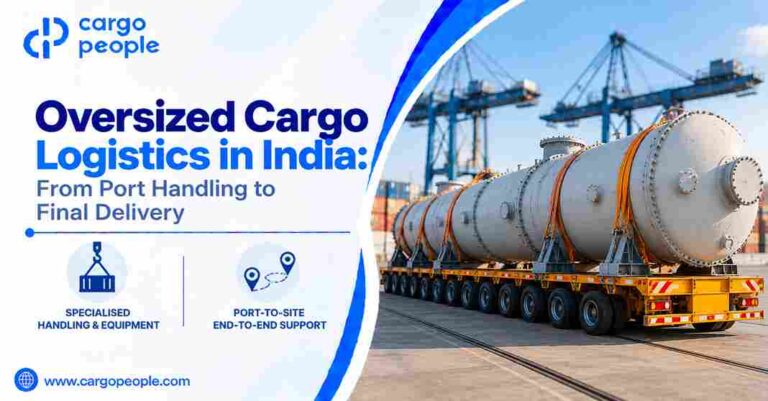
Oversized Cargo Logistics in India: From Port Handling to Final Delivery
Oversized cargo logistics in India requires a very different approach from standard container shipping. When cargo is too large, too heavy or too technically complex for normal equipment, every stage of the movement needs to be planned before the shipment starts. For manufacturers and importers, this can include machinery, transformers, pressure vessels, generators, turbines, fabrication structures, construction equipment and complete production lines. These shipments may move on flat racks, open-top containers, RoRo equipment or as breakbulk cargo depending on their final packed dimensions and weight. The main challenge is not simply moving a heavy piece of equipment. The real challenge is connecting sea freight, port handling, customs clearance, specialised trailers, route engineering, lifting and final site delivery into one workable plan. A delay at any one stage can affect the entire shipment. For this reason, oversized cargo logistics should be managed as a project rather than as a routine freight booking. What Is Oversized Cargo in International Logistics? Oversized cargo is generally cargo that exceeds the standard dimensions or weight limits of normal transport equipment. In container shipping, cargo may be classified as out-of-gauge when it extends beyond the normal dimensions of the equipment being used. In Indian road transport, the term ODC, or Over Dimensional Cargo, is commonly used when the loaded vehicle exceeds normal dimensional limits. Breakbulk cargo is different again. Instead of being packed inside a conventional container, the cargo is handled and loaded as a separate unit. This distinction matters because the logistics method can change completely depending on the dimensions. For example, a machine weighing 35 tonnes may still be suitable for a flat rack if its dimensions and weight distribution are manageable. Another machine weighing only 22 tonnes may need a more complex transport solution if it is excessively wide or tall. The main factors normally considered are: For large industrial shipments, these details should be available before the freight quotation is finalised. Why Oversized Cargo Logistics in India Needs Early Planning Oversized cargo cannot be planned successfully after the shipment reaches the port. The planning needs to begin at origin. The freight forwarder first needs to understand how the cargo will be packed, lifted and transported. Once the final dimensions are available, the team can decide whether the shipment should move on a flat rack, in an open-top container, on RoRo equipment or as breakbulk cargo. The selected shipping method then affects carrier approval, ocean freight cost, terminal handling and destination-port planning. At the Indian end, customs clearance and inland transportation also need to be prepared before arrival. This becomes especially important when the cargo requires specialised resources such as hydraulic trailers, 10-axle or 12-axle combinations, mobile cranes, lifting teams or route modifications. These resources cannot always be arranged at short notice. A project cargo movement may therefore take several weeks of preparation even when the actual ocean transit is relatively short. Good planning reduces three major risks: The earlier these issues are identified, the easier and less expensive they are to manage. Complete Oversized Cargo Logistics Process in India Oversized cargo transportation normally passes through several connected stages. The first step is cargo assessment. The shipper provides exact dimensions, gross weight, technical drawings and lifting details. The second step is transport feasibility. The freight forwarder evaluates shipping equipment, carrier acceptance, origin handling, vessel schedules and destination-port capability. The third stage is booking and loading. Depending on the shipment, this may involve specialised container equipment, crane operations, lashing, surveys and additional terminal coordination. While the cargo is in transit, destination planning should already be underway. This includes customs documentation, Bill of Entry preparation, route survey, trailer selection and site readiness. After arrival, the cargo moves through port handling and customs release before being transferred to specialised inland transport. The final stage is delivery at the project location. Stage Main Activity Typical Planning Requirement Cargo assessment Confirm dimensions and weight 1-3 days Freight feasibility Select equipment and carrier 2-5 days Booking approval Carrier and vessel confirmation 3-10 days Origin loading Crane, lashing and survey 1-3 days Ocean transport International movement Route dependent Customs clearance Bill of Entry to release Commonly 2-4 days Port evacuation Lifting and trailer positioning 1-2 days Inland transport ODC movement Route dependent Final unloading Crane and site delivery 1 day or more These are planning ranges, not fixed timelines. The actual schedule depends on the cargo, port, origin country and final destination. Cargo Dimensions Can Change the Entire Freight Plan One of the most common problems in oversized cargo is using approximate dimensions at the quotation stage. The difference may look small on paper, but it can have a major operational impact. Suppose an unpacked machine is 10.8 metres long, 2.7 metres wide and 2.9 metres high. After export packing, timber reinforcement and protective covering, the final dimension may become 11.1 metres long, 3 metres wide and 3.2 metres high. That increase can affect flat-rack suitability, vessel stowage, terminal handling and inland route feasibility. The forwarder should therefore receive the final packed dimensions wherever possible. The weight also needs to be accurate. A difference of 2 or 3 tonnes may affect trailer selection or lifting arrangements, particularly when the cargo is already close to equipment limits. Centre of gravity is equally important. Two machines weighing 40 tonnes can require very different handling if one has evenly distributed weight while the other has most of its weight concentrated at one end. For this reason, technical drawings are often more useful than a simple weight-and-dimension sheet. Flat Rack Shipping for Oversized Cargo Flat racks are widely used for industrial machinery and OOG cargo that cannot fit inside a standard container. They provide a containerised base while allowing cargo to exceed normal height or width. A 40-foot flat rack can carry substantial weight. Published specifications from major carriers show payload capacities in the region of 47 tonnes for some equipment. However, that figure should not be interpreted as a universal loading limit. Cargo acceptance also depends on weight distribution, over-width, over-height, centre of gravity, securing arrangements and terminal capability. The shipping line normally needs full cargo details before confirming the booking. Flat rack shipping can be an efficient option when the cargo remains within manageable project dimensions because the shipment can still move through parts of the container shipping network. However, when the cargo becomes significantly larger, another shipping method may be more practical. When Open-Top Containers Make More Sense Open-top containers are useful when cargo cannot be loaded through normal container doors or when the equipment exceeds standard container height. The cargo can be lowered from above using a crane. This method is commonly used for certain machinery and industrial equipment where width remains manageable but height is the main limitation. Open-top cargo still needs proper securing and weather protection. Depending on the amount of over-height, carriers may apply additional charges because another container cannot necessarily be stacked above the cargo. For this reason, the freight rate for an open-top shipment should not be compared directly with a standard container rate. The commercial decision should be based on the complete transport requirement. When Breakbulk Shipping Becomes More Practical Breakbulk becomes increasingly relevant when cargo is too heavy or too large for practical containerised movement. Large transformers, pressure vessels, generators, industrial modules and plant equipment may fall into this category. Instead of being placed inside or on container equipment, the cargo is loaded directly onto the vessel. This gives the shipping plan greater flexibility but also increases the importance of lifting engineering, vessel planning and port handling. Breakbulk cargo often requires detailed lift plans, surveys and securing arrangements. The sailing schedule may also be less frequent than standard container services. If the available vessel sails every 10 or 14 days, missing one loading window can create a significant project delay. For time-sensitive industrial projects, production completion and vessel booking therefore need to be closely aligned. Port Handling for Oversized Cargo in India The Indian port selected for oversized cargo should not be chosen only because it offers the cheapest ocean freight. Port capability can have a major impact on total landed logistics cost. The selected port needs to handle the cargo safely and also provide a practical inland route to the project site. India has several major gateways capable of handling containerised, breakbulk and project cargo, including JNPA, Mundra, Chennai and Kattupalli. JNPA handled approximately 8.17 million TEUs in FY 2025-26. During the same period, the port handled around 1.13 million tonnes of breakbulk cargo. This is significant because breakbulk volumes at JNPA increased substantially compared with the previous financial year. Chennai Port also strengthened its heavy-lift capability in 2026. Three new Harbour Mobile Cranes were commissioned, each with approximately 100 tonnes of lifting capacity. Tandem operations can provide lifting capability of around 170 tonnes. For heavy cargo, these port capabilities matter. A 120-tonne cargo unit cannot be planned in the same way as a 20-tonne piece. The team needs to confirm how the cargo will be discharged, whether shore cranes or vessel gear will be used and whether the terminal can receive the specialised trailer. Why Port Location Alone Should Not Decide the Route The port closest to the final factory is not always the most economical option. A port may be geographically close but have difficult road connectivity for ODC transport. Another port located 150-250 km farther away may provide better heavy-cargo infrastructure and a more practical inland route. For oversized cargo, total logistics cost should therefore include both sea freight and inland transport. A saving of ₹75,000 or ₹1,00,000 on the ocean leg can easily disappear if the alternative route requires extra axle lines, route modifications, additional handling or several days of trailer movement. The correct comparison is therefore: Port A total delivered cost vs Port B total delivered cost not simply: Port A ocean freight vs Port B ocean freight This is one of the most important procurement principles in project logistics. Customs Clearance for Oversized Cargo in India Customs clearance should be prepared before vessel arrival. Oversized cargo follows the normal import customs framework, but the financial impact of a delay is usually higher because specialised resources may already be booked. The normal process includes Bill of Entry filing, assessment, applicable duty payment, document verification, examination where required and Out of Charge. Recent Indian customs data provides a useful planning benchmark. Average import release time across the seaports studied was approximately 79 hours, or around 3.3 days. However, the average varied by port. Mundra recorded an average close to 56 hours, while Nhava Sheva was approximately 73 hours. The figures should not be treated as guaranteed clearance timelines, but they show that customs release can vary significantly between shipments and gateways. For oversized cargo, that variation matters because trailers and cranes may already be scheduled. Advance Bill of Entry Can Reduce Delay Risk One of the strongest operational lessons from recent customs data is the value of advance filing. Advance-filed Bills of Entry recorded average release times of approximately 71 hours. Late-filed Bills of Entry recorded average release times of almost 159 hours. That is a difference of close to 88 hours. For standard cargo, an 88-hour delay creates inconvenience. For project cargo, the impact can be much larger. A hydraulic trailer may need to be rescheduled. A heavy crane booking may move to another project. Transport manpower may need to be extended. The project installation schedule may also shift. This is why customs preparation should not begin after the vessel berths. Commercial documents, HS classification and applicable approvals should be reviewed before arrival. Documentation Required for Oversized Cargo Imports The customs documents are largely similar to other imports, but technical documents become more important. The commercial invoice and packing list need to clearly identify the imported equipment. The packing list should also reflect accurate weight and dimensions. The Bill of Lading description should remain consistent with the commercial documentation. For industrial machinery, customs may also require additional clarity regarding the product’s function, technical specification or classification. Technical catalogues and drawings can therefore become important supporting documents. Document Purpose Main Risk Commercial Invoice Product value and description Incorrect value or description Packing List Packages, weight and dimensions Actual dimensions differ Bill of Lading Shipping details Description mismatch Bill of Entry Customs declaration Classification error IEC Details Importer identification Data mismatch Technical Catalogue Product identification Insufficient information Cargo Drawing Handling and route planning Incorrect technical data Certificate of Origin Origin information Missing or incorrect details Import Approval Product compliance where applicable Approval not available For a high-value machine, documents should ideally be checked before the vessel departs origin. Customs Delay Can Affect More Than Port Storage A common mistake is calculating customs delay only in terms of port storage. Oversized cargo usually has several other cost dependencies. A specialised trailer may have been reserved. A crane may have been booked for a specific date. The transport team may have scheduled the movement for a particular night window. The final project site may have planned installation manpower around the cargo arrival. If customs release moves by 48 or 72 hours, the entire chain may need adjustment. Therefore, project cargo planning should include a delay matrix. Management should know what becomes chargeable after: This is much more useful than relying on one generic demurrage number. Route Survey for Oversized Cargo Transportation in India The route survey is one of the most important parts of oversized cargo transportation. The objective is not to identify the shortest route. The objective is to identify a route that the loaded transport combination can actually use. The survey needs to consider the complete height, width, length and weight of the trailer with the cargo loaded. Road width is only one factor. Turning radius can become a major issue for long trailers. Bridges may create structural or load-distribution concerns. Flyovers, railway crossings, toll plazas and overhead power lines may limit available height. Road gradients can also create problems for very heavy loads. A movement of 500 km may therefore require detailed route engineering before dispatch. In some cases, the recommended route can be 50 or 100 km longer simply because it provides better clearance and safer movement. For oversized cargo, the safest workable route is usually more important than the shortest route. The Last 5 Kilometres Often Need the Most Attention Long-distance highway movement is not always the most difficult part of the shipment. The final approach to the factory can create more challenges. Industrial estates may contain narrow service roads, tight corners, parked vehicles, overhead cables or temporary construction. The factory gate may also be smaller than expected. A loaded trailer can travel 800 km successfully and still struggle with the final 500 metres. For that reason, the route survey should not stop at the main highway. The survey should continue through the plant gate to the exact unloading position. Internal roads, turning space and crane access should all be checked. This final-site assessment can prevent expensive delays after the cargo has already completed most of its journey. Selecting the Right ODC Trailer The trailer configuration should be selected according to cargo dimensions, weight distribution and route conditions. Low-bed trailers are commonly used when loaded height needs to be reduced. For heavier cargo, multi-axle trailers allow the load to be distributed across a larger number of axles. Hydraulic modular trailers may be required when cargo becomes extremely heavy or when additional manoeuvrability is required. Large project movements can involve 12, 16, 20 or more axle lines depending on the equipment and weight. The correct trailer cannot be selected by looking only at the tonnage. A 70-tonne machine with a low and balanced centre of gravity may require one configuration. Another 70-tonne unit with concentrated weight or greater height may require a completely different setup. The trailer quotation should therefore be supported by technical cargo information. Oversized Cargo Transportation Cost in India There is no single standard rate for oversized cargo transportation services in India. The total cost depends on several variables. The first is the cargo itself. Length, width, height and weight influence equipment selection. The second is the route. A 300 km movement on a straightforward industrial corridor can cost considerably less than a 200 km movement involving bridge restrictions, narrow roads and overhead obstacles. The third factor is handling. If the cargo requires a 250-tonne or 300-tonne crane at the port and another crane at destination, lifting costs can become a major part of the logistics budget. The total cost can include: For complex project movements, additional costs can arise from road modification, obstacle removal or specialised engineering. The correct approach is therefore to compare the total port-to-site logistics cost. Demurrage, Detention, Port Storage and Standby Costs These charges should not be treated as the same thing. Port or terminal storage relates to cargo remaining within the terminal beyond applicable free arrangements. Demurrage and detention generally relate to shipping-line equipment usage under the carrier’s free-time rules. For oversized cargo, additional standby exposure may arise from trailers, cranes and manpower. There is no responsible single figure such as ₹7,000 or ₹15,000 per day that can be applied to every project cargo shipment. Rates vary by carrier, port, equipment and free-time arrangement. The cost of a delay should therefore be calculated shipment by shipment. For a large industrial shipment, a 2-day delay can sometimes cost substantially more through equipment standby than through the original freight rate difference between two forwarders. This is why schedule reliability should be considered when evaluating logistics quotations. Why Oversized Cargo Shipments Get Delayed Many project cargo delays are preventable. Incorrect cargo dimensions are one of the most common causes of planning changes. A freight plan may be approved using preliminary dimensions only to require revision when final packing is completed. Customs documentation can create another delay. Incorrect HS classification, missing technical literature or incomplete approvals can hold cargo after arrival. Route conditions can also change. Road construction, new barriers, utility work or temporary traffic restrictions can affect a route that was … Continue reading Oversized Cargo Logistics in India: From Port Handling to Final Delivery
