

 United Kingdom
 Germany
 Argentina
 Australia
 Canada
 New Zealand
A mid-sized electronics importer in Delhi NCR had containers arriving at Nhava Sheva just as domestic demand slowed.
Clearing the cargo immediately meant paying full customs duty and GST — locking up lakhs of rupees in inventory that wouldn’t move for months.
Holding the cargo at the port wasn’t an option either. Demurrage was piling up daily.
The real question wasn’t where to store the goods — it was how to store them smartly.
This is where the choice between bonded and non-bonded warehousing in India becomes a strategic business decision, not just a logistics one.
Understanding Warehousing in India’s Trade Ecosystem
Warehousing is no longer just about space. For importers and exporters, it directly impacts:
-
Cash flow and working capital
-
Customs duty exposure
-
Inventory flexibility
-
Compliance risk
India’s warehousing landscape broadly offers two options for imported goods:
-
Bonded warehouses
-
Non-bonded (regular) warehouses
Choosing the wrong one can quietly erode margins. Choosing the right one can improve liquidity and operational control.
What Is a Bonded Warehouse in India?
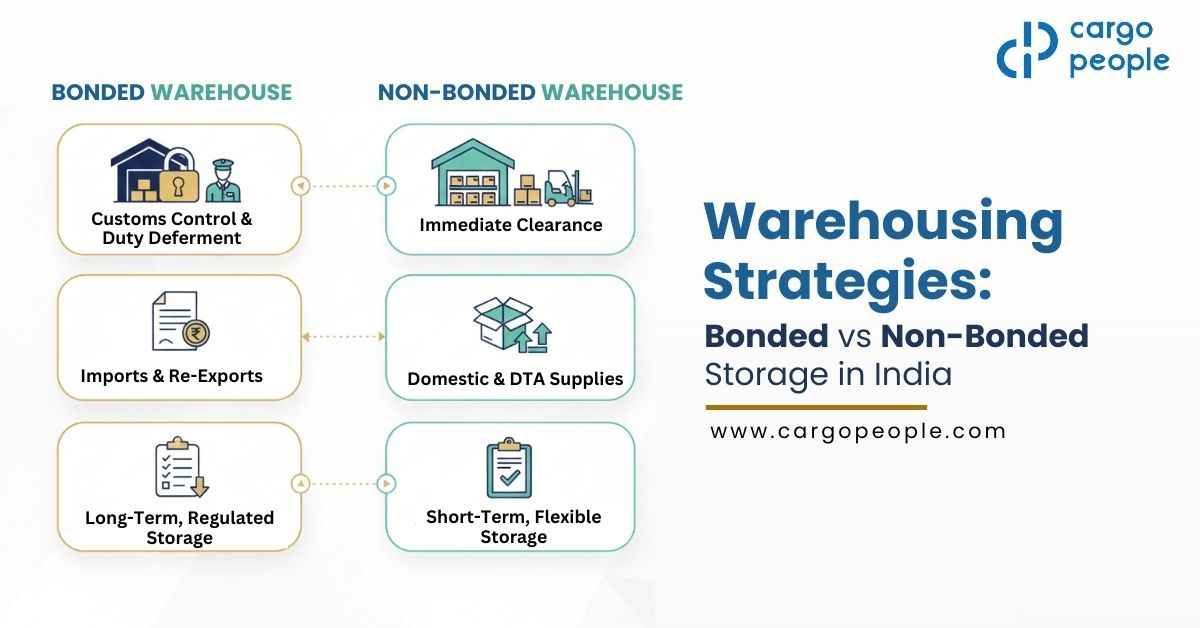
A bonded warehouse is a customs-licensed facility where imported goods can be stored without immediate payment of customs duty and IGST.
Goods remain under customs control until:
-
They are cleared for home consumption, or
-
They are re-exported, or
-
They are transferred under permitted procedures
Why bonded warehouses matter for businesses
-
Customs duty is paid only when goods are sold or required
-
Storage is legally permitted for extended periods
-
Ideal for uncertain demand cycles or phased sales
For many Indian importers, bonded warehousing acts as a financial buffer, not just a storage solution.
What Is a Non-Bonded Warehouse?
A non-bonded warehouse is a regular storage facility where goods are stored after full customs clearance.
Once goods enter a non-bonded warehouse:
-
Customs duty and GST are already paid
-
Goods are freely available for sale or distribution
-
No customs supervision applies
When non-bonded storage works best
-
Fast-moving consumer goods
-
Predictable sales cycles
-
Immediate distribution requirements
It offers simplicity — but not flexibility.
Bonded vs Non-Bonded Warehouse: Core Differences That Affect Business Decisions
| Parameter | Bonded Warehouse | Non-Bonded Warehouse |
|---|---|---|
| Customs Duty Payment | Deferred | Paid upfront |
| Customs Control | Yes | No |
| Cash Flow Impact | Positive | Neutral to negative |
| Re-export Option | Allowed without duty | Duty already paid |
| Ideal For | Importers, traders, OEMs | Distributors, retailers |
What this means for Indian businesses:
If duty outflow timing matters to your balance sheet, bonded warehousing offers a clear advantage.
Customs Regulations Governing Bonded Warehousing in India
Bonded warehouses operate under the Customs Act, supervised by Indian Customs authorities.
Key regulatory aspects businesses must plan for:
-
Warehousing bonds and documentation
-
Periodic customs audits
-
Stock reconciliation requirements
-
Defined warehousing periods
While compliance is strict, structured planning with an experienced logistics partner keeps operations smooth and predictable.
Where Bonded Warehousing Fits Best in India
Bonded warehouses are especially effective around major trade gateways:
-
Nhava Sheva (JNPT) — import-heavy cargo
-
Mundra — long-dwell and bulk shipments
-
Chennai — automotive and industrial imports
-
Delhi NCR — air-sea combined supply chains
These locations support faster cargo movement once clearance decisions are made.
Cost Impact Comparison: Duty Paid vs Duty Deferred
| Scenario | Immediate Clearance (Non-Bonded) | Bonded Warehousing |
|---|---|---|
| Import Value | ₹50,00,000 | ₹50,00,000 |
| Customs Duty + IGST | Paid upfront | Deferred |
| Inventory Holding Period | 90 days | 90 days |
| Cash Blocked | High | Low |
| Flexibility to Re-export | No | Yes |
Interpretation:
Bonded warehousing doesn’t eliminate duty — it gives you control over when you pay it. That timing difference can significantly improve working capital.
Operational Risks of Ignoring the Right Warehousing Strategy
A chemical importer stored uncleared cargo at a port yard, assuming quick buyer confirmation.
Sales were delayed. The cargo stayed longer than expected.
Demurrage and detention charges crossed ₹3 lakh before clearance even began.
What went wrong
-
No bonded storage planning
-
No duty deferment strategy
-
Reactive decision-making
Proactive warehousing planning avoids these silent but expensive mistakes.
When Non-Bonded Warehousing Is the Smarter Choice
Despite its advantages, bonded warehousing isn’t for everyone.
Non-bonded storage works better when:
-
Sales cycles are short
-
Goods must move immediately
-
Compliance overhead needs to stay minimal
-
Duty cost is already factored into pricing
The smartest businesses don’t default to one option — they align warehousing with sales strategy.
How Cargo People Helps You Choose the Right Warehousing Model
At Cargo People, warehousing decisions are treated as trade planning, not backend logistics.
We help clients:
-
Evaluate duty exposure and cash-flow impact
-
Choose between bonded, non-bonded, or hybrid models
-
Coordinate customs, transport, and storage seamlessly
-
Reduce demurrage, detention, and compliance risk
The goal isn’t just storage — it’s control.
Conclusion: Warehousing Is a Financial Decision Disguised as Logistics
Bonded vs non-bonded warehousing in India isn’t about facilities.
It’s about:
-
When you pay duty
-
How you manage inventory risk
-
How efficiently capital is used
Ignoring this decision leads to avoidable costs.
Planning it properly gives businesses flexibility, compliance, and financial breathing room.