

 United Kingdom
 Germany
 Argentina
 Australia
 Canada
 New Zealand
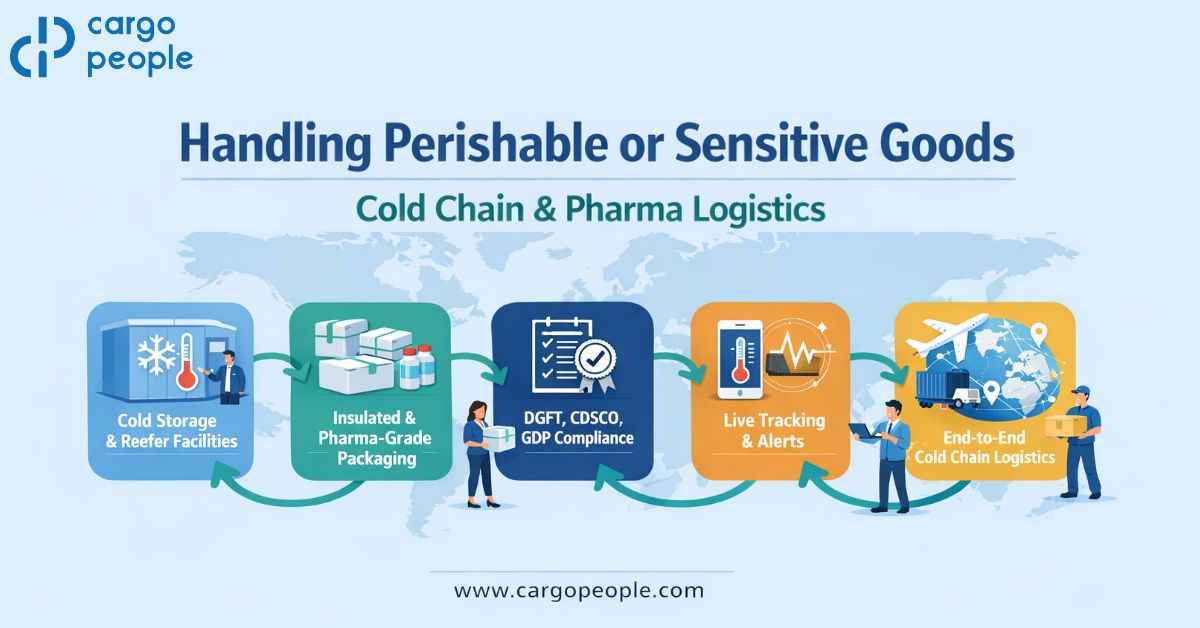
Cold chain and pharmaceutical logistics play a critical role in India’s export and import ecosystem. As Indian businesses expand into global markets, especially in pharmaceuticals, food processing, and healthcare, maintaining product integrity during transit has become a business necessity rather than an operational detail.
Temperature-sensitive cargo is highly vulnerable to delays, mishandling, and regulatory gaps. A single temperature deviation can result in shipment rejection, financial loss, or long-term damage to buyer relationships. For Indian exporters, cold chain logistics is directly linked to compliance, profitability, and brand credibility in international markets.
What Cold Chain Logistics Involves Beyond Refrigeration
Cold chain logistics is often misunderstood as simply using refrigerated vehicles or containers. In reality, it is a continuous system that ensures temperature stability at every stage of the supply chain.
It includes:
-
Pre-cooling of cargo before dispatch
-
Temperature-controlled storage at origin
-
Managed handling at ports and airports
-
Monitored transportation by air or sea
-
Controlled customs clearance processes
-
Temperature-safe delivery at destination
Any break in this chain exposes the cargo to risk. For pharmaceuticals and perishables, maintaining consistency is more important than speed alone.
Types of Goods That Require Temperature-Controlled Logistics
Indian businesses commonly use cold chain logistics for a wide range of sensitive cargo.
These include:
-
Pharmaceutical products such as vaccines, APIs, injectables, and biologics
-
Perishable food items like seafood, meat, dairy products, and fruits
-
Specialty chemicals and laboratory materials
-
Medical devices requiring temperature stability
-
Nutraceuticals and wellness products
Each category has different temperature requirements, handling protocols, and compliance expectations. Understanding these differences is essential before selecting a transport strategy.
Key Challenges in Cold Chain & Pharma Logistics in India
Despite infrastructure improvements, cold chain logistics in India still faces practical challenges that businesses must plan for.
Common issues include:
-
Delays during customs inspection and documentation verification
-
Limited cold storage availability at certain ports and airports
-
Power dependency for reefer containers during dwell time
-
Coordination gaps between multiple logistics stakeholders
-
Inconsistent handling standards across locations
These challenges do not always cause visible damage immediately but can compromise cargo quality by the time it reaches the buyer.
Choosing Between Air Freight and Sea Freight for Cold Chain Cargo
Selecting the right transport mode is one of the most critical decisions in temperature-controlled logistics.
Air Freight for Pharmaceutical and High-Value Cargo
Air freight is widely used for pharmaceutical shipments due to shorter transit times and controlled handling environments.
It is suitable when:
-
Products have short shelf life
-
High value or regulatory sensitivity is involved
-
Buyers demand faster delivery timelines
-
Temperature deviation tolerance is minimal
However, air freight requires precise documentation and seamless customs clearance. Any delay at the airport can offset the benefits of faster transit.
Sea Freight Using Reefer Containers for Perishables
Reefer sea freight is commonly used for large-volume perishable cargo where cost efficiency is a priority.
It works best when:
-
Transit times are planned realistically
-
Reefer containers are properly inspected and calibrated
-
Ports offer reliable cold chain infrastructure
-
Monitoring systems are in place throughout the journey
Sea freight failures usually occur due to administrative delays rather than equipment malfunction.
Role of Indian Ports in Cold Chain Logistics
Not all ports in India offer the same level of cold chain capability. Choosing the right port can significantly reduce operational risk.
Major Indian Ports Supporting Cold Chain Cargo
| Port | Key Strengths |
|---|---|
| Nhava Sheva (JNPT) | Strong reefer infrastructure, pharma handling |
| Mundra Port | Integrated cold storage, agro exports |
| Chennai Port | Pharma and seafood expertise |
| Kolkata Port | Regional perishables hub |
Routing cargo through ports with established cold chain facilities helps minimize dwell time and temperature exposure.
Customs Clearance and Regulatory Requirements for Pharma Cargo
Pharmaceutical shipments face stricter scrutiny due to health and safety considerations.
Key compliance elements include:
-
Correct HS code classification
-
Export licenses and regulatory approvals where required
-
Accurate commercial and shipping documentation
-
Temperature validation and product stability records
-
Alignment with destination country regulations
Customs delays are one of the most common causes of cold chain failure. Proactive documentation planning is essential to avoid detention.
Operational Risks and Their Business Impact
Cold chain logistics failures can have consequences beyond immediate financial loss.
Potential business impacts include:
-
Shipment rejection or destruction
-
Penalties and additional inspection costs
-
Insurance claim complications
-
Loss of overseas buyers
-
Damage to long-term brand reputation
For exporters, these risks often outweigh the cost of professional cold chain planning.
Market Outlook for Cold Chain & Pharma Logistics in India
India’s pharmaceutical exports and processed food industries continue to grow steadily. This growth is driving increased demand for reliable temperature-controlled logistics.
As volumes rise, global buyers are becoming more stringent about compliance, documentation accuracy, and temperature integrity. Businesses that invest in structured cold chain solutions are better positioned to scale internationally.
Practical Example: Improving Profitability Through Better Planning
An Indian exporter shipping frozen food products was using air freight to meet delivery timelines. After reviewing transit routes and buyer requirements, the logistics strategy was shifted to optimized reefer sea freight with tighter monitoring controls.
The outcome included:
-
Significant reduction in freight costs
-
Stable product quality at destination
-
Improved buyer confidence
-
Better margins without operational compromise
This highlights how informed logistics decisions directly influence business performance.
How Cargo People Supports Cold Chain & Pharma Logistics
Cargo People provides end-to-end support for temperature-controlled cargo by focusing on risk management and compliance.
Our approach includes:
-
Shipment-specific cold chain planning
-
Air and sea freight coordination
-
Reefer container and temperature monitoring
-
Customs clearance and regulatory support
-
Port and trade-lane expertise
-
Proactive issue resolution
The objective is to ensure cargo integrity while balancing cost, compliance, and delivery timelines.
Conclusion: Cold Chain Logistics Is About Control and Confidence
Handling perishable or sensitive goods requires more than infrastructure. It requires planning, coordination, and experience.
Businesses that treat cold chain logistics as a strategic function gain:
-
Better compliance outcomes
-
Reduced shipment losses
-
Stronger buyer relationships
-
Sustainable international growth
Partnering with an experienced logistics provider ensures that sensitive cargo reaches its destination safely and efficiently.
Contact Cargo People Logistics
📞 +91 9717465454
📧 wecare@cargopeople.com
👉 Book a Consultation with Cargo People Logistics