

 United Kingdom
 Germany
 Argentina
 Australia
 Canada
 New Zealand
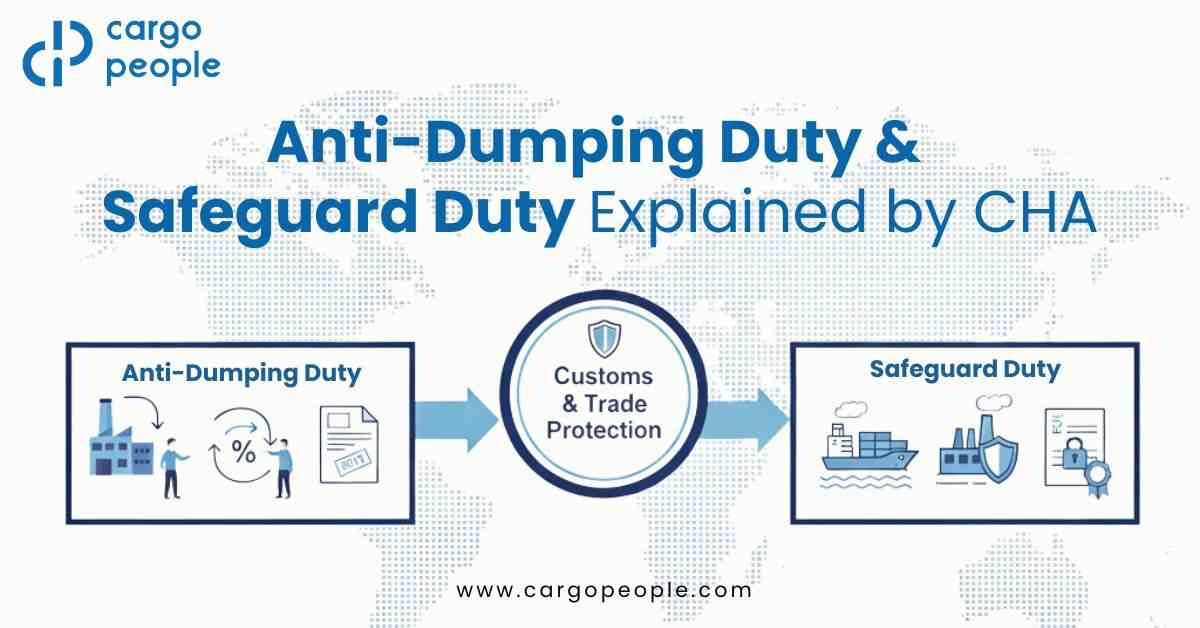
Anti-dumping duty is not just a trade policy term—it directly impacts your landed cost, delivery timelines, and buyer commitments. Many Indian importers only discover its impact when customs raises a query and clearance suddenly stops.
From a CHA’s perspective, anti-dumping duty applies when imported goods are priced lower than their normal value in the exporting country, causing injury to Indian manufacturers. Customs does not assess intent; it strictly applies notified duty rates based on product classification and country of origin.
Key business realities importers must understand:
-
Even a small HS code mismatch can trigger anti-dumping duty
-
Duty rates vary by exporter, not just by country
-
The duty applies over and above basic customs duty and IGST
-
Retrospective checks can happen even after clearance
For businesses importing steel, chemicals, textiles, electronics components, or solar products, anti-dumping duty is a recurring risk that must be factored into pricing and contracts upfront.
How Safeguard Duty Works and When It Suddenly Impacts Shipments
Safeguard duty often surprises businesses because it is not product-specific in the same way as anti-dumping duty. It is imposed when there is a sudden surge in imports that threatens domestic industry, regardless of whether dumping has occurred.
Unlike anti-dumping duty, safeguard duty:
-
Applies uniformly across countries (with limited exemptions)
-
Is usually temporary but can be extended
-
Can be imposed with little advance notice
-
Often affects bulk importers and project cargo
From a logistics planning angle, safeguard duty can completely change the feasibility of a shipment mid-cycle. Importers who book long-term contracts or bulk consignments are most exposed, especially in sectors like steel, solar modules, and industrial machinery.
A CHA’s role here is to continuously monitor duty notifications and advise clients before cargo sails—not after it arrives.
Anti-Dumping vs Safeguard Duty: What Importers Commonly Misunderstand
Many importers assume both duties are interchangeable or that one replaces the other. In reality, they serve different purposes and can affect shipments very differently.
Practical differences that matter in real operations:
-
Anti-dumping duty targets unfair pricing; safeguard duty targets volume surge
-
Anti-dumping duty varies by exporter; safeguard duty is broader
-
Anti-dumping duty can last for years; safeguard duty is typically short-term
-
Documentation requirements differ at the time of clearance
Misunderstanding these differences often leads to incorrect costing, disputes with overseas suppliers, and delays at Indian ports. Importers who rely only on freight quotes without duty validation face avoidable financial exposure.
The Role of a CHA in Managing Anti-Dumping and Safeguard Duties
A Customs House Agent does far more than file documents. In duty-sensitive shipments, a CHA acts as a compliance advisor, risk assessor, and cost controller.
Before shipment:
-
Verifies HS classification against duty notifications
-
Reviews country of origin implications
-
Flags duty exposure during quotation stage
-
Advises on alternative sourcing or structuring
During clearance:
-
Ensures correct declaration to avoid post-clearance audits
-
Handles customs queries proactively
-
Coordinates with customs officers to resolve classification issues
After clearance:
-
Supports audit responses if duty applicability is questioned
-
Helps businesses build internal compliance systems
This proactive approach prevents demurrage, detention, and unexpected duty demands that can disrupt cash flow.
Common Compliance Mistakes That Lead to Duty Disputes at Indian Ports
Most duty-related problems are not caused by deliberate non-compliance, but by gaps in understanding and coordination.
Frequent mistakes seen at ports like Mundra and Nhava Sheva include:
-
Using outdated HS codes copied from old invoices
-
Assuming duty exemption based on previous shipments
-
Ignoring exporter-specific duty rates
-
Failing to verify country of origin documentation
-
Treating CHA involvement as a post-arrival activity
Each of these mistakes can lead to shipment detention, financial penalties, and strained buyer relationships.
How Duty Planning Reduces Demurrage and Improves Delivery Commitments
Duty planning is not a paperwork exercise—it is a commercial decision. Importers who assess duty exposure before finalizing shipments gain predictability in cost and delivery.
Effective duty planning helps businesses:
-
Avoid cargo holds at customs
-
Reduce port storage and demurrage charges
-
Maintain delivery timelines with buyers
-
Protect profit margins in competitive markets
From a CHA’s experience, early-stage duty checks often save more money than any freight rate negotiation.
Why Importers Should Treat Duty Compliance as Part of Logistics Planning
Anti-dumping and safeguard duties are not isolated regulatory issues. They directly affect sourcing decisions, freight planning, and buyer commitments.
Businesses that integrate CHA consultation into early logistics planning:
-
Make informed sourcing decisions
-
Price products accurately
-
Reduce operational risk
-
Build long-term compliance resilience
In today’s regulatory environment, reactive compliance is expensive. Proactive compliance is strategic.
Conclusion: Plan Duties Early, Ship with Confidence
Anti-dumping duty and safeguard duty can either be costly surprises or manageable business variables—it depends on preparation.
With the right CHA guidance, importers can:
-
Identify duty risks before shipment
-
Avoid clearance delays and penalties
-
Protect margins and delivery timelines
📞 +91 78350 06245 | 📧 Cha@cargopeople.com
Book a Consultation with Cargo People Logistics